 Kwisi: O dinosaure efe?
 Ntwa ya didinosaure
 Peiso ya didinosaure
 Dipapadi tse nyane tsa didinosaure
 Albamo ya ditikara
 Manane a TOP a didinosaure
 Nkgethele!
Carinodens
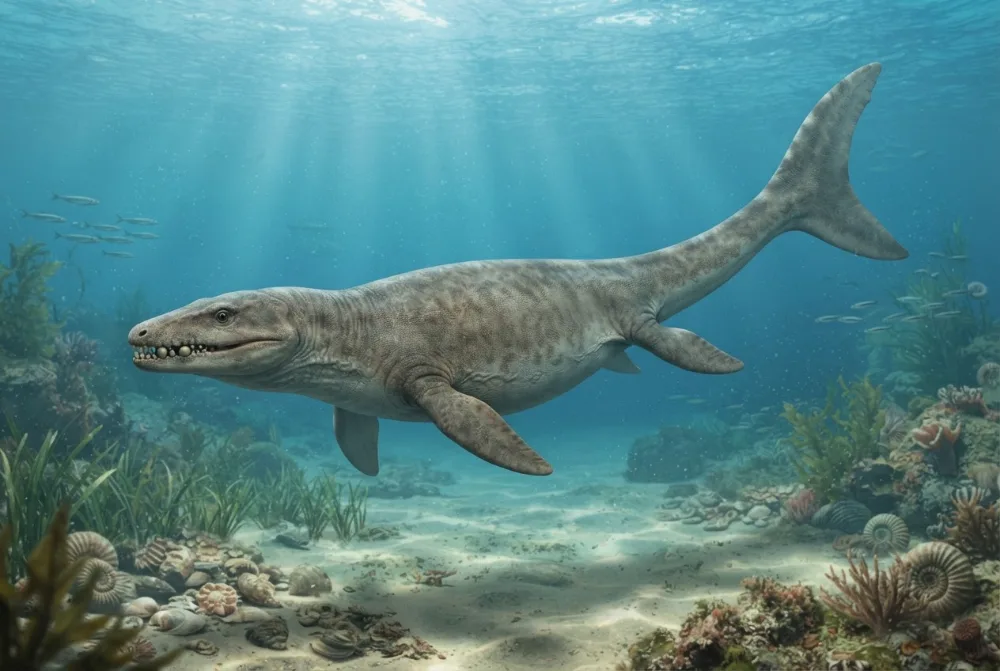
Carinodens was a small mosasaur, a marine lizard that lived in the late Cretaceous seas. It had round, blunt teeth like a set of nutcrackers for crushing hard-shelled animals. At only about 2 to 2.6 metres long, it was one of the tiniest mosasaurs ever.1
E phetse neng?
E ne e le kgolo hakae?
E ne e le telele hakae?
 telele jwaloka dintja tse 2.5 ho tloha nkong ho isa mohatleng🍌telele jwaloka dibanana tse 14 di behilwe ka mola🏊e ne e ka sesa bolelele ba letamo le leholo la ho sesa (50 m) ka metsotswana e 6
Carinodens e ne e le kgolo hakae ha e bapiswa le WENA?
Ke dipalo feela ho browser ya hao. Ha ho letho le bolokwang kapa le romelwang kae kapa kae.
E ne e le lebelo hakae?


Dintlha tse monate
Carinodens was first thought to be a crocodile! A fossil jaw was originally named Bottosaurus belgicus and considered a crocodilian before being recognized as a mosasaur.1
Its teeth were very different from each other. The front teeth were round and curved, while the back teeth were flat and blade-like with a keel on each side.1
Scientists can tell what Carinodens ate by looking at tiny scratches on its teeth. The wear patterns show it munched on hard-shelled animals that lived on the seafloor.1
Carinodens is closely related to Globidens, another mosasaur with crushing teeth. Together they belong to a group called Globidensini.1
The name Carinodens means 'keel teeth' because its teeth have a ridge like the keel of a boat. It replaced the older name Compressidens, which was already used for a different animal.1
Dipotso tse botswang haholo ka Carinodens
?What did Carinodens eat?
Carinodens ate hard-shelled animals like clams, oysters, and sea urchins. Its blunt teeth were perfect for crushing them, and scratches on the teeth show it munched on creatures that lived on the seafloor.12
?How big was Carinodens?
Carinodens was about 2 to 2.6 metres (6.6 to 8.5 feet) long. That makes it one of the smallest mosasaurs ever.1
?Where did Carinodens live?
Carinodens lived in the late Cretaceous seas, and its fossils have been found in Europe, North America, South America, and North Africa. Most skull fossils come from the Netherlands and Belgium.1
?Is Carinodens a dinosaur?
No, Carinodens is not a dinosaur. It is a marine lizard called a mosasaur that lived in the sea during the time of the dinosaurs.1
Bakeng sa ditsebi tsa didinosaure
- Lebitso la saense
- Carinodens
- E rehilwe ke
- Thurmond 19693
- Sehlopha
- Dimosasaure
- Lelapa / leloko
- Mosasauridae3
- Tlhophiso
- Mosasauroidea3
- Dilemo tsa mafika
- dilemo tse dimilione tse 72 ho isa ho 66 (Maastrichtian)3
- Dibopeho tsa mafika
- Maastricht, Gramame, Bereza Beds3
- Dinaha
- Netherlands, Moroko, Brazil, Ukraine, Russia, Belgium3
- Direkoto tsa difosili
- 16 ho The Paleobiology Database3
- Ho sibollwa
- The first fossils were found in Belgium and described by Louis Dollo in 1913 as Globidens fraasi. In 1969, J.T. Thurmond gave it the new name Carinodens because the old name was already taken.1
- E sa ntse e phehwa kgang
- Scientists are not sure how many species of Carinodens existed. Some think C. belgicus and C. fraasi might be the same species, while others believe they are different based on tooth shape.1
Moo dintlha di tswang teng
- Carinodens (en.wikipedia.org)
- Feeding the Mechanical Mosasaur: what did Carinodens eat? | Netherlands Journal of Geosciences | Cambridge Core (cambridge.org)
- Carinodens in The Paleobiology Database (CC BY 4.0): dilemo, dibaka, dibopeho tsa mafika, tlhophiso.
Ntlha e nngwe le e nngwe leqepheng lena e na le nomoro e supang mohlodi wa yona. Haeba re fositse ho hong, re kopa tshwarelo, re balatedi ba didinosaure, ha re koranta ya saense. Re bolelle ho [email protected] mme re tla e lokisa.
 Rex o lapile! Dino Wiki ke projeke ya ntate bakeng sa mora wa hae ya ratang didinosaure, ke mahala, ha ho dipapatso, ha ho disebedi. Batho ba baholo ba ka fepa Rex seneke ho thusa hore e dule e le inthaneteng.Fepa Rex
 Mosasaurus
 Prognathodon
 Tylosaurus
 Platecarpus
 Clidastes
 Globidens
 Tyrannosaurus
 Triceratops
 Velociraptor
 Spinosaurus
 Ankylosaurus
 Parasaurolophus