 Kwisi: O dinosaure efe?
 Ntwa ya didinosaure
 Peiso ya didinosaure
 Dipapadi tse nyane tsa didinosaure
 Albamo ya ditikara
 Manane a TOP a didinosaure
 Nkgethele!
Eonatator
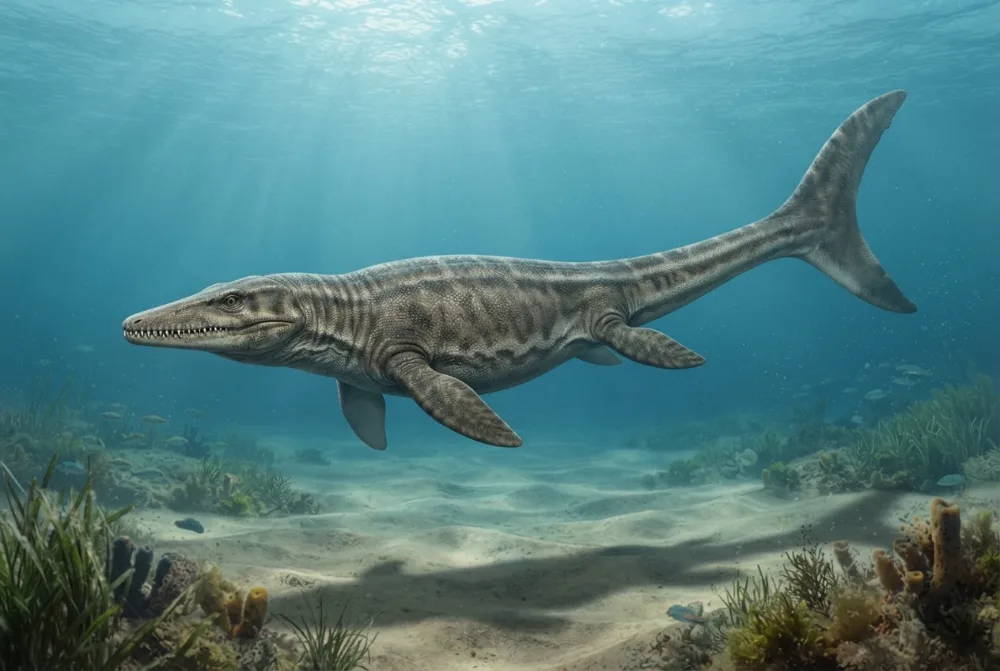
Eonatator was a small, speedy marine lizard that swam in warm Cretaceous seas. It was an early relative of the giant mosasaurs, but much smaller and more agile.1
E phetse neng?
E ne e le kgolo hakae?
E ne e le telele hakae?
 telele jwaloka dintja tse 2.5 ho tloha nkong ho isa mohatleng🍌telele jwaloka dibanana tse 14 di behilwe ka mola🏊e ne e ka sesa bolelele ba letamo le leholo la ho sesa (50 m) ka metsotswana e 6
Eonatator e ne e le kgolo hakae ha e bapiswa le WENA?
Ke dipalo feela ho browser ya hao. Ha ho letho le bolokwang kapa le romelwang kae kapa kae.
E ne e le lebelo hakae?


Dintlha tse monate
Eonatator's tail made up about 40% of its head and body length, helping it swim fast.1
The first Eonatator fossil was found in the Niobrara Chalk of Kansas in 1918 by Charles Hazelius Sternberg and his son Levi.1
Eonatator was originally thought to be a species of Clidastes or Halisaurus, but scientists gave it its own genus in 2005.1
A second species, Eonatator coellensis, was discovered in Colombia and named after the town of Coello.1
Eonatator had a smooth, triangular bone on top of its skull with a round hole called the parietal foramen.1
Like many mosasaurs, Eonatator gave birth to live young instead of laying eggs.2
Dipotso tse botswang haholo ka Eonatator
?How big was Eonatator?
Eonatator was a small mosasaur. The type specimen of Eonatator sternbergii was about 2.6 metres (8.5 ft) long, and a specimen of Eonatator coellensis measured 2.8 metres (9.2 ft) long as preserved, missing part of its tail.1
?What did Eonatator eat?
The sources do not say exactly what Eonatator ate. As a small marine lizard and a mosasaur, it likely ate fish and other small sea creatures, but no specific diet is given.1
?Where was Eonatator found?
Eonatator fossils have been found in North America (Kansas and Alabama), Colombia, and Sweden. The first fossil was discovered in the Niobrara Chalk of Kansas in 1918.1
?Is Eonatator a dinosaur?
No, Eonatator is not a dinosaur. It is a marine lizard belonging to the mosasaur family.1
Bakeng sa ditsebi tsa didinosaure
- Lebitso la saense
- Eonatator
- E rehilwe ke
- Bardet et al. 20053
- Sehlopha
- Dimosasaure
- Lelapa / leloko
- Mosasauridae3
- Tlhophiso
- Mosasauroidea3
- Dilemo tsa mafika
- dilemo tse dimilione tse 86 ho isa ho 72 (Santonian / Campanian)3
- Dibopeho tsa mafika
- Niobrara, Nivel de Lutitas y Arenas3
- Dinaha
- Sweden, Amerika, Kolombia3
- Direkoto tsa difosili
- 9 ho The Paleobiology Database3
- Ho sibollwa
- The first Eonatator fossil, a nearly complete skeleton, was found in Kansas in 1918 by Charles Hazelius Sternberg and his son Levi. It was named Eonatator sternbergii by Nathalie Bardet and colleagues in 2005.1
- E sa ntse e phehwa kgang
- Some scientists think Eonatator might actually belong to the genus Halisaurus, but most now accept it as a separate genus.1
Moo dintlha di tswang teng
- Eonatator (en.wikipedia.org)
- PBDB Taxon (paleobiodb.org)
- Eonatator in The Paleobiology Database (CC BY 4.0): dilemo, dibaka, dibopeho tsa mafika, tlhophiso.
Ntlha e nngwe le e nngwe leqepheng lena e na le nomoro e supang mohlodi wa yona. Haeba re fositse ho hong, re kopa tshwarelo, re balatedi ba didinosaure, ha re koranta ya saense. Re bolelle ho [email protected] mme re tla e lokisa.
 Rex o lapile! Dino Wiki ke projeke ya ntate bakeng sa mora wa hae ya ratang didinosaure, ke mahala, ha ho dipapatso, ha ho disebedi. Batho ba baholo ba ka fepa Rex seneke ho thusa hore e dule e le inthaneteng.Fepa Rex
 Mosasaurus
 Prognathodon
 Tylosaurus
 Platecarpus
 Clidastes
 Globidens
 Tyrannosaurus
 Triceratops
 Velociraptor
 Spinosaurus
 Ankylosaurus
 Parasaurolophus