 Kwisi: O dinosaure efe?
 Ntwa ya didinosaure
 Peiso ya didinosaure
 Dipapadi tse nyane tsa didinosaure
 Albamo ya ditikara
 Manane a TOP a didinosaure
 Nkgethele!
Eremiasaurus
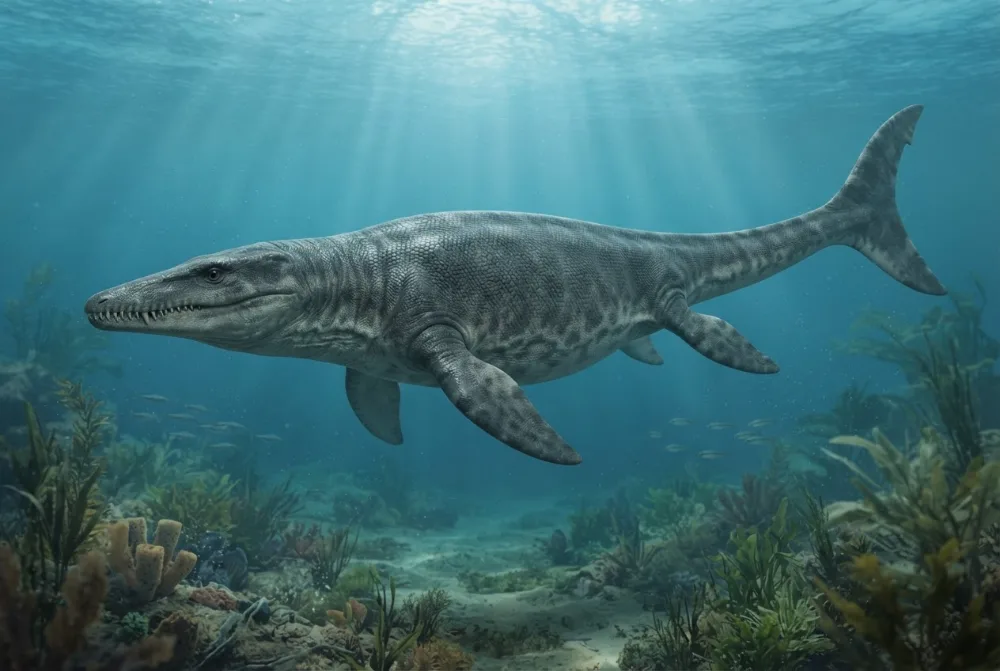
Eremiasaurus was a marine reptile that swam in warm seas during the time of the dinosaurs. It was a mosasaur, not a dinosaur, and it lived about 70 to 66 million years ago. This predator had a streamlined body and a long tail to help it zoom through the water.1
E phetse neng?
E ne e le kgolo hakae?
E ne e le telele hakae?
 telele jwaloka dintja tse 5 ho tloha nkong ho isa mohatleng🍌telele jwaloka dibanana tse 28 di behilwe ka mola🏊e ne e ka sesa bolelele ba letamo le leholo la ho sesa (50 m) ka metsotswana e 4.7
Eremiasaurus e ne e le kgolo hakae ha e bapiswa le WENA?
Ke dipalo feela ho browser ya hao. Ha ho letho le bolokwang kapa le romelwang kae kapa kae.
E ne e le lebelo hakae?


Dintlha tse monate
Eremiasaurus had very different-shaped teeth in its jaws, a rare trait for mosasaurs. Its species name heterodontus means 'different teeth'.1
The first fossils of Eremiasaurus were teeth found in Morocco in 1952. Scientists at first thought they belonged to another mosasaur called Mosasaurus.1
Eremiasaurus was named in 2012 from two nearly complete skeletons. One skeleton was found by a scientist, and the other came from a commercial fossil collector.1
This mosasaur had a tail that bent downward and a fan of bones in its tail, which helped it swim fast. Its tail was similar to the fast-swimming mosasaur Plotosaurus.1
Eremiasaurus lived in a warm, shallow sea called the Mediterranean Tethys. Many other mosasaurs and fish lived there too.1
Scientists think Eremiasaurus ate different food than its larger mosasaur neighbors, like Thalassotitan and Prognathodon. This helped them avoid competing for the same prey.1
Dipotso tse botswang haholo ka Eremiasaurus
?How big was Eremiasaurus?
About 5 metres (16 feet) long, which is a bit shorter than a minibus.1
?What did Eremiasaurus eat?
Nobody knows for sure. Its different-shaped teeth make it unclear what prey it ate.1
?Could Eremiasaurus swim fast?
Yes. Its tail bones suggest it was a high-speed pursuit predator, built for fast swimming.1
?Where did Eremiasaurus live?
It lived in a warm, shallow sea called the Mediterranean Tethys, near what is now Morocco.1
Bakeng sa ditsebi tsa didinosaure
- Lebitso la saense
- Eremiasaurus
- E rehilwe ke
- LeBlanc et al. 20122
- Sehlopha
- Dimosasaure
- Lelapa / leloko
- Mosasauridae2
- Tlhophiso
- Mosasauroidea2
- Dilemo tsa mafika
- dilemo tse dimilione tse 72 ho isa ho 66 (Maastrichtian)2
- Dibopeho tsa mafika
- Phosphates, Couche III2
- Dinaha
- Moroko2
- Direkoto tsa difosili
- 7 ho The Paleobiology Database2
- Ho sibollwa
- Eremiasaurus was named in 2012 by paleontologists Aaron LeBlanc, Michael Caldwell, and Nathalie Bardet. They described it from two skeletons found in the phosphate mines of the Ouled Abdoun Basin in Morocco.1
- E sa ntse e phehwa kgang
- Scientists are not sure exactly what Eremiasaurus ate. Its unusual teeth make it hard to guess its favorite prey.1
Moo dintlha di tswang teng
- Eremiasaurus (en.wikipedia.org)
- Eremiasaurus in The Paleobiology Database (CC BY 4.0): dilemo, dibaka, dibopeho tsa mafika, tlhophiso.
Ntlha e nngwe le e nngwe leqepheng lena e na le nomoro e supang mohlodi wa yona. Haeba re fositse ho hong, re kopa tshwarelo, re balatedi ba didinosaure, ha re koranta ya saense. Re bolelle ho [email protected] mme re tla e lokisa.
 Rex o lapile! Dino Wiki ke projeke ya ntate bakeng sa mora wa hae ya ratang didinosaure, ke mahala, ha ho dipapatso, ha ho disebedi. Batho ba baholo ba ka fepa Rex seneke ho thusa hore e dule e le inthaneteng.Fepa Rex
 Mosasaurus
 Prognathodon
 Tylosaurus
 Platecarpus
 Clidastes
 Globidens
 Tyrannosaurus
 Triceratops
 Velociraptor
 Spinosaurus
 Ankylosaurus
 Parasaurolophus