 Kwisi: O dinosaure efe?
 Ntwa ya didinosaure
 Peiso ya didinosaure
 Dipapadi tse nyane tsa didinosaure
 Albamo ya ditikara
 Manane a TOP a didinosaure
 Nkgethele!
Falcarius
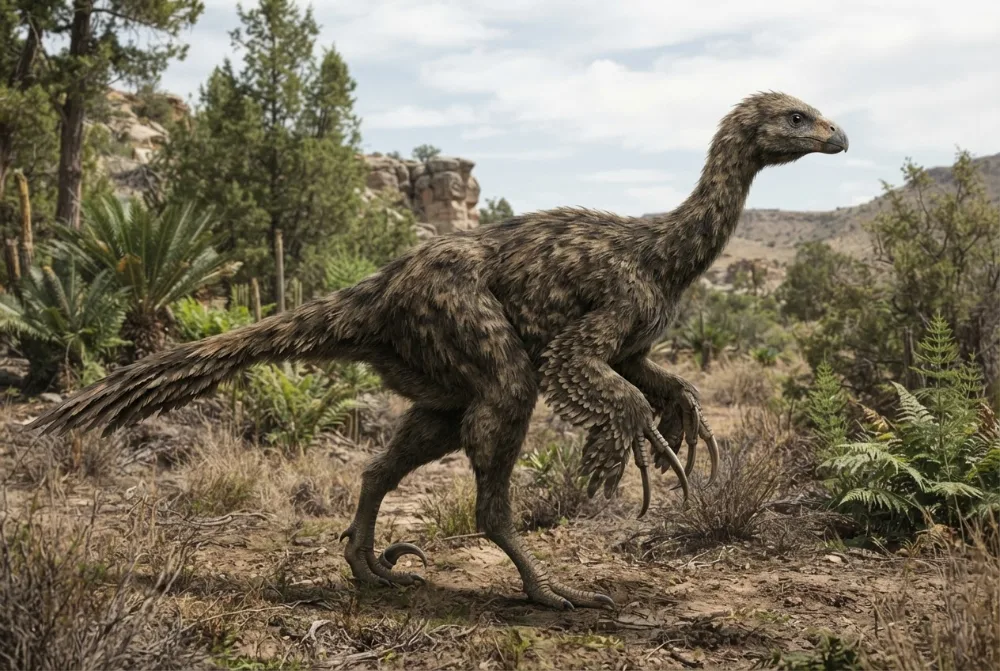
Falcarius was a strange dinosaur that looked like a mix between an ostrich, a gorilla, and Edward Scissorhands! It had a small head, a long neck, and huge curved claws on its hands. This dinosaur lived in what is now Utah, USA, about 139 to 134 million years ago.1
E phetse neng?
E ne e le kgolo hakae?
E ne e le telele hakae?
E ne e phahame hakae?
E ne e le boima hakae?
 telele jwaloka dintja tse 5 ho tloha nkong ho isa mohatleng🍌telele jwaloka dibanana tse 28 di behilwe ka mola🍉boima jwaloka mahapu a 20🧸boima jwaloka bana ba kereshe ba 5🎒boima jwaloka bana ba sekolo ba 3🏃e ne e ka matha dimitara tse 100 ka metsotswana e 12 (motho ya lebelo ka ho fetisisa o hloka 9,6)
Falcarius e ne e le kgolo hakae ha e bapiswa le WENA?
Ke dipalo feela ho browser ya hao. Ha ho letho le bolokwang kapa le romelwang kae kapa kae.
E ne e le lebelo hakae?


Dintlha tse monate
Falcarius is one of the most primitive therizinosaurs ever found. It helps scientists understand how meat-eating dinosaurs turned into plant-eaters.2
Over 3,000 bones of Falcarius have been dug up from a single quarry in Utah. That's a lot of fossils!1
Falcarius had a long neck that let it reach leaves about 1.5 metres (5 feet) off the ground.1
Its hand claws were huge and curved, like sickles. That's how it got its name, which means 'sickle cutter'.1
Falcarius probably had feathers, like its close relatives from Asia.1
The smallest Falcarius was less than 1 metre (3.3 feet) long, but adults grew to about 4 to 5 metres (13 to 16 feet).1
Dipotso tse botswang haholo ka Falcarius
?How big was Falcarius?
About 4 metres (13 feet) long and about 1.4 metres (4.5 feet) tall at the hip, weighing around 100 kilograms (220 pounds). The smallest known individual was less than 1 metre (3.3 feet) long.14
?What did Falcarius eat?
Mostly plants. Its leaf-shaped, serrated teeth were good for shredding leaves, but the pointed front teeth suggest it might have also eaten small animals like lizards sometimes.1
?Did Falcarius have feathers?
Scientists think yes. No feathers were found with its fossils, but its close feathered relatives from China make it very likely Falcarius had shaggy, hair-like proto-feathers.4
?How fast could Falcarius run?
Probably not very fast. Its lower legs were stubby, which suggests it no longer needed to run after prey like its meat-eating relatives did.4
Bakeng sa ditsebi tsa didinosaure
- Lebitso la saense
- Falcarius
- E rehilwe ke
- Kirkland et al. 20055
- Sehlopha
- Didinosaure tse makatsang tse nang le mafofa
- Lelapa / leloko
- Therizinosauria5
- Tlhophiso
- Theropoda > Therizinosauria5
- Dilemo tsa mafika
- dilemo tse dimilione tse 143 ho isa ho 133 (Berriasian / Valanginian)5
- Dibopeho tsa mafika
- Cedar Mountain5
- Dinaha
- Amerika5
- Direkoto tsa difosili
- 2 ho The Paleobiology Database5
- Ho sibollwa
- Falcarius was discovered in 1999 by fossil collector Lawrence Walker in Utah. Scientists named it in 2005.1
- E sa ntse e phehwa kgang
- Scientists are not sure if Falcarius was a pure plant-eater or if it also ate meat. Its front teeth are sharp and pointed, which might mean it ate small animals too.1
Moo dintlha di tswang teng
- Falcarius (en.wikipedia.org)
- A primitive therizinosauroid dinosaur from the Early Cretaceous of Utah | Nature (nature.com)
- A Primitive Therizinosauroid Dinosaur from the Early Cretaceous of Utah - DocsLib (docslib.org)
- Falcarius Utahensis - Utah Geological Survey (geology.utah.gov)
- Falcarius in The Paleobiology Database (CC BY 4.0): dilemo, dibaka, dibopeho tsa mafika, tlhophiso.
Ntlha e nngwe le e nngwe leqepheng lena e na le nomoro e supang mohlodi wa yona. Haeba re fositse ho hong, re kopa tshwarelo, re balatedi ba didinosaure, ha re koranta ya saense. Re bolelle ho [email protected] mme re tla e lokisa.
 Rex o lapile! Dino Wiki ke projeke ya ntate bakeng sa mora wa hae ya ratang didinosaure, ke mahala, ha ho dipapatso, ha ho disebedi. Batho ba baholo ba ka fepa Rex seneke ho thusa hore e dule e le inthaneteng.Fepa Rex
Tse ding tsa sehlopha se le seng: Didinosaure tse makatsang tse nang le mafofa
 TherizinosaurusDidinosaure tse makatsang tse nang le mafofa
 OviraptorDidinosaure tse makatsang tse nang le mafofa
 ChirostenotesDidinosaure tse makatsang tse nang le mafofa
 CitipesDidinosaure tse makatsang tse nang le mafofa
 LeptorhynchosDidinosaure tse makatsang tse nang le mafofa
 AvimimusDidinosaure tse makatsang tse nang le mafofa
 Stegosaurus
 Iguanodon
 Archaeopteryx
 Giganotosaurus
 Microraptor
 Deinonychus