 Kwisi: O dinosaure efe?
 Ntwa ya didinosaure
 Peiso ya didinosaure
 Dipapadi tse nyane tsa didinosaure
 Albamo ya ditikara
 Manane a TOP a didinosaure
 Nkgethele!
E phetse neng?

E ne e le kgolo hakae?
E ne e le telele hakae?
E ne e phahame hakae?
kakanyo
E ne e le boima hakae?

 telele jwaloka dikatse tsa lapeng tse 4 ho tloha nkong ho isa mohatleng🍌telele jwaloka dibanana tse 11 di behilwe ka molaboima jwaloka dikatse tsa lapeng tse 10🍉boima jwaloka mahapu a 8🧸boima jwaloka bana ba kereshe ba 2🎒boima jwaloka bana ba sekolo ba 1🏃e ne e ka matha dimitara tse 100 ka metsotswana e 8.2 (motho ya lebelo ka ho fetisisa o hloka 9,6)
Oviraptor e ne e le kgolo hakae ha e bapiswa le WENA?
Ke dipalo feela ho browser ya hao. Ha ho letho le bolokwang kapa le romelwang kae kapa kae.
E ne e le lebelo hakae?


Dintlha tse monate
Oviraptor had no teeth. Instead it used a horny beak to crush its food.2
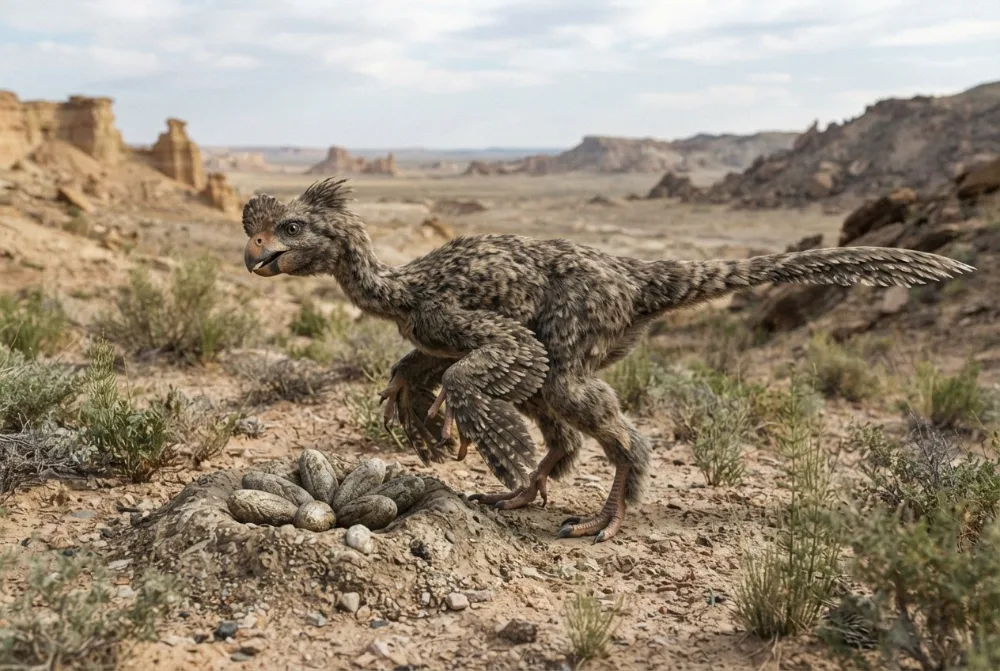
The first Oviraptor fossil was found lying on top of a nest of eggs. Scientists thought it was stealing them, but later they realized it was probably protecting its own eggs.1
Oviraptor was covered in feathers. Its tail ended in a pygostyle, a bone that supported a fan of feathers.1
Oviraptor lived about 75 to 71 million years ago, during the Late Cretaceous period.1
Its arms were long and ended in three fingers with curved claws.1
The name Oviraptor means 'egg thief' because the first fossil was found with eggs. But scientists now think it was a good parent, not a thief.1
Dipotso tse botswang haholo ka Oviraptor
?How big was Oviraptor?
Oviraptor was about 1.6 to 2 metres (5.2 to 6.6 feet) long and weighed between 33 and 40 kilograms (73 to 88 pounds).1
?Did Oviraptor have teeth?
No, Oviraptor had no teeth. It had a horny beak like a parrot that could crush hard food.12
?What did Oviraptor eat?
Oviraptor was an omnivore. It ate hard fruits, eggs, and possibly shellfish, using its strong beak to crush them.2
?Did Oviraptor steal eggs?
No, that was a mistake. Scientists once thought Oviraptor stole eggs, but now we know it was actually a caring parent that brooded its own eggs.1
?Did Oviraptor have feathers?
Yes, Oviraptor was covered in feathers. Its tail ended in a pygostyle that supported a fan of feathers.1
?When did Oviraptor live?
Oviraptor lived during the Late Cretaceous period, about 85 to 75 million years ago.2
?Where was Oviraptor found?
Oviraptor fossils were found in the Gobi Desert of Mongolia, at a place called the Flaming Cliffs.1
?What does the name Oviraptor mean?
Oviraptor means 'egg thief' in Latin, because the first fossil was found lying on a nest of eggs. But we now know it was a good parent, not a thief.1
Mosenyi wa ditshomo
Tshomo: Oviraptor stole and ate the eggs of other dinosaurs.
Nnete: The Oviraptor fossil was found on a nest, but it was probably sitting on its own eggs to keep them warm, like a bird. It likely ate plants, fruits, and small animals, not eggs.1
Bakeng sa ditsebi tsa didinosaure
- Lebitso la saense
- Oviraptor
- E rehilwe ke
- Osborn 19243
- Sehlopha
- Didinosaure tse makatsang tse nang le mafofa
- Lelapa / leloko
- Oviraptoridae3
- Tlhophiso
- Theropoda > Oviraptorosauria3
- Dilemo tsa mafika
- dilemo tse dimilione tse 90 ho isa ho 72 (Coniacian / Campanian)3
- Dibopeho tsa mafika
- Djadokhta, Dabrazhin3
- Dinaha
- Mongolia, Kazakhstan3
- Direkoto tsa difosili
- 3 ho The Paleobiology Database3
- Ho sibollwa
- Oviraptor was discovered in 1923 in the Gobi Desert of Mongolia during an expedition led by Roy Chapman Andrews. It was named by Henry Fairfield Osborn in 1924.1
- E sa ntse e phehwa kgang
- Scientists are not sure exactly what Oviraptor ate. Its strong beak could crush hard objects, but whether it mainly ate plants, eggs, or shellfish is still debated.21
Moo dintlha di tswang teng
- Oviraptor (en.wikipedia.org)
- Oviraptor | Natural History Museum (nhm.ac.uk)
- Oviraptor in The Paleobiology Database (CC BY 4.0): dilemo, dibaka, dibopeho tsa mafika, tlhophiso.
Ntlha e nngwe le e nngwe leqepheng lena e na le nomoro e supang mohlodi wa yona. Haeba re fositse ho hong, re kopa tshwarelo, re balatedi ba didinosaure, ha re koranta ya saense. Re bolelle ho [email protected] mme re tla e lokisa.
 Rex o lapile! Dino Wiki ke projeke ya ntate bakeng sa mora wa hae ya ratang didinosaure, ke mahala, ha ho dipapatso, ha ho disebedi. Batho ba baholo ba ka fepa Rex seneke ho thusa hore e dule e le inthaneteng.Fepa Rex
Tse ding tsa sehlopha se le seng: Didinosaure tse makatsang tse nang le mafofa
 TherizinosaurusDidinosaure tse makatsang tse nang le mafofa
 ChirostenotesDidinosaure tse makatsang tse nang le mafofa
 CitipesDidinosaure tse makatsang tse nang le mafofa
 LeptorhynchosDidinosaure tse makatsang tse nang le mafofa
 AvimimusDidinosaure tse makatsang tse nang le mafofa
 CaenagnathusDidinosaure tse makatsang tse nang le mafofa
 Tyrannosaurus
 Triceratops
 Velociraptor
 Spinosaurus
 Ankylosaurus
 Parasaurolophus