 Kwisi: O dinosaure efe?
 Ntwa ya didinosaure
 Peiso ya didinosaure
 Dipapadi tse nyane tsa didinosaure
 Albamo ya ditikara
 Manane a TOP a didinosaure
 Nkgethele!
E phetse neng?

E ne e le kgolo hakae?
E ne e le telele hakae?
E ne e phahame hakae?
kakanyo
Halszkaraptor e ne e le kgolo hakae ha e bapiswa le WENA?
Ke dipalo feela ho browser ya hao. Ha ho letho le bolokwang kapa le romelwang kae kapa kae.
E ne e le lebelo hakae?


Dintlha tse monate
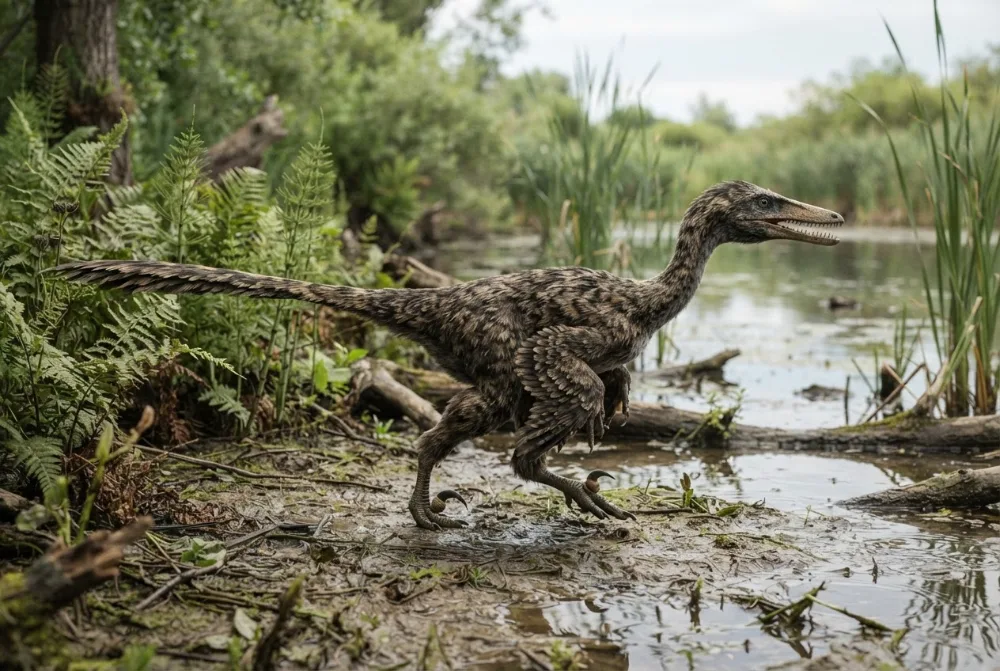
Halszkaraptor had a very long neck for a dinosaur, about 20 cm (7.9 in) long, which is almost half its total body length.1
Its front limbs were short and flipper-like, which scientists think it may have used to paddle in water.1
The snout had many tiny holes that might have held sensors to detect vibrations in water, like a crocodile.1
The only known fossil was smuggled out of Mongolia and later returned after scientists proved it was real using a powerful X-ray scanner.1
It lived about 75 million years ago, during the Late Cretaceous period.1
Some scientists think Halszkaraptor was an insectivore that hunted small bugs in murky water or at night, because its eyes were large.1
Dipotso tse botswang haholo ka Halszkaraptor
?Was Halszkaraptor a dinosaur?
Yes, Halszkaraptor was a small, duck-sized dromaeosaurid dinosaur from the Late Cretaceous.1
?How big was Halszkaraptor?
About the size of a mallard duck. Its head was 7 cm long and its neck was 20 cm long.1
?Could Halszkaraptor swim?
Some scientists think it could swim using flipper-like forelimbs and a long neck, but others disagree because its bones were not dense enough.12
?What did Halszkaraptor eat?
It likely ate small fish or insects. Its sharp, backward-curving teeth and snout sensors helped it catch prey in water.13
?Why did Halszkaraptor have a long neck?
Its long, swan-like neck helped it strike at prey in the water, similar to how herons hunt today.13
?When did Halszkaraptor live?
It lived about 75 million years ago, during the Late Cretaceous period.1
Mosenyi wa ditshomo
Tshomo: Halszkaraptor was a fully aquatic dinosaur like a dolphin.
Nnete: Scientists debate whether it was semi-aquatic. It had some adaptations for water, like a long neck and flipper-like arms, but also strong legs for running on land. It likely spent time both in water and on land.1
Bakeng sa ditsebi tsa didinosaure
- Lebitso la saense
- Halszkaraptor
- E rehilwe ke
- Cau et al. 20174
- Sehlopha
- Diraptor
- Lelapa / leloko
- Dromaeosauridae4
- Tlhophiso
- Theropoda > Dromaeosauridae4
- Dilemo tsa mafika
- dilemo tse dimilione tse 84 ho isa ho 72 (Campanian)4
- Dibopeho tsa mafika
- Djadokhta4
- Dinaha
- Mongolia4
- Direkoto tsa difosili
- 1 ho The Paleobiology Database4
- Ho sibollwa
- The fossil was found by poachers in Mongolia before 2011, then bought by a dealer who showed it to scientists in 2015. It was named Halszkaraptor escuilliei in 2017 by Andrea Cau and colleagues.1
- E sa ntse e phehwa kgang
- Scientists are still debating whether Halszkaraptor was truly semi-aquatic or mainly lived on land and ate insects.1
Moo dintlha di tswang teng
- Halszkaraptor (en.wikipedia.org)
- Synchrotron scanning reveals amphibious ecomorphology in a new clade of bird-like dinosaurs | Nature (nature.com)
- Duck-Like Dinosaur Is Among Oddest Fossils Yet Found | National Geographic (nationalgeographic.com)
- Halszkaraptor in The Paleobiology Database (CC BY 4.0): dilemo, dibaka, dibopeho tsa mafika, tlhophiso.
Ntlha e nngwe le e nngwe leqepheng lena e na le nomoro e supang mohlodi wa yona. Haeba re fositse ho hong, re kopa tshwarelo, re balatedi ba didinosaure, ha re koranta ya saense. Re bolelle ho [email protected] mme re tla e lokisa.
 Rex o lapile! Dino Wiki ke projeke ya ntate bakeng sa mora wa hae ya ratang didinosaure, ke mahala, ha ho dipapatso, ha ho disebedi. Batho ba baholo ba ka fepa Rex seneke ho thusa hore e dule e le inthaneteng.Fepa Rex
 Velociraptor
 Microraptor
 Deinonychus
 Asiamericana
 Richardoestesia
 Saurornitholestes
 Tyrannosaurus
 Triceratops
 Spinosaurus
 Ankylosaurus
 Parasaurolophus
 Pteranodon