 Kwisi: O dinosaure efe?
 Ntwa ya didinosaure
 Peiso ya didinosaure
 Dipapadi tse nyane tsa didinosaure
 Albamo ya ditikara
 Manane a TOP a didinosaure
 Nkgethele!
Hatzegopteryx
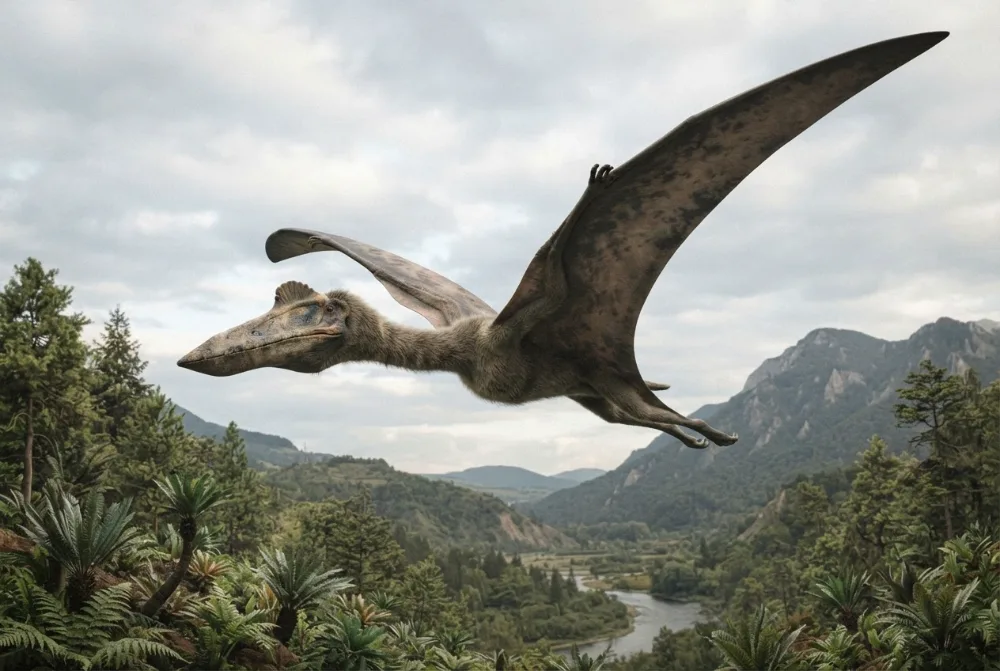
Hatzegopteryx was a giant flying reptile that lived on an island in what is now Romania. It had a huge, strong skull and a short, muscular neck, and it was probably the top predator on its island home.1
E phetse neng?
E ne e le kgolo hakae?
Mapheo a yona a ne a pharaletse hakae?
E ne e le boima hakae?

 mapheo a pharaletse jwaloka dikoloi tse 2.5 ka mola🍉boima jwaloka mahapu a 50🧸boima jwaloka bana ba kereshe ba 13🎒boima jwaloka bana ba sekolo ba 8⚽e ne e ka fofa ho tshela lebala lohle la bolo ya maoto ka metsotswana e 3.9
Hatzegopteryx e ne e le kgolo hakae ha e bapiswa le WENA?
Ke dipalo feela ho browser ya hao. Ha ho letho le bolokwang kapa le romelwang kae kapa kae.
E ne e le lebelo hakae?


Dintlha tse monate
Hatzegopteryx had a skull that was about 2.5 meters (8 feet) long, one of the largest skulls of any non-marine animal.1
Its neck was only 1.5 meters (5 feet) long, which is half the length of other giant pterosaurs with the same wingspan.1
The bones of Hatzegopteryx were filled with tiny pits and hollows, making them lightweight but strong, like Styrofoam.1
It lived on Hațeg Island, a subtropical island in the ancient Tethys Sea, where dinosaurs were small due to island dwarfism.1
Hatzegopteryx was probably the top predator on its island because there were no large meat-eating dinosaurs there.1
The first fossils of Hatzegopteryx were found in the late 1970s by students, but were at first mistaken for dinosaur bones.1
Dipotso tse botswang haholo ka Hatzegopteryx
?How big was Hatzegopteryx?
It had a wingspan of about 10 to 12 meters (33 to 39 feet), making it one of the biggest pterosaurs ever.1
?Could Hatzegopteryx fly?
Yes, it could fly. Its wing bones were similar to other flying pterosaurs, and its skull was lightweight thanks to a spongy internal structure.14
?What did Hatzegopteryx eat?
It was a predator that probably ate dwarf dinosaurs like titanosaurs and iguanodontians, and it could tackle prey too big to swallow whole.1
?Is Hatzegopteryx a dinosaur?
No, it is a pterosaur, which is a flying reptile and not a dinosaur.1
?When did Hatzegopteryx live?
It lived about 72 million years ago, during the Late Cretaceous Period.1
?Where was Hatzegopteryx found?
Its fossils were found in Transylvania, Romania, on what was once Hațeg Island.1
?How heavy was Hatzegopteryx?
Its weight has been estimated at around 250 kilograms (550 pounds).4
?Was Hatzegopteryx bigger than Quetzalcoatlus?
It was about the same size or slightly smaller. Both had wingspans around 10 to 12 meters, but Hatzegopteryx had a shorter, stronger neck.1
?Why did Hatzegopteryx have a short neck?
Its short, thick neck was very strong and helped it hunt large prey, like dwarf dinosaurs, by catching them.15
?Could Hatzegopteryx swim?
Nobody knows for sure, but it probably spent most of its time on land hunting, like other azhdarchid pterosaurs.1
Mosenyi wa ditshomo
Tshomo: Hatzegopteryx was too heavy to fly.
Nnete: Its bones had a spongy, lightweight internal structure that made the skull strong but light enough for flight.1
Bakeng sa ditsebi tsa didinosaure
- Lebitso la saense
- Hatzegopteryx
- E rehilwe ke
- Buffetaut et al. 20026
- Sehlopha
- Dihahabi tse fofang
- Lelapa / leloko
- Azhdarchidae6
- Tlhophiso
- Pterosauria > Pterodactyloidea > Azhdarchidae6
- Dilemo tsa mafika
- dilemo tse dimilione tse 72 ho isa ho 66 (Maastrichtian)6
- Dibopeho tsa mafika
- Densuș-Ciula, Sebeş, Râul Mare6
- Dinaha
- Romania6
- Direkoto tsa difosili
- 4 ho The Paleobiology Database6
- Ho sibollwa
- Hatzegopteryx was named in 2002 by paleontologists Eric Buffetaut, Dan Grigorescu, and Zoltan Csiki, based on skull fragments and a wing bone found in Romania.1
- E sa ntse e phehwa kgang
- Scientists are not sure exactly how wide its wingspan was, with estimates ranging from 10 to 12 meters (33 to 39 feet).1
Moo dintlha di tswang teng
- Hatzegopteryx (en.wikipedia.org)
- PBDB Taxon (paleobiodb.org)
- A new giant pterosaur with a robust skull from the latest cretaceous of Romania (pubmed.ncbi.nlm.nih.gov)
- Eons | When a Giant Pterosaur Ruled the European Islands | Season 4 | Episode 23 | PBS (pbs.org)
- Neck biomechanics indicate that giant Transylvanian azhdarchid pterosaurs were short-necked arch predators (pmc.ncbi.nlm.nih.gov)
- Hatzegopteryx in The Paleobiology Database (CC BY 4.0): dilemo, dibaka, dibopeho tsa mafika, tlhophiso.
Ntlha e nngwe le e nngwe leqepheng lena e na le nomoro e supang mohlodi wa yona. Haeba re fositse ho hong, re kopa tshwarelo, re balatedi ba didinosaure, ha re koranta ya saense. Re bolelle ho [email protected] mme re tla e lokisa.
 Rex o lapile! Dino Wiki ke projeke ya ntate bakeng sa mora wa hae ya ratang didinosaure, ke mahala, ha ho dipapatso, ha ho disebedi. Batho ba baholo ba ka fepa Rex seneke ho thusa hore e dule e le inthaneteng.Fepa Rex
 Pteranodon
 Quetzalcoatlus
 Dorygnathus
 Rhamphorhynchus
 Anhanguera
 Pterodactylus
 Tyrannosaurus
 Triceratops
 Velociraptor
 Spinosaurus
 Ankylosaurus
 Parasaurolophus