 Kwisi: O dinosaure efe?
 Ntwa ya didinosaure
 Peiso ya didinosaure
 Dipapadi tse nyane tsa didinosaure
 Albamo ya ditikara
 Manane a TOP a didinosaure
 Nkgethele!
Helicoprion
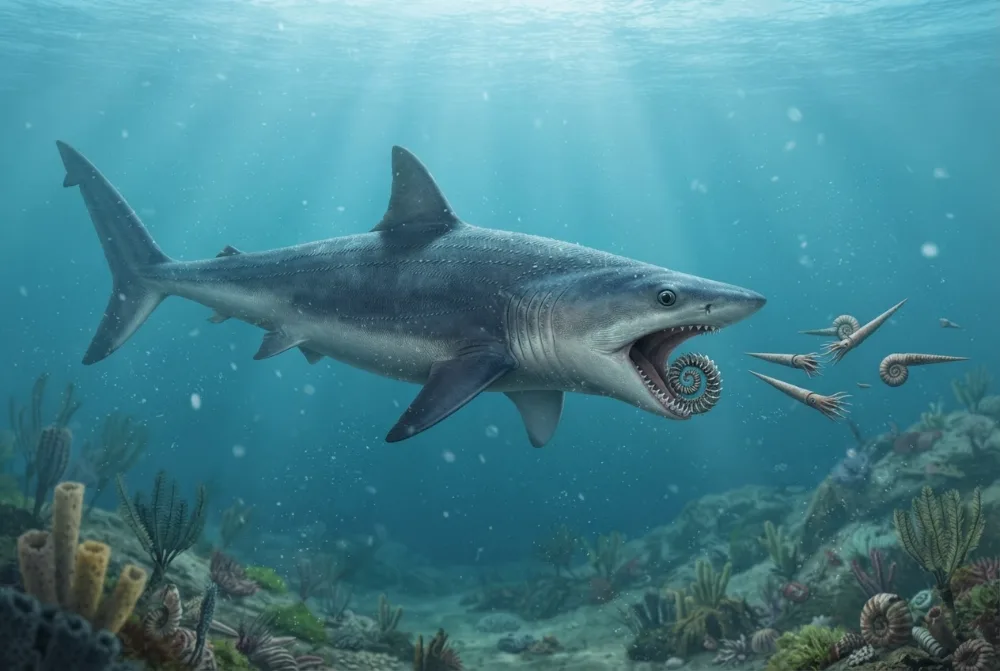
Helicoprion was a shark-like fish that lived in the Permian seas. It had a strange, spiral-shaped tooth whorl in its lower jaw that looked like a buzz-saw. This helped it catch and eat soft prey like squid and other cephalopods.12
E phetse neng?
E ne e le kgolo hakae?
E ne e le telele hakae?
 telele jwaloka dikoloi tse 2.5 tse pakilweng ka mola🍌telele jwaloka dibanana tse 67 di behilwe ka mola🏊e ne e ka sesa bolelele ba letamo le leholo la ho sesa (50 m) ka metsotswana e 6
Helicoprion e ne e le kgolo hakae ha e bapiswa le WENA?
Ke dipalo feela ho browser ya hao. Ha ho letho le bolokwang kapa le romelwang kae kapa kae.
E ne e le lebelo hakae?


Dintlha tse monate
Helicoprion is known mostly from its spiral tooth whorls, because its skeleton was made of cartilage and did not fossilize easily.12
The tooth whorl sat in the lower jaw, and each tooth had a different job: front teeth hooked prey, middle teeth pierced and cut, and back teeth pushed food into the throat.12
Helicoprion lived during the Permian Period, about 290 to 270 million years ago, which is before the dinosaurs.1
Scientists think Helicoprion was an apex predator in its environment, and it may have gathered in deep inland seas like the Phosphoria Sea (now Idaho) to breed or hunt.1
The name Helicoprion comes from Greek words meaning 'spiral saw', because of its coiled tooth whorl.1
Helicoprion could grow up to 12 metres (39 feet) long, about as long as a school bus.1
Dipotso tse botswang haholo ka Helicoprion
?Was Helicoprion a dinosaur?
No, Helicoprion was a shark-like cartilaginous fish, not a dinosaur. It lived in the Permian seas long before the first dinosaurs appeared.1
?How big was Helicoprion?
Helicoprion is estimated to have reached lengths between 5 and 12 metres, about as long as a school bus.1
?What did Helicoprion eat?
Helicoprion ate soft-bodied prey like squid, belemnoids, and other cephalopods. It may also have eaten hard-shelled ammonoids and nautiloids by pulling the body out of the shell.12
?When did Helicoprion live?
Helicoprion lived from the Early to the Middle Permian, about 290 to 270 million years ago. That is before the dinosaurs.1
?Where was Helicoprion found?
Helicoprion fossils have been found all over the world, including in the United States (especially Idaho), Russia, Australia, China, and Japan. It lived in many seas.12
?How did Helicoprion use its tooth whorl?
The tooth whorl sat in the lower jaw and worked like a saw. Front teeth hooked prey, middle teeth pierced and cut, and back teeth pushed food into the throat.12
?Why did Helicoprion have a spiral tooth?
The spiral tooth whorl helped Helicoprion catch and eat soft prey like squid. It could also help shell hard-shelled animals by pulling the body out of the shell.12
?Is Helicoprion still alive?
No, Helicoprion went extinct about 270 million years ago, at the end of the Middle Permian. It is only known from fossils.1
?How fast could Helicoprion swim?
Maybe up to about 30 km/h (19 mph). This is a guess: nobody knows for sure. Its body was probably shaped like a tuna or mackerel shark, so it was likely a fast swimmer.1
?What would happen if Helicoprion was alive today?
If Helicoprion were alive today, it would be a large, fast-swimming predator that ate squid and fish. But it lived in the Permian and is extinct, so we can only imagine.1
Bakeng sa ditsebi tsa didinosaure
- Lebitso la saense
- Helicoprion
- E rehilwe ke
- Karpinsky 18993
- Sehlopha
- Dibopuwa tse tummeng tsa mehleng ya kgale
- Lelapa / leloko
- Helicoprionidae3
- Tlhophiso
- Chondrichthyes > Eugeneodontiformes > Helicoprionidae3
- Dilemo tsa mafika
- dilemo tse dimilione tse 299 ho isa ho 254 (Asselian / Wuchiapingian)3
- Dibopeho tsa mafika
- Phosphoria, Assistance, Bone Spring3
- Dinaha
- Amerika, Kanada, Japane, Meksiko, Australia, Kazakhstan3
- Direkoto tsa difosili
- 35 ho The Paleobiology Database3
- Ho sibollwa
- Helicoprion was first named in 1899 by Russian geologist Alexander Karpinsky, based on fossils found in Russia and Australia. The type species is Helicoprion bessonowi.13
- E sa ntse e phehwa kgang
- Scientists are still unsure about the exact shape of Helicoprion's body, because almost no skeleton has been found, only tooth whorls.12
Moo dintlha di tswang teng
- Helicoprion (en.wikipedia.org)
- Helicoprion - The Australian Museum (australian.museum)
- Helicoprion in The Paleobiology Database (CC BY 4.0): dilemo, dibaka, dibopeho tsa mafika, tlhophiso.
Ntlha e nngwe le e nngwe leqepheng lena e na le nomoro e supang mohlodi wa yona. Haeba re fositse ho hong, re kopa tshwarelo, re balatedi ba didinosaure, ha re koranta ya saense. Re bolelle ho [email protected] mme re tla e lokisa.
 Rex o lapile! Dino Wiki ke projeke ya ntate bakeng sa mora wa hae ya ratang didinosaure, ke mahala, ha ho dipapatso, ha ho disebedi. Batho ba baholo ba ka fepa Rex seneke ho thusa hore e dule e le inthaneteng.Fepa Rex
Tse ding tsa sehlopha se le seng: Dibopuwa tse tummeng tsa mehleng ya kgale
 MegalodonDibopuwa tse tummeng tsa mehleng ya kgale
 Sabre-toothed catDibopuwa tse tummeng tsa mehleng ya kgale
 DimetrodonDibopuwa tse tummeng tsa mehleng ya kgale
 Woolly mammothDibopuwa tse tummeng tsa mehleng ya kgale
 ArthropleuraDibopuwa tse tummeng tsa mehleng ya kgale
 DeinosuchusDibopuwa tse tummeng tsa mehleng ya kgale