 Kwisi: O dinosaure efe?
 Ntwa ya didinosaure
 Peiso ya didinosaure
 Dipapadi tse nyane tsa didinosaure
 Albamo ya ditikara
 Manane a TOP a didinosaure
 Nkgethele!
Deinosuchus
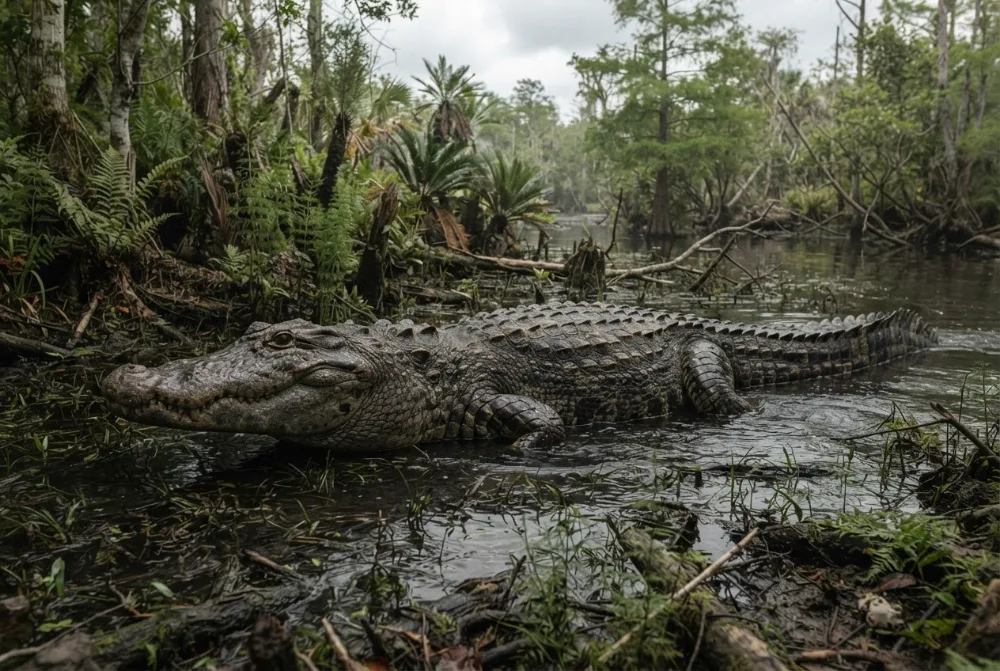
Deinosuchus was a giant crocodile-like reptile that lived during the Late Cretaceous, about 82 to 73 million years ago. It was one of the biggest crocodilian predators ever, growing longer than a school bus! Even though it looked like a crocodile, it was actually more closely related to alligators.1
E phetse neng?
E ne e le kgolo hakae?
E ne e le telele hakae?
E ne e le boima hakae?
 telele jwaloka dikoloi tse 2 tse pakilweng ka mola🍌telele jwaloka dibanana tse 56 di behilwe ka mola
 e batla e le boima jwaloka tlou🍉boima jwaloka mahapu a 1000🎒boima jwaloka ditlelase tse feletseng tse 6 tsa bana ba sekolo🐻❄️boima jwaloka dibere tse tshweu tse 11🏊e ne e ka sesa bolelele ba letamo le leholo la ho sesa (50 m) ka metsotswana e 6
Deinosuchus e ne e le kgolo hakae ha e bapiswa le WENA?
Ke dipalo feela ho browser ya hao. Ha ho letho le bolokwang kapa le romelwang kae kapa kae.
E ne e le lebelo hakae?


Dintlha tse monate
Deinosuchus could grow over 9 meters (30 feet) long, making it one of the largest crocodilian relatives ever.1
Its back was covered in thick, round bony plates called osteoderms, which acted like armor.1
Scientists think Deinosuchus may have lived for up to 50 years, growing slowly but for a very long time.1
Deinosuchus lived on both sides of the Western Interior Seaway, a huge sea that split North America in two during the Cretaceous.1
Bite marks on dinosaur bones show that Deinosuchus attacked and ate large dinosaurs.2
The first Deinosuchus fossils were found in North Carolina in the 1850s, but the animal was not named until 1909.1
Deinosuchus had a longer skull than modern crocodiles and alligators, and its teeth were built for crushing.1
Dipotso tse botswang haholo ka Deinosuchus
?Was Deinosuchus a dinosaur?
No, Deinosuchus was not a dinosaur. It was a giant crocodile-like reptile, more closely related to alligators.1
?How big was Deinosuchus?
The largest Deinosuchus could grow over 9 meters (30 feet) long, longer than a school bus. Some specimens may have approached 10 meters.12
?Could Deinosuchus eat dinosaurs?
Yes, bite marks on dinosaur bones show that Deinosuchus attacked and ate large dinosaurs. It was an apex predator.12
?When did Deinosuchus live?
Deinosuchus lived during the Late Cretaceous, about 82 to 73 million years ago.1
?Where was Deinosuchus found?
Deinosuchus fossils have been found in 12 U.S. states, including Texas, Montana, and along the East Coast, as well as in northern Mexico.1
?How long did Deinosuchus live?
Scientists think Deinosuchus may have lived for up to 50 years, growing slowly but for a very long time.1
?What did Deinosuchus eat?
Deinosuchus probably ate large dinosaurs, sea turtles, fish, and other aquatic and terrestrial prey. It was an opportunistic predator.1
?Did Deinosuchus have armor?
Yes, its back was covered with thick, round bony plates called osteoderms, which acted like armor.1
?Is Deinosuchus related to alligators?
Yes, Deinosuchus was more closely related to alligators than to crocodiles, though some scientists think it was a stem-group crocodilian.14
?How fast could Deinosuchus run?
Nobody knows for sure, but like modern crocodilians, it was probably a slow runner on land and a fast ambush predator in water.1
Mosenyi wa ditshomo
Tshomo: Deinosuchus is often thought to be a dinosaur because of its huge size and scary name.
Nnete: Deinosuchus was not a dinosaur. It was a giant relative of alligators and crocodiles, called a crocodylian.1
Bakeng sa ditsebi tsa didinosaure
- Lebitso la saense
- Deinosuchus
- E rehilwe ke
- Holland 19095
- Sehlopha
- Dibopuwa tse tummeng tsa mehleng ya kgale
- Lelapa / leloko
- Alligatoroidea5
- Tlhophiso
- Reptilia > Crocodylia > Alligatoroidea5
- Dilemo tsa mafika
- dilemo tse dimilione tse 84 ho isa ho 72 (Campanian)5
- Dibopeho tsa mafika
- Aguja, Judith River, Mooreville5
- Dinaha
- Amerika, Meksiko5
- Direkoto tsa difosili
- 19 ho The Paleobiology Database5
- Ho sibollwa
- The first Deinosuchus fossils were found in North Carolina in the 1850s, but the genus was named in 1909 by William Holland based on fossils from Montana. Later, in the 1940s, more complete remains were found in Texas by an American Museum of Natural History expedition led by Barnum Brown and Roland Bird.12
- E sa ntse e phehwa kgang
- Scientists still debate whether Deinosuchus from eastern and western North America were different species or just one species that lived across a wide area.2
Moo dintlha di tswang teng
- Deinosuchus (en.wikipedia.org)
- Full article: A systematic review of the giant alligatoroid Deinosuchus from the Campanian of North America and its implications for the relationships at the root of Crocodylia (tandfonline.com)
- How the ‘terror crocodile’ grew so big | Nature (nature.com)
- Expanded phylogeny elucidates Deinosuchus relationships, crocodylian osmoregulation and body-size evolution (pmc.ncbi.nlm.nih.gov)
- Deinosuchus in The Paleobiology Database (CC BY 4.0): dilemo, dibaka, dibopeho tsa mafika, tlhophiso.
Ntlha e nngwe le e nngwe leqepheng lena e na le nomoro e supang mohlodi wa yona. Haeba re fositse ho hong, re kopa tshwarelo, re balatedi ba didinosaure, ha re koranta ya saense. Re bolelle ho [email protected] mme re tla e lokisa.
 Rex o lapile! Dino Wiki ke projeke ya ntate bakeng sa mora wa hae ya ratang didinosaure, ke mahala, ha ho dipapatso, ha ho disebedi. Batho ba baholo ba ka fepa Rex seneke ho thusa hore e dule e le inthaneteng.Fepa Rex
Tse ding tsa sehlopha se le seng: Dibopuwa tse tummeng tsa mehleng ya kgale
 MegalodonDibopuwa tse tummeng tsa mehleng ya kgale
 Sabre-toothed catDibopuwa tse tummeng tsa mehleng ya kgale
 DimetrodonDibopuwa tse tummeng tsa mehleng ya kgale
 Woolly mammothDibopuwa tse tummeng tsa mehleng ya kgale
 ArthropleuraDibopuwa tse tummeng tsa mehleng ya kgale
 HelicoprionDibopuwa tse tummeng tsa mehleng ya kgale
 Tyrannosaurus
 Triceratops
 Velociraptor
 Spinosaurus
 Ankylosaurus
 Parasaurolophus