 Kwisi: O dinosaure efe?
 Ntwa ya didinosaure
 Peiso ya didinosaure
 Dipapadi tse nyane tsa didinosaure
 Albamo ya ditikara
 Manane a TOP a didinosaure
 Nkgethele!
Woolly mammoth
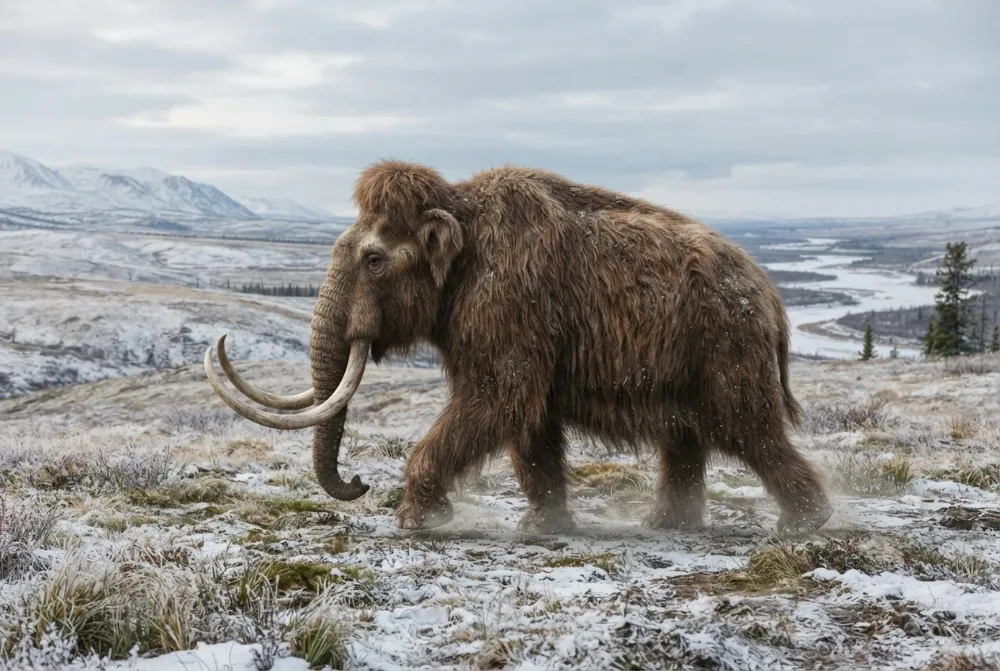
The woolly mammoth was a huge, furry elephant that lived during the Ice Age. It had long, curved tusks and a thick coat of hair to keep warm in the freezing cold. These amazing animals roamed across Europe, Asia, and North America.1
E phetse neng?
E ne e le kgolo hakae?
E ne e le telele hakae?
E ne e phahame hakae?
E ne e le boima hakae?

 telele jwaloka dintja tse 4 ho tloha nkong ho isa mohatleng🍌telele jwaloka dibanana tse 25 di behilwe ka mola
 boima jwaloka ditlou tse 1.5🍉boima jwaloka mahapu a 1600🎒boima jwaloka ditlelase tse feletseng tse 10 tsa bana ba sekolo🐻❄️boima jwaloka dibere tse tshweu tse 18🏃e ne e ka matha dimitara tse 100 ka metsotswana e 14 (motho ya lebelo ka ho fetisisa o hloka 9,6)
Woolly mammoth e ne e le kgolo hakae ha e bapiswa le WENA?
Ke dipalo feela ho browser ya hao. Ha ho letho le bolokwang kapa le romelwang kae kapa kae.
E ne e le lebelo hakae?


Dintlha tse monate
Woolly mammoths had very small ears and a short tail to stop them from getting frostbite in the cold.1
A newborn woolly mammoth calf weighed about 90 kilograms (200 pounds), as much as a large adult human.1
Woolly mammoths and Columbian mammoths sometimes mated and had hybrid babies in North America.1
The last woolly mammoths lived on Wrangel Island in the Arctic Ocean until about 4,000 years ago, when the Egyptian pyramids were already built.1
Woolly mammoths had four molars that were replaced six times during their life, just like modern elephants.1
Scientists have found frozen woolly mammoth carcasses with fur, skin, and even stomach contents still preserved.1
Dipotso tse botswang haholo ka Woolly mammoth
?How big was a woolly mammoth?
About the same size as a modern African elephant. Males stood 2.67 to 3.49 metres tall at the shoulder and weighed 3.9 to 8.2 tonnes.1
?What did woolly mammoths eat?
They mainly ate forbs and grasses. Their diet was similar to that of modern elephants.1
?When did woolly mammoths go extinct?
Most woolly mammoths died out about 10,000 years ago, but small groups survived on islands. The very last ones lived on Wrangel Island until about 4,000 years ago.1
?Did woolly mammoths have fur?
Yes, they had a thick, shaggy coat of fur to keep warm in the Ice Age cold. It had long guard hairs and a shorter, dense undercoat.1
?How long were woolly mammoth tusks?
Their tusks were long and curved, but the exact length varied. They used them for fighting, foraging, and moving objects.1
?Did humans hunt woolly mammoths?
Yes, early humans hunted woolly mammoths for food and used their bones and tusks to make art, tools, and shelters.1
?Are woolly mammoths dinosaurs?
No, they are not dinosaurs. Woolly mammoths are mammals, specifically a type of extinct elephant.1
?Why did woolly mammoths have small ears?
Their small ears helped prevent frostbite and reduce heat loss in the freezing cold.1
?Can we bring woolly mammoths back?
Scientists have talked about trying to revive them using DNA, but none of those methods are possible right now.1
Mosenyi wa ditshomo
Tshomo: Many people think woolly mammoths lived only in snowy, icy landscapes.
Nnete: Woolly mammoths actually lived on a dry, grassy steppe called the mammoth steppe, which was not covered in ice and snow all year.1
Bakeng sa ditsebi tsa didinosaure
- Lebitso la saense
- Mammuthus primigenius
- E rehilwe ke
- (Blumenbach 1799)4
- Sehlopha
- Dibopuwa tse tummeng tsa mehleng ya kgale
- Lelapa / leloko
- Elephantidae4
- Tlhophiso
- Mammalia > Proboscidea > Elephantidae4
- Dilemo tsa mafika
- dilemo tse dimilione tse 7.2 ho isa ho 0.01 (Messinian / Holocene)4
- Dibopeho tsa mafika
- Wiota Gravels, Oberer Travertin4
- Dinaha
- Amerika, Kanada, Jeremane, United Kingdom, Russia, Netherlands4
- Direkoto tsa difosili
- 77 ho The Paleobiology Database4
- Ho sibollwa
- In 1796, French scientist Georges Cuvier was the first to show that woolly mammoth fossils were from an extinct species, not modern elephants. German naturalist Johann Friedrich Blumenbach gave it the scientific name Elephas primigenius in 1799.1
- E sa ntse e phehwa kgang
- Scientists are still debating exactly why woolly mammoths went extinct, whether it was due to climate change, hunting by humans, or a combination of both.1
Moo dintlha di tswang teng
- Woolly mammoth (en.wikipedia.org)
- Genomics of adaptive evolution in the woolly mammoth: Current Biology (cell.com)
- Woolly Mammoth — size, diet & habitat | DinoLifePedia (dinolifepedia.com)
- Woolly mammoth in The Paleobiology Database (CC BY 4.0): dilemo, dibaka, dibopeho tsa mafika, tlhophiso.
Ntlha e nngwe le e nngwe leqepheng lena e na le nomoro e supang mohlodi wa yona. Haeba re fositse ho hong, re kopa tshwarelo, re balatedi ba didinosaure, ha re koranta ya saense. Re bolelle ho [email protected] mme re tla e lokisa.
 Rex o lapile! Dino Wiki ke projeke ya ntate bakeng sa mora wa hae ya ratang didinosaure, ke mahala, ha ho dipapatso, ha ho disebedi. Batho ba baholo ba ka fepa Rex seneke ho thusa hore e dule e le inthaneteng.Fepa Rex
Tse ding tsa sehlopha se le seng: Dibopuwa tse tummeng tsa mehleng ya kgale
 MegalodonDibopuwa tse tummeng tsa mehleng ya kgale
 Sabre-toothed catDibopuwa tse tummeng tsa mehleng ya kgale
 DimetrodonDibopuwa tse tummeng tsa mehleng ya kgale
 ArthropleuraDibopuwa tse tummeng tsa mehleng ya kgale
 HelicoprionDibopuwa tse tummeng tsa mehleng ya kgale
 DeinosuchusDibopuwa tse tummeng tsa mehleng ya kgale