 Kwisi: O dinosaure efe?
 Ntwa ya didinosaure
 Peiso ya didinosaure
 Dipapadi tse nyane tsa didinosaure
 Albamo ya ditikara
 Manane a TOP a didinosaure
 Nkgethele!
Kaikaifilu
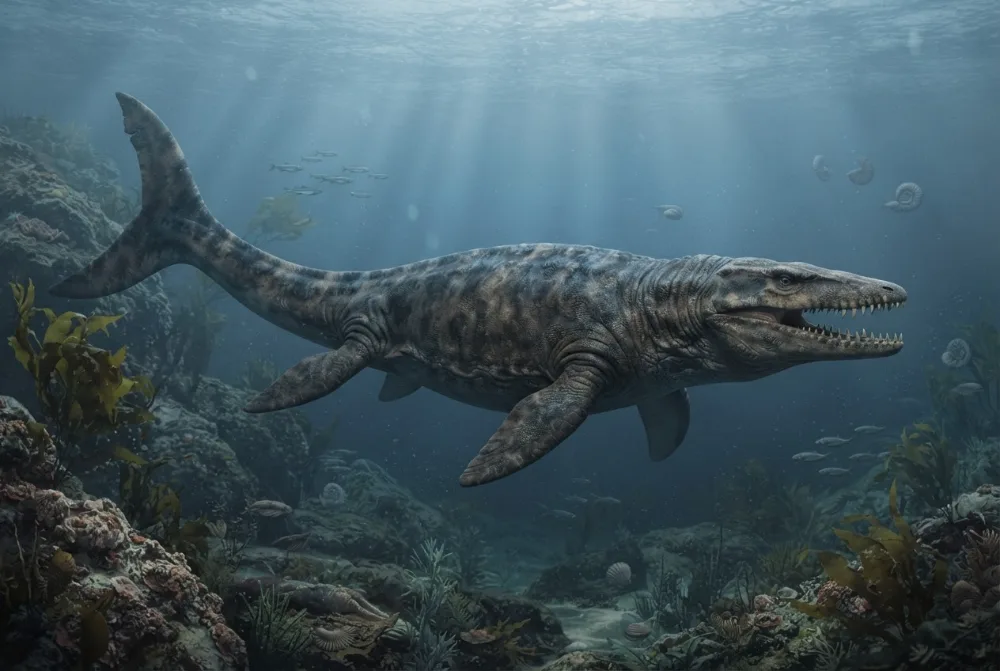
Kaikaifilu was a giant marine lizard that swam in the cold seas near Antarctica 66 million years ago. It was one of the biggest mosasaurs in the Southern Hemisphere, with a skull as long as a tall child!1
E phetse neng?
E ne e le kgolo hakae?
E ne e le telele hakae?
 telele jwaloka dikoloi tse 2 tse pakilweng ka mola🍌telele jwaloka dibanana tse 56 di behilwe ka mola🏊e ne e ka sesa bolelele ba letamo le leholo la ho sesa (50 m) ka metsotswana e 5.5
Kaikaifilu e ne e le kgolo hakae ha e bapiswa le WENA?
Ke dipalo feela ho browser ya hao. Ha ho letho le bolokwang kapa le romelwang kae kapa kae.
E ne e le lebelo hakae?


Dintlha tse monate
Kaikaifilu had different types of teeth in its mouth, which is rare for mosasaurs. This is called heterodont dentition.1
Its skull was about 1.1 to 1.2 metres long, almost twice as long as the skull of another Antarctic mosasaur called Taniwhasaurus antarcticus.1
Kaikaifilu lived in waters that could be as cold as 6 °C, and sometimes the sea surface temperature dropped below freezing.1
It lived right at the end of the Age of Dinosaurs, during the Cretaceous-Paleogene extinction event, and was one of the last mosasaurs to exist.1
The only known fossil of Kaikaifilu is a partial skull and a humerus (upper arm bone), found in 2011 by a Chilean expedition.2
Scientists think Kaikaifilu might belong to the Tylosaurinae group, but some features make this uncertain.1
Dipotso tse botswang haholo ka Kaikaifilu
?How big was Kaikaifilu?
About 10 metres long, making it the largest mosasaur known from the Southern Hemisphere.13
?What did Kaikaifilu eat?
It was an apex predator that ate fish, plesiosaurs, other mosasaurs, and filter-feeding marine reptiles.13
?When did Kaikaifilu live?
It lived about 66 million years ago, right at the end of the Age of Dinosaurs, during the Cretaceous-Paleogene extinction event.13
?Where was Kaikaifilu found?
Its fossil was found on Seymour Island in Antarctica, by a Chilean expedition in 2011.1
?Why did Kaikaifilu have different teeth?
It had different types of teeth (heterodont dentition), which is rare for mosasaurs and helped it eat a variety of prey.1
Bakeng sa ditsebi tsa didinosaure
- Lebitso la saense
- Kaikaifilu
- E rehilwe ke
- Otero et al. 20174
- Sehlopha
- Dimosasaure
- Lelapa / leloko
- Mosasauridae4
- Tlhophiso
- Mosasauroidea4
- Dilemo tsa mafika
- dilemo tse dimilione tse 72 ho isa ho 66 (Maastrichtian)4
- Dibopeho tsa mafika
- Lopez de Bertodano4
- Dinaha
- Antaraktika4
- Direkoto tsa difosili
- 1 ho The Paleobiology Database4
- Ho sibollwa
- Kaikaifilu was named in 2017 by Rodrigo Otero and colleagues, based on a fossil found in January 2011 on Seymour Island, Antarctica, by a Chilean expedition.42
- E sa ntse e phehwa kgang
- Scientists are not sure if Kaikaifilu truly belongs to the Tylosaurinae group, because some of its features are different from other tylosaurines.1
Moo dintlha di tswang teng
- Kaikaifilu (en.wikipedia.org)
- Kaikaifilu hervei gen. et sp. nov., a new large mosasaur (Squamata, Mosasauridae) from the upper Maastrichtian of Antarctica (sciencedirect.com)
- A giant predatory lizard swam in Antarctic seas near the end of the dinosaur age | ScienceDaily (sciencedaily.com)
- Kaikaifilu in The Paleobiology Database (CC BY 4.0): dilemo, dibaka, dibopeho tsa mafika, tlhophiso.
Ntlha e nngwe le e nngwe leqepheng lena e na le nomoro e supang mohlodi wa yona. Haeba re fositse ho hong, re kopa tshwarelo, re balatedi ba didinosaure, ha re koranta ya saense. Re bolelle ho [email protected] mme re tla e lokisa.
 Rex o lapile! Dino Wiki ke projeke ya ntate bakeng sa mora wa hae ya ratang didinosaure, ke mahala, ha ho dipapatso, ha ho disebedi. Batho ba baholo ba ka fepa Rex seneke ho thusa hore e dule e le inthaneteng.Fepa Rex
 Mosasaurus
 Prognathodon
 Tylosaurus
 Platecarpus
 Clidastes
 Globidens
 Tyrannosaurus
 Triceratops
 Velociraptor
 Spinosaurus
 Ankylosaurus
 Parasaurolophus