 Kwisi: O dinosaure efe?
 Ntwa ya didinosaure
 Peiso ya didinosaure
 Dipapadi tse nyane tsa didinosaure
 Albamo ya ditikara
 Manane a TOP a didinosaure
 Nkgethele!
Khinjaria
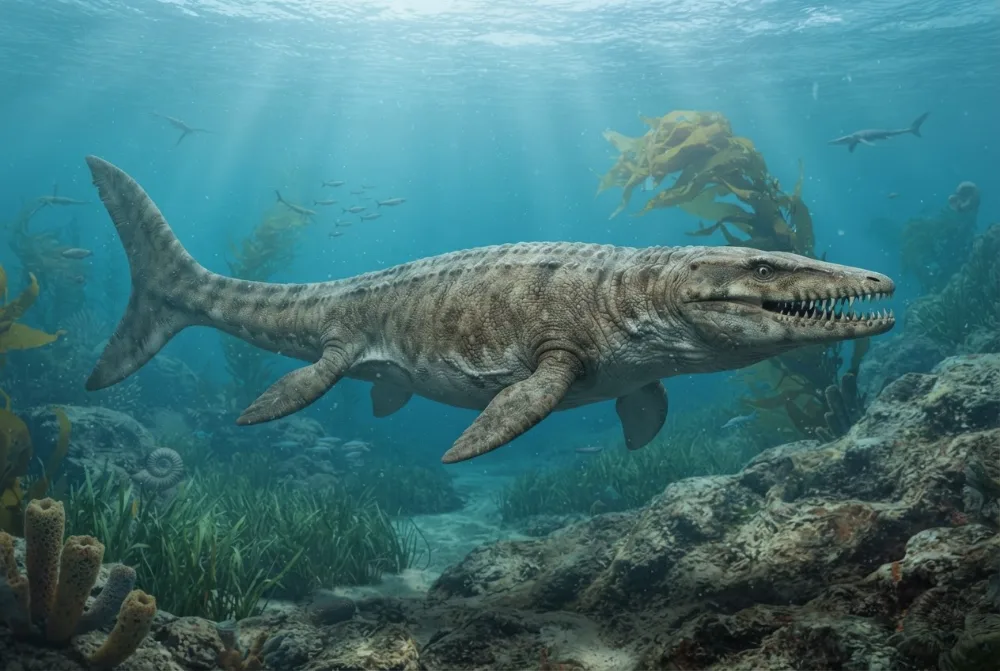
Khinjaria was a giant marine lizard that lived in the sea near Africa. It had huge, blade-like teeth and a short, powerful jaw to grab big prey.12
E phetse neng?
E ne e le kgolo hakae?
E ne e le telele hakae?
 telele jwaloka dintja tse 8 ho tloha nkong ho isa mohatleng🍌telele jwaloka dibanana tse 44 di behilwe ka mola🏊e ne e ka sesa bolelele ba letamo le leholo la ho sesa (50 m) ka metsotswana e 5
Khinjaria e ne e le kgolo hakae ha e bapiswa le WENA?
Ke dipalo feela ho browser ya hao. Ha ho letho le bolokwang kapa le romelwang kae kapa kae.
E ne e le lebelo hakae?


Dintlha tse monate
Khinjaria's name comes from an Arabic word for dagger, because of its sharp, blade-like teeth.1
Its skull bones were tightly fused together, making its bite very powerful.1
Khinjaria lived at the very end of the Age of Dinosaurs, about 72 to 66 million years ago.4
It was about 8 metres (26 feet) long, as long as a big bus.1
Scientists think Khinjaria was an apex predator, meaning it was at the top of the food chain in its ocean.2
Dipotso tse botswang haholo ka Khinjaria
?Was Khinjaria a dinosaur?
No, Khinjaria was not a dinosaur. It was a giant marine lizard called a mosasaur, related to today's Komodo dragons.3
Bakeng sa ditsebi tsa didinosaure
- Lebitso la saense
- Khinjaria
- E rehilwe ke
- Longrich et al. 20244
- Sehlopha
- Dimosasaure
- Lelapa / leloko
- Mosasauridae4
- Tlhophiso
- Mosasauroidea4
- Dilemo tsa mafika
- dilemo tse dimilione tse 72 ho isa ho 66 (Maastrichtian)4
- Dibopeho tsa mafika
- Couche III4
- Dinaha
- Moroko4
- Direkoto tsa difosili
- 1 ho The Paleobiology Database4
- Ho sibollwa
- Khinjaria was named in 2024 by Nicholas Longrich and colleagues based on a partial skull and a vertebra found in Morocco.14
- E sa ntse e phehwa kgang
- Scientists are still debating exactly how Khinjaria used its unusual short, powerful jaws and dagger-like teeth compared to other mosasaurs.2
Moo dintlha di tswang teng
- Khinjaria (en.wikipedia.org)
- A bizarre new plioplatecarpine mosasaurid from the Maastrichtian of Morocco - the University of Bath's research portal (researchportal.bath.ac.uk)
- Fossils of giant sea lizard show how our oceans have fundamentally changed since the dinosaur era (bath.ac.uk)
- Khinjaria in The Paleobiology Database (CC BY 4.0): dilemo, dibaka, dibopeho tsa mafika, tlhophiso.
Ntlha e nngwe le e nngwe leqepheng lena e na le nomoro e supang mohlodi wa yona. Haeba re fositse ho hong, re kopa tshwarelo, re balatedi ba didinosaure, ha re koranta ya saense. Re bolelle ho [email protected] mme re tla e lokisa.
 Rex o lapile! Dino Wiki ke projeke ya ntate bakeng sa mora wa hae ya ratang didinosaure, ke mahala, ha ho dipapatso, ha ho disebedi. Batho ba baholo ba ka fepa Rex seneke ho thusa hore e dule e le inthaneteng.Fepa Rex
 Mosasaurus
 Prognathodon
 Tylosaurus
 Platecarpus
 Clidastes
 Globidens
 Tyrannosaurus
 Triceratops
 Velociraptor
 Spinosaurus
 Ankylosaurus
 Parasaurolophus