 Kwisi: O dinosaure efe?
 Ntwa ya didinosaure
 Peiso ya didinosaure
 Dipapadi tse nyane tsa didinosaure
 Albamo ya ditikara
 Manane a TOP a didinosaure
 Nkgethele!
E phetse neng?

E ne e le kgolo hakae?
E ne e le telele hakae?
E ne e phahame hakae?
kakanyo
E ne e le boima hakae?
 telele jwaloka dikoloi tse 2 tse pakilweng ka mola🍌telele jwaloka dibanana tse 56 di behilwe ka mola
 e batla e le boima jwaloka tlou🍉boima jwaloka mahapu a 1000🎒boima jwaloka ditlelase tse feletseng tse 6 tsa bana ba sekolo🐻❄️boima jwaloka dibere tse tshweu tse 11🏃e ne e ka matha dimitara tse 100 ka metsotswana e 13 (motho ya lebelo ka ho fetisisa o hloka 9,6)
Maip e ne e le kgolo hakae ha e bapiswa le WENA?
Ke dipalo feela ho browser ya hao. Ha ho letho le bolokwang kapa le romelwang kae kapa kae.
E ne e le lebelo hakae?


Dintlha tse monate
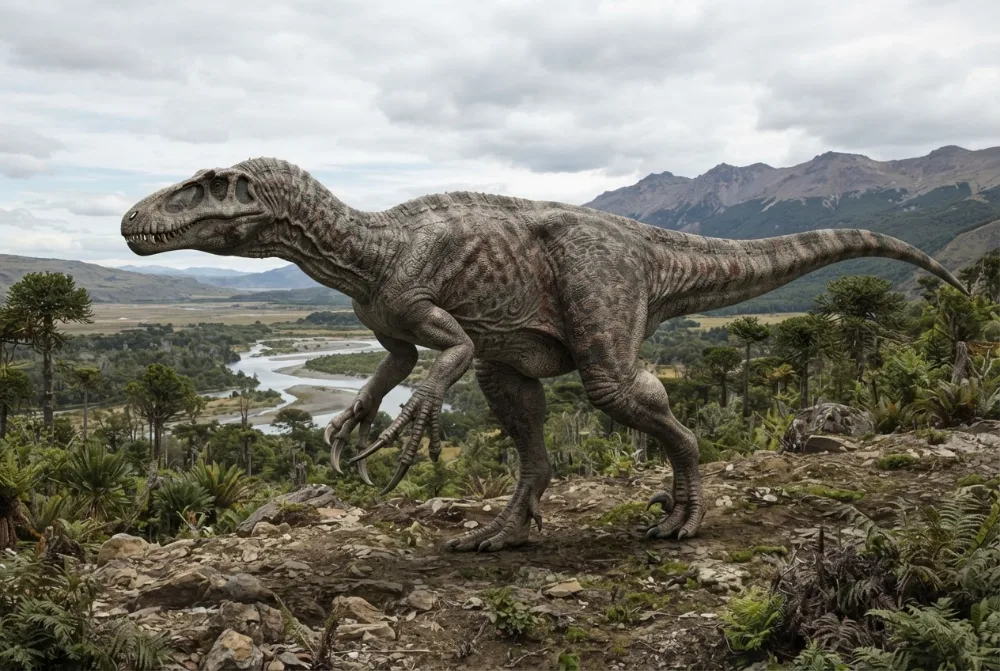
Maip is the biggest megaraptorid dinosaur ever found, reaching about 9 to 10 metres long.1
Its name comes from a monster in the mythology of the Aonikenk people that kills with cold wind.1
Maip had a very wide chest, more than 1.2 metres across, which is why its species name is 'macrothorax' meaning 'big chest'.1
It lived near the end of the Age of Dinosaurs, about 72 to 66 million years ago.6
Maip is known from a partial skeleton including many back bones, ribs, and part of the shoulder.1
Its teeth were short, strongly curved, and shaped like an '8' in cross-section.2
Dipotso tse botswang haholo ka Maip
?How big was Maip?
Maip was about 9 to 10 metres (30 to 33 feet) long and weighed over 1.3 metric tons (1.4 short tons). It is the largest known megaraptorid.54
?What did Maip eat?
Maip was a meat-eater. It used its long arms and 35-centimetre-long claws to grab and tear apart its prey, and its teeth were sharp but small.4
?When did Maip live?
Maip lived near the end of the Age of Dinosaurs, about 72 to 66 million years ago, during the Late Cretaceous period.5
?Where was Maip found?
Maip's fossils were discovered on a farm called La Anita, about 30 kilometres west of El Calafate in Santa Cruz, Argentina.5
?Why is it called Maip?
Maip is named after a monster from Aonikenk mythology that kills with cold wind. The name was chosen because the dinosaur lived in a cold, mountainous area.54
?Did Maip have feathers?
No direct feather fossils have been found for Maip, but it is a coelurosaur, a group that includes feathered dinosaurs. Scientists are not sure if it had feathers.5
?Was Maip bigger than T. rex?
No, Maip was smaller than T. rex. T. rex could reach about 12 metres (40 feet) long and weigh over 8 metric tons, while Maip was about 9 to 10 metres long and weighed over 1.3 metric tons.5
?How fast could Maip run?
Scientists do not know exactly how fast Maip could run, but its long legs and light, hollow bones suggest it was a relatively agile predator.4
Bakeng sa ditsebi tsa didinosaure
- Lebitso la saense
- Maip
- E rehilwe ke
- Aranciaga Rolando et al. 20226
- Sehlopha
- Didinosaure tse jang nama
- Lelapa / leloko
- Megaraptoridae6
- Tlhophiso
- Theropoda > Megaraptora6
- Dilemo tsa mafika
- dilemo tse dimilione tse 72 ho isa ho 66 (Maastrichtian)6
- Dibopeho tsa mafika
- Chorrillo6
- Dinaha
- Argentina6
- Direkoto tsa difosili
- 1 ho The Paleobiology Database6
- Ho sibollwa
- Maip was named in 2022 by a team of scientists led by Alexis Aranciaga Rolando. The fossils were found at La Anita Farm in southern Argentina.61
- E sa ntse e phehwa kgang
- Scientists are not sure whether megaraptorids like Maip are more closely related to allosauroids or to coelurosaurs.2
Moo dintlha di tswang teng
- A large Megaraptoridae (Theropoda: Coelurosauria) from Upper Cretaceous (Maastrichtian) of Patagonia, Argentina (dinodata.de)
- A large Megaraptoridae (Theropoda: Coelurosauria) from Upper Cretaceous (Maastrichtian) of Patagonia, Argentina - PubMed (pubmed.ncbi.nlm.nih.gov)
- Maip (Wikipedia) (Wikipedia)
- Maip: the huge carnivorous predator that was one of the last dinosaurs before extinction | CONICET (conicet.gov.ar)
- Maip (en.wikipedia.org)
- Maip in The Paleobiology Database (CC BY 4.0): dilemo, dibaka, dibopeho tsa mafika, tlhophiso.
Ntlha e nngwe le e nngwe leqepheng lena e na le nomoro e supang mohlodi wa yona. Haeba re fositse ho hong, re kopa tshwarelo, re balatedi ba didinosaure, ha re koranta ya saense. Re bolelle ho [email protected] mme re tla e lokisa.
 Rex o lapile! Dino Wiki ke projeke ya ntate bakeng sa mora wa hae ya ratang didinosaure, ke mahala, ha ho dipapatso, ha ho disebedi. Batho ba baholo ba ka fepa Rex seneke ho thusa hore e dule e le inthaneteng.Fepa Rex
 Allosaurus
 Carnotaurus
 Dilophosaurus
 Giganotosaurus
 Compsognathus
 Paronychodon
 Tyrannosaurus
 Triceratops
 Velociraptor
 Spinosaurus
 Ankylosaurus
 Parasaurolophus