 Kwisi: O dinosaure efe?
 Ntwa ya didinosaure
 Peiso ya didinosaure
 Dipapadi tse nyane tsa didinosaure
 Albamo ya ditikara
 Manane a TOP a didinosaure
 Nkgethele!
Malawania
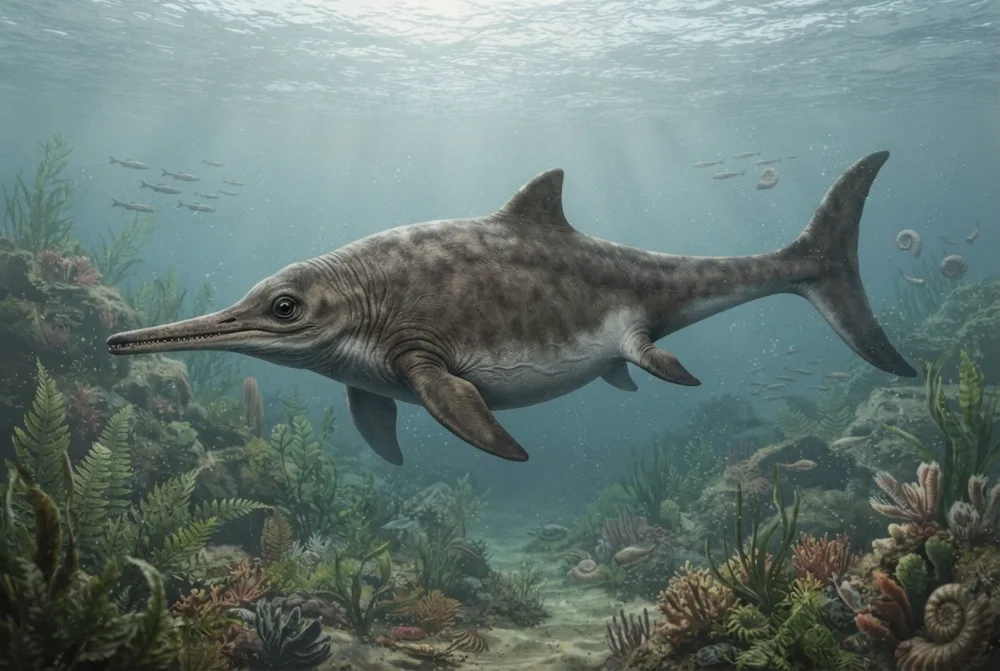
Malawania was a small ichthyosaur that lived in the Early Cretaceous seas. It looked a bit like a dolphin, with flippers instead of legs and a long snout. It is special because it was one of the last ichthyosaurs that did not belong to the ophthalmosaurid group.12
E phetse neng?
E ne e le kgolo hakae?
E ne e le telele hakae?
 telele jwaloka dintja tse 3 ho tloha nkong ho isa mohatleng🍌telele jwaloka dibanana tse 17 di behilwe ka mola🏊e ne e ka sesa bolelele ba letamo le leholo la ho sesa (50 m) ka metsotswana e 3.8
Malawania e ne e le kgolo hakae ha e bapiswa le WENA?
Ke dipalo feela ho browser ya hao. Ha ho letho le bolokwang kapa le romelwang kae kapa kae.
E ne e le lebelo hakae?


Dintlha tse monate
Malawania is the first non-ophthalmosaurid ichthyosaur known from after the Jurassic,Cretaceous boundary, meaning it survived a time when most of its relatives had died out.1
Its scientific name means 'out-of-time swimmer' because it seemed to belong to an earlier time period.1
The only fossil of Malawania was found in 1952, but scientists did not know its age until 2013 when they studied tiny fossils called palynomorphs in the rock.2
Malawania had a short, trapezoid-shaped humerus (upper arm bone) and an intermedium bone in its flipper that was almost as big as the radius.2
Its forefin had four main fingers and no extra digits, unlike many later ichthyosaurs.2
The fossil was found in Iraq, which is the first post-Triassic ichthyosaur ever reported from the Middle East.2
Dipotso tse botswang haholo ka Malawania
?How big was Malawania?
About 3 metres (9.8 feet) long. That is roughly as long as a small car.1
?What did Malawania eat?
Scientists are not sure exactly, but like other ichthyosaurs it probably ate fish and squid. Its long snout and sharp teeth were good for catching slippery prey.1
?When did Malawania live?
It lived during the Early Cretaceous period, about 130 to 125 million years ago. That is after most of its relatives had already died out.12
?Where was Malawania found?
The only fossil was discovered in 1952 in Iraqi Kurdistan, near the town of Amadia. It is the first post-Triassic ichthyosaur ever found in the Middle East.1
Bakeng sa ditsebi tsa didinosaure
- Lebitso la saense
- Malawania
- E rehilwe ke
- Fischer et al. 20133
- Sehlopha
- Diikhthiosaure
- Lelapa / leloko
- Thunnosauria3
- Tlhophiso
- Ichthyosauria > Ichthyosauromorpha3
- Dilemo tsa mafika
- dilemo tse dimilione tse 133 ho isa ho 121 (Hauterivian / Barremian)3
- Dinaha
- Iraq3
- Direkoto tsa difosili
- 1 ho The Paleobiology Database3
- Ho sibollwa
- The only known fossil of Malawania was discovered in 1952 near Amadia in Iraq. It was named Malawania anachronus by Fischer and colleagues in 2013.12
- E sa ntse e phehwa kgang
- Scientists are still debating exactly how Malawania is related to other ichthyosaurs, because it has a mix of ancient and modern features.2
Moo dintlha di tswang teng
- Malawania (en.wikipedia.org)
- biblio.naturalsciences.be (biblio.naturalsciences.be)
- Malawania in The Paleobiology Database (CC BY 4.0): dilemo, dibaka, dibopeho tsa mafika, tlhophiso.
Ntlha e nngwe le e nngwe leqepheng lena e na le nomoro e supang mohlodi wa yona. Haeba re fositse ho hong, re kopa tshwarelo, re balatedi ba didinosaure, ha re koranta ya saense. Re bolelle ho [email protected] mme re tla e lokisa.
 Rex o lapile! Dino Wiki ke projeke ya ntate bakeng sa mora wa hae ya ratang didinosaure, ke mahala, ha ho dipapatso, ha ho disebedi. Batho ba baholo ba ka fepa Rex seneke ho thusa hore e dule e le inthaneteng.Fepa Rex
 Ichthyosaurus
 Platypterygius
 Stenopterygius
 Khudiakovia
 Ophthalmosaurus
 Chonespondylus
 Stegosaurus
 Iguanodon
 Archaeopteryx
 Giganotosaurus
 Microraptor
 Deinonychus