 Kwisi: O dinosaure efe?
 Ntwa ya didinosaure
 Peiso ya didinosaure
 Dipapadi tse nyane tsa didinosaure
 Albamo ya ditikara
 Manane a TOP a didinosaure
 Nkgethele!
Megapterygius
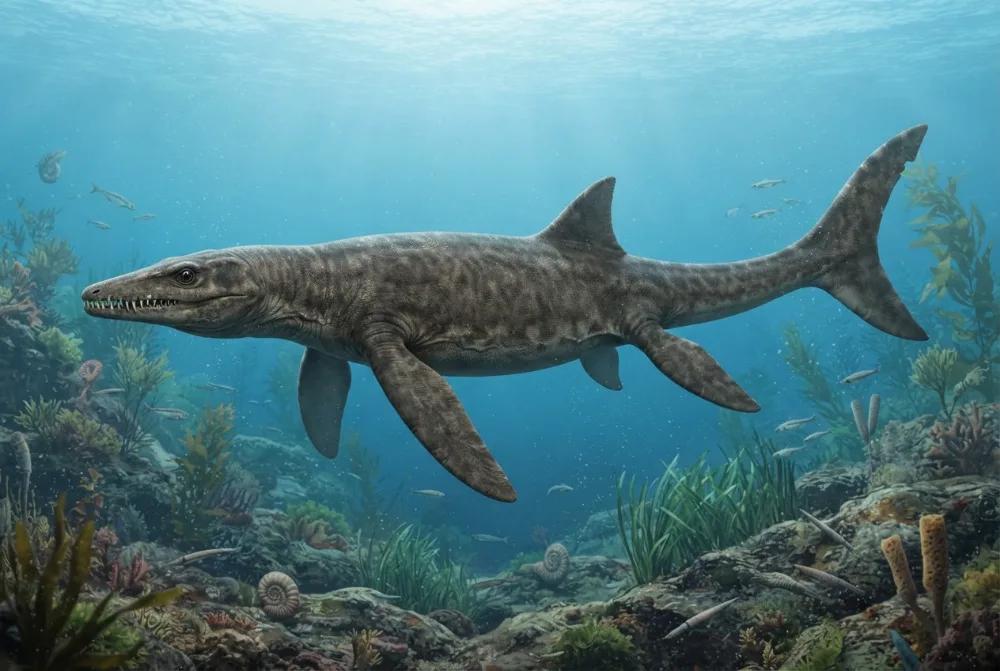
Megapterygius was a huge marine lizard that swam in the seas around Japan 72 million years ago. It had enormous flippers that were longer than its head, and scientists think it even had a dorsal fin like a shark!12
E phetse neng?
E ne e le kgolo hakae?
E ne e le telele hakae?
E ne e le boima hakae?
 telele jwaloka dintja tse 6 ho tloha nkong ho isa mohatleng🍌telele jwaloka dibanana tse 33 di behilwe ka mola🍉boima jwaloka mahapu a 90🧸boima jwaloka bana ba kereshe ba 24🎒boima jwaloka bana ba sekolo ba 14🏊e ne e ka sesa bolelele ba letamo le leholo la ho sesa (50 m) ka metsotswana e 4.7
Megapterygius e ne e le kgolo hakae ha e bapiswa le WENA?
Ke dipalo feela ho browser ya hao. Ha ho letho le bolokwang kapa le romelwang kae kapa kae.
E ne e le lebelo hakae?


Dintlha tse monate
Megapterygius had rear flippers that were even longer than its front flippers, a feature only seen in one other mosasaur, Tylosaurus.1
Its flippers were longer than its skull, which is unique among mosasaurs with paddle-like limbs.1
The shape of its backbone suggests it had a dorsal fin, like a dolphin or shark, which would have helped it turn quickly in the water.12
Its skull was slightly wide around the eye sockets, giving it binocular vision that helped it hunt prey. This is only the second mosasaur known to have this ability.1
The fossil was found in 2006 by Akihiro Misaki, who was actually looking for ammonite fossils when he spotted a vertebra.12
More than 100 shark teeth were found around the Megapterygius skeleton, suggesting that sharks scavenged its body after it died.1
Megapterygius is the most complete mosasaur skeleton ever found in Japan or the northwestern Pacific.2
Dipotso tse botswang haholo ka Megapterygius
?How big was Megapterygius?
Megapterygius was about 6 metres long, with a skull about 0.8 metres long. That is roughly the size of a large great white shark.12
?Did Megapterygius have a dorsal fin?
Scientists think it did. The shape of its backbone is like that of dolphins and porpoises, which have dorsal fins, and this would have helped it turn quickly in the water. It's the first mosasaur with evidence of a dorsal fin.12
?What did Megapterygius eat?
Scientists think it hunted large groups of small prey, like schools of fish. Its binocular vision and big flippers would have helped it catch them.1
Bakeng sa ditsebi tsa didinosaure
- Lebitso la saense
- Megapterygius
- E rehilwe ke
- Konishi et al. 20234
- Sehlopha
- Dimosasaure
- Lelapa / leloko
- Mosasauridae4
- Tlhophiso
- Mosasauroidea4
- Dilemo tsa mafika
- dilemo tse dimilione tse 84 ho isa ho 66 (Campanian / Maastrichtian)4
- Dibopeho tsa mafika
- Toyajo4
- Dinaha
- Japane4
- Direkoto tsa difosili
- 1 ho The Paleobiology Database4
- Ho sibollwa
- The fossil was discovered in 2006 by Akihiro Misaki in Wakayama Prefecture, Japan. It was named Megapterygius wakayamaensis by Takuya Konishi and colleagues in 2023.12
- E sa ntse e phehwa kgang
- Scientists are still debating how Megapterygius used its four large flippers and tail fin together for swimming, since no modern animal has a similar body shape.2
Moo dintlha di tswang teng
- Megapterygius (en.wikipedia.org)
- UC paleontologist describes Wakayama 'blue dragon' that ruled prehistoric waters off Japan - University of Cincinnati: Founder of Co-op, Leader in Co-op | University of Cincinnati (uc.edu)
- Megapterygius | Dino Encyclopedia (dinosaurmuseum.jp)
- Megapterygius in The Paleobiology Database (CC BY 4.0): dilemo, dibaka, dibopeho tsa mafika, tlhophiso.
Ntlha e nngwe le e nngwe leqepheng lena e na le nomoro e supang mohlodi wa yona. Haeba re fositse ho hong, re kopa tshwarelo, re balatedi ba didinosaure, ha re koranta ya saense. Re bolelle ho [email protected] mme re tla e lokisa.
 Rex o lapile! Dino Wiki ke projeke ya ntate bakeng sa mora wa hae ya ratang didinosaure, ke mahala, ha ho dipapatso, ha ho disebedi. Batho ba baholo ba ka fepa Rex seneke ho thusa hore e dule e le inthaneteng.Fepa Rex
 Mosasaurus
 Prognathodon
 Tylosaurus
 Platecarpus
 Clidastes
 Globidens
 Tyrannosaurus
 Triceratops
 Velociraptor
 Spinosaurus
 Ankylosaurus
 Parasaurolophus