 Kwisi: O dinosaure efe?
 Ntwa ya didinosaure
 Peiso ya didinosaure
 Dipapadi tse nyane tsa didinosaure
 Albamo ya ditikara
 Manane a TOP a didinosaure
 Nkgethele!
Pervushovisaurus
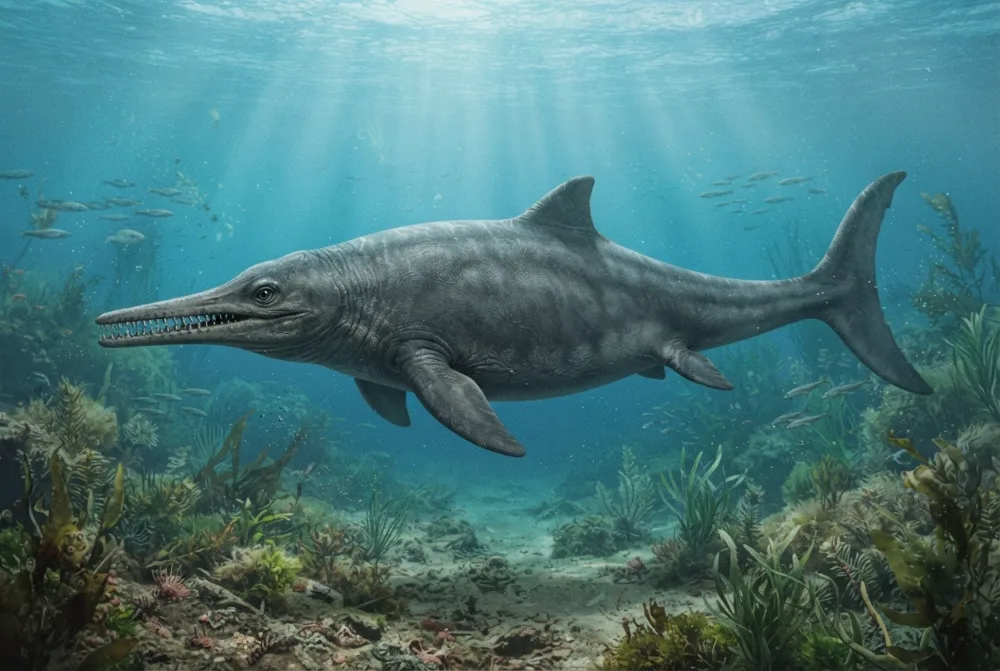
Pervushovisaurus was a fast-swimming marine reptile that looked like a dolphin with a long snout full of sharp teeth. It lived in the seas that covered Europe during the time of the dinosaurs, about 113 to 94 million years ago.31
E phetse neng?
E ne e le kgolo hakae?
E ne e le telele hakae?
 telele jwaloka dintja tse 6 ho tloha nkong ho isa mohatleng🍌telele jwaloka dibanana tse 32 di behilwe ka mola🏊e ne e ka sesa bolelele ba letamo le leholo la ho sesa (50 m) ka metsotswana e 4.1
Pervushovisaurus e ne e le kgolo hakae ha e bapiswa le WENA?
Ke dipalo feela ho browser ya hao. Ha ho letho le bolokwang kapa le romelwang kae kapa kae.
E ne e le lebelo hakae?


Dintlha tse monate
Pervushovisaurus was first thought to be a type of Platypterygius, but scientists later decided it was different enough to be its own genus.1
This ichthyosaur had a straight snout, unlike some of its relatives that had curved jaws.1
Its teeth had square roots with sharp 90-degree angles, which is unusual for an ichthyosaur.1
One species, Pervushovisaurus campylodon, was originally named Ichthyosaurus campylodon in 1846.1
Pervushovisaurus lived during the Cretaceous period, at the same time as dinosaurs like Tyrannosaurus and Triceratops, but in the ocean.3
Fossils of Pervushovisaurus have been found in the Melovatka Formation in Russia and the La Penthiève Beds in France.1
Like other ichthyosaurs, Pervushovisaurus gave birth to live young, not laying eggs on land.2
Dipotso tse botswang haholo ka Pervushovisaurus
?How big was Pervushovisaurus?
It was a medium-sized ichthyosaur, measuring about 5.8 metres (19 feet) long.1
?What did Pervushovisaurus eat?
It was a carnivore that ate fish and other sea creatures, using its long snout full of sharp teeth to catch prey.3
?Where did Pervushovisaurus live?
It lived in the seas that covered Europe during the Cretaceous period, and its fossils have been found in Russia, France, and the United Kingdom.1
?Is Pervushovisaurus a dinosaur?
No, it is not a dinosaur. It is an ichthyosaur, a marine reptile that lived in the ocean at the same time as dinosaurs.1
Bakeng sa ditsebi tsa didinosaure
- Lebitso la saense
- Pervushovisaurus
- E rehilwe ke
- Arkhangelsky 19983
- Sehlopha
- Diikhthiosaure
- Lelapa / leloko
- Ophthalmosauridae3
- Tlhophiso
- Ichthyosauria > Ichthyosauromorpha3
- Dilemo tsa mafika
- dilemo tse dimilione tse 113 ho isa ho 94 (Albian / Cenomanian)3
- Dibopeho tsa mafika
- West Melbury Marly Chalk, Melovatskaya, La Penthiève Beds3
- Dinaha
- Fora, United Kingdom, Russia, Jeremane3
- Direkoto tsa difosili
- 14 ho The Paleobiology Database3
- Ho sibollwa
- The genus Pervushovisaurus was named by Russian paleontologist M. S. Arkhangelsky in 1998, based on a partial skull from the Saratov region of Russia.13
- E sa ntse e phehwa kgang
- Scientists are still debating whether the two species Pervushovisaurus bannovkensis and Pervushovisaurus campylodon are truly distinct or if they represent the same animal.1
Moo dintlha di tswang teng
- Pervushovisaurus (en.wikipedia.org)
- PBDB Taxon (paleobiodb.org)
- Pervushovisaurus in The Paleobiology Database (CC BY 4.0): dilemo, dibaka, dibopeho tsa mafika, tlhophiso.
Ntlha e nngwe le e nngwe leqepheng lena e na le nomoro e supang mohlodi wa yona. Haeba re fositse ho hong, re kopa tshwarelo, re balatedi ba didinosaure, ha re koranta ya saense. Re bolelle ho [email protected] mme re tla e lokisa.
 Rex o lapile! Dino Wiki ke projeke ya ntate bakeng sa mora wa hae ya ratang didinosaure, ke mahala, ha ho dipapatso, ha ho disebedi. Batho ba baholo ba ka fepa Rex seneke ho thusa hore e dule e le inthaneteng.Fepa Rex
 Ichthyosaurus
 Platypterygius
 Stenopterygius
 Khudiakovia
 Ophthalmosaurus
 Chonespondylus
 Stegosaurus
 Iguanodon
 Archaeopteryx
 Giganotosaurus
 Microraptor
 Deinonychus