 Kwisi: O dinosaure efe?
 Ntwa ya didinosaure
 Peiso ya didinosaure
 Dipapadi tse nyane tsa didinosaure
 Albamo ya ditikara
 Manane a TOP a didinosaure
 Nkgethele!
Simbirskiasaurus
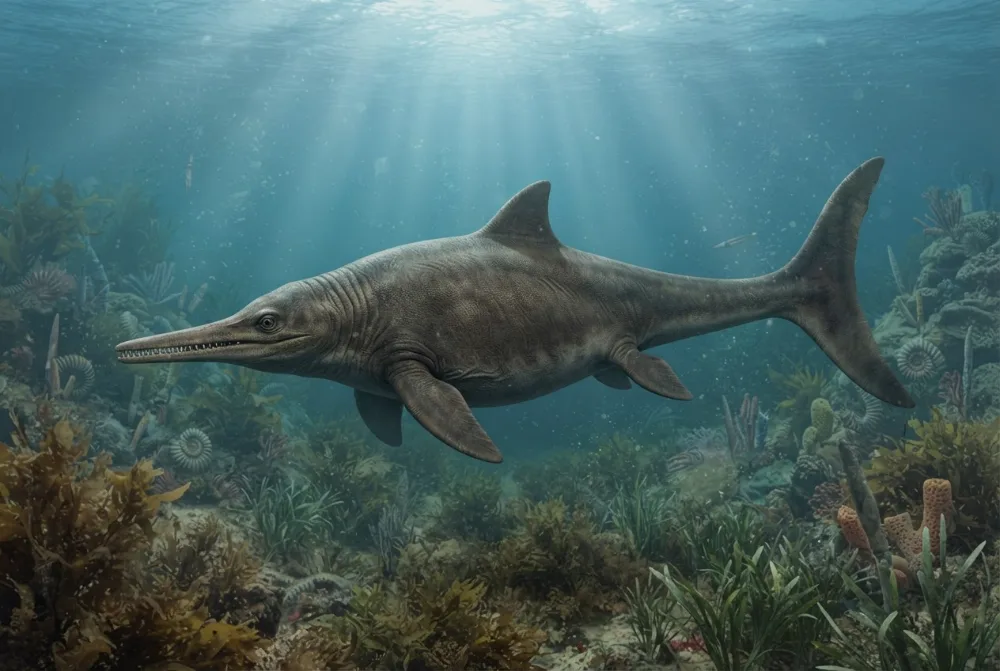
Simbirskiasaurus was a fast-swimming marine reptile that lived in the Early Cretaceous seas. It had a long snout and sharp teeth for catching fish and squid. This ichthyosaur was not a dinosaur, but a reptile that breathed air like a dolphin.31
E phetse neng?
E ne e le kgolo hakae?
E ne e le telele hakae?
 telele jwaloka dintja tse 5 ho tloha nkong ho isa mohatleng🍌telele jwaloka dibanana tse 28 di behilwe ka mola🏊e ne e ka sesa bolelele ba letamo le leholo la ho sesa (50 m) ka metsotswana e 3.9
Simbirskiasaurus e ne e le kgolo hakae ha e bapiswa le WENA?
Ke dipalo feela ho browser ya hao. Ha ho letho le bolokwang kapa le romelwang kae kapa kae.
E ne e le lebelo hakae?


Dintlha tse monate
Simbirskiasaurus had a divided nostril opening, with a bony pillar separating it into two parts. This is a rare feature among ichthyosaurs.1
Its skull bones show deep interlocking joints between the prefrontal and lacrimal bones, similar to the much older ichthyosaur Temnodontosaurus.1
The only known fossil is a partial skull and backbone, found in clay from the Simbirskites Clay formation.13
Scientists once thought Simbirskiasaurus was a doubtful name, but a 2014 study confirmed it is a valid genus of platypterygiine ichthyosaur.2
It lived about 130 million years ago, during the early Barremian stage of the Early Cretaceous.1
Mosenyi wa ditshomo
Tshomo: Simbirskiasaurus is a dinosaur.
Nnete: Simbirskiasaurus is an ichthyosaur, a marine reptile that lived in the ocean and was not a dinosaur.1
Bakeng sa ditsebi tsa didinosaure
- Lebitso la saense
- Simbirskiasaurus
- E rehilwe ke
- Otschev and Efimov 19853
- Sehlopha
- Diikhthiosaure
- Lelapa / leloko
- Ophthalmosauridae3
- Tlhophiso
- Ichthyosauria > Ichthyosauromorpha3
- Dilemo tsa mafika
- dilemo tse dimilione tse 126 ho isa ho 121 (Barremian)3
- Dibopeho tsa mafika
- Simbirskites Clay3
- Dinaha
- Russia3
- Direkoto tsa difosili
- 1 ho The Paleobiology Database3
- Ho sibollwa
- Simbirskiasaurus was named by Russian paleontologists V. G. Otschev and V. M. Efimov in 1985, based on a fragmentary skull and backbone found near the Volga River in Russia.31
- E sa ntse e phehwa kgang
- Scientists are not sure about the exact size of Simbirskiasaurus because only a partial skull and backbone have been found.1
Moo dintlha di tswang teng
- Simbirskiasaurus (en.wikipedia.org)
- Simbirskiasaurus and Pervushovisaurus reassessed: implications for the taxonomy and cranial osteology of Cretaceous platypterygiine ichthyosaurs - Fischer - 2014 - Zoological Journal of the Linnean Society - Wiley Online Library (onlinelibrary.wiley.com)
- Simbirskiasaurus in The Paleobiology Database (CC BY 4.0): dilemo, dibaka, dibopeho tsa mafika, tlhophiso.
Ntlha e nngwe le e nngwe leqepheng lena e na le nomoro e supang mohlodi wa yona. Haeba re fositse ho hong, re kopa tshwarelo, re balatedi ba didinosaure, ha re koranta ya saense. Re bolelle ho [email protected] mme re tla e lokisa.
 Rex o lapile! Dino Wiki ke projeke ya ntate bakeng sa mora wa hae ya ratang didinosaure, ke mahala, ha ho dipapatso, ha ho disebedi. Batho ba baholo ba ka fepa Rex seneke ho thusa hore e dule e le inthaneteng.Fepa Rex
 Ichthyosaurus
 Platypterygius
 Stenopterygius
 Khudiakovia
 Ophthalmosaurus
 Chonespondylus
 Stegosaurus
 Iguanodon
 Archaeopteryx
 Giganotosaurus
 Microraptor
 Deinonychus