 Kwisi: O dinosaure efe?
 Ntwa ya didinosaure
 Peiso ya didinosaure
 Dipapadi tse nyane tsa didinosaure
 Albamo ya ditikara
 Manane a TOP a didinosaure
 Nkgethele!
Sisteronia
Sisteronia was a fast-swimming marine reptile that lived in the Cretaceous seas. It had sharp teeth for catching small fish and squid. Sisteronia was an ichthyosaur, not a dinosaur, and looked a bit like a modern dolphin.12
E phetse neng?
E ne e le lebelo hakae?


Dintlha tse monate
Sisteronia had teeth that were rectangular in cross-section, which is unusual among ichthyosaurs.2
It lived during the Albian and early Cenomanian stages of the Cretaceous, about 112 to 100 million years ago.2
Sisteronia is known from fossils found in England, France, and Russia, showing it lived in the seas of western Europe.3
This ichthyosaur belonged to the group Platypterygiinae, which were the last surviving ichthyosaurs before they went extinct.2
The name Sisteronia comes from the town of Sisteron in France, near where some of its fossils were found.1
Sisteronia had a raised process on the floor of the foramen magnum (the hole in the skull for the spinal cord), a unique feature not seen in other ichthyosaurs.2
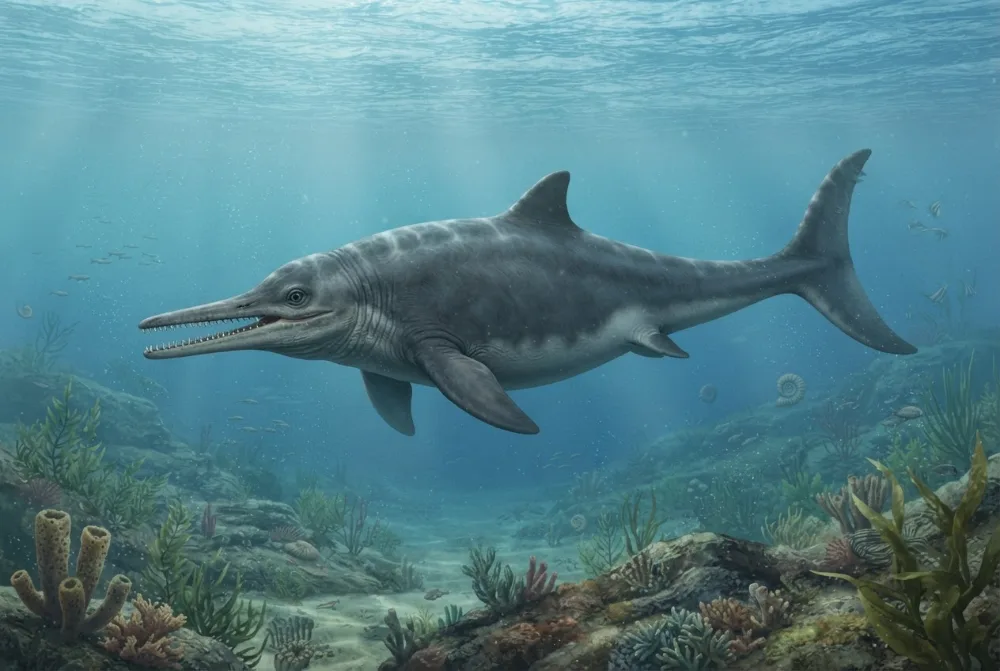
Bakeng sa ditsebi tsa didinosaure
- Lebitso la saense
- Sisteronia
- E rehilwe ke
- Fischer et al. 20143
- Sehlopha
- Diikhthiosaure
- Lelapa / leloko
- Ophthalmosauridae3
- Tlhophiso
- Ichthyosauria > Ichthyosauromorpha3
- Dilemo tsa mafika
- dilemo tse dimilione tse 113 ho isa ho 94 (Albian / Cenomanian)3
- Dibopeho tsa mafika
- Marnes bleues, West Melbury Marly Chalk, Gault3
- Dinaha
- United Kingdom, Fora, Russia3
- Direkoto tsa difosili
- 6 ho The Paleobiology Database3
- Ho sibollwa
- Sisteronia was named by Fischer and colleagues in 2014, based on fossils from the Cambridge Greensand Member in England and the Vocontian Basin in France.31
- E sa ntse e phehwa kgang
- Scientists are still debating exactly how diverse late Cretaceous ichthyosaurs were, and whether Sisteronia was part of a broader European hotspot of ichthyosaur diversity.1
Moo dintlha di tswang teng
- High Diversity in Cretaceous Ichthyosaurs from Europe Prior to Their Extinction (pmc.ncbi.nlm.nih.gov)
- Sisteronia (en.wikipedia.org)
- Sisteronia in The Paleobiology Database (CC BY 4.0): dilemo, dibaka, dibopeho tsa mafika, tlhophiso.
Ntlha e nngwe le e nngwe leqepheng lena e na le nomoro e supang mohlodi wa yona. Haeba re fositse ho hong, re kopa tshwarelo, re balatedi ba didinosaure, ha re koranta ya saense. Re bolelle ho [email protected] mme re tla e lokisa.
 Rex o lapile! Dino Wiki ke projeke ya ntate bakeng sa mora wa hae ya ratang didinosaure, ke mahala, ha ho dipapatso, ha ho disebedi. Batho ba baholo ba ka fepa Rex seneke ho thusa hore e dule e le inthaneteng.Fepa Rex
 Ichthyosaurus
 Platypterygius
 Stenopterygius
 Khudiakovia
 Ophthalmosaurus
 Chonespondylus
 Stegosaurus
 Iguanodon
 Archaeopteryx
 Giganotosaurus
 Microraptor
 Deinonychus