 Kwisi: O dinosaure efe?
 Ntwa ya didinosaure
 Peiso ya didinosaure
 Dipapadi tse nyane tsa didinosaure
 Albamo ya ditikara
 Manane a TOP a didinosaure
 Nkgethele!
Suzhousaurus
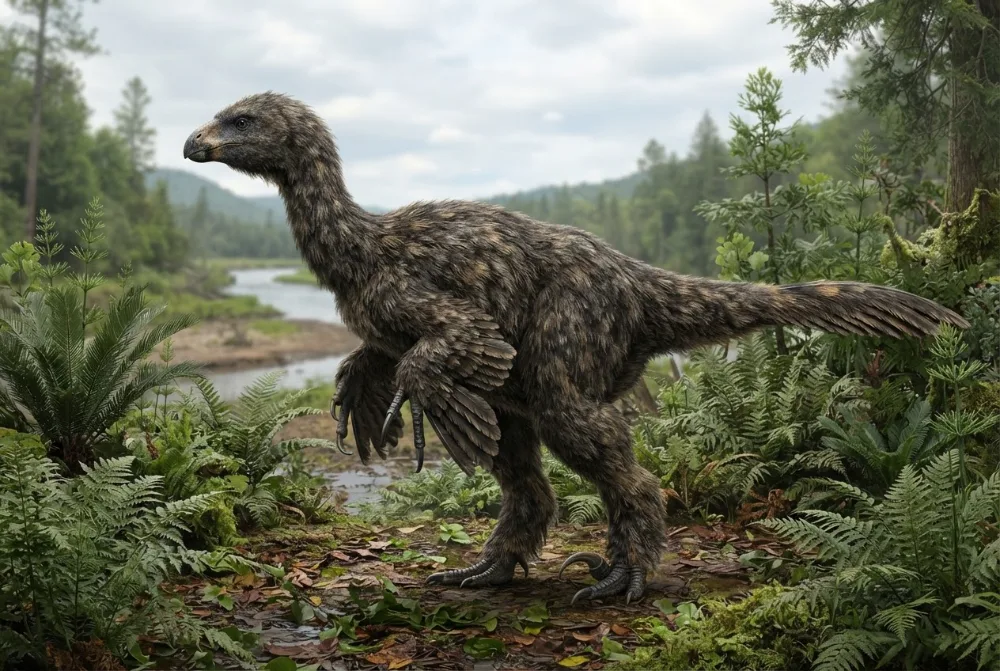
Suzhousaurus was a huge, plant-eating dinosaur with a big belly, strong legs, and long claws. It lived in China during the Early Cretaceous, about 124 to 113 million years ago. It probably had feathers, just like its close relatives!1
E phetse neng?
E ne e le kgolo hakae?
E ne e le telele hakae?
E ne e phahame hakae?
kakanyo
E ne e le boima hakae?

 telele jwaloka dintja tse 6 ho tloha nkong ho isa mohatleng🍌telele jwaloka dibanana tse 33 di behilwe ka molaboima jwaloka dintja tse 160🍉boima jwaloka mahapu a 620🎒boima jwaloka ditlelase tse feletseng tse 4 tsa bana ba sekolo🐻❄️boima jwaloka dibere tse tshweu tse 7🏃e ne e ka matha dimitara tse 100 ka metsotswana e 22 (motho ya lebelo ka ho fetisisa o hloka 9,6)
Suzhousaurus e ne e le kgolo hakae ha e bapiswa le WENA?
Ke dipalo feela ho browser ya hao. Ha ho letho le bolokwang kapa le romelwang kae kapa kae.
E ne e le lebelo hakae?


Dintlha tse monate
Suzhousaurus was one of the largest Early Cretaceous therizinosauroids, reaching about 6 metres (20 feet) long and weighing around 3.1 tonnes (3,100 kilograms).1
Its upper arm bone (humerus) had very expanded ends and a big entepicondyle, which helped scientists identify it as a therizinosauroid.3
Unlike more advanced therizinosaurids, Suzhousaurus's backbone was not highly pneumatized, meaning it had fewer air spaces in its vertebrae.1
Its pelvis was opisthopubic, a feature that is typical of therizinosaurids, even though Suzhousaurus was a more basal member of the group.1
Suzhousaurus had a large belly and a reduced tail, which helped it balance its heavy body.1
Feather impressions from the related Beipiaosaurus suggest that Suzhousaurus was probably at least partially feathered.1
The first specimen, FRDC-GSJB-99, was found in 1999 and includes a right humerus, shoulder bones, ten back vertebrae, and part of the pelvis, but no skull.1
A second, more complete skeleton found in 2004 includes the sacrum, tail vertebrae, a nearly complete pelvis, and both thigh bones.1
Dipotso tse botswang haholo ka Suzhousaurus
?How big was Suzhousaurus?
Suzhousaurus was about 6 metres (20 feet) long and weighed around 3.1 tonnes (3,100 kilograms). That makes it one of the largest Early Cretaceous therizinosauroids.1
?What did Suzhousaurus eat?
It was a plant-eater. It had a big belly, strong legs, and long claws for browsing on plants.1
?Did Suzhousaurus have feathers?
Probably yes. Feather impressions from its close relative Beipiaosaurus suggest that Suzhousaurus was at least partially feathered.1
?When did Suzhousaurus live?
It lived during the Early Cretaceous, about 124 to 113 million years ago, in what is now China.1
?Was Suzhousaurus a dinosaur?
Yes, it was a theropod dinosaur, specifically a therizinosauroid.1
?Why did Suzhousaurus have long claws?
Its long claws were probably used for pulling down branches and leaves to eat, like other therizinosauroids.1
Bakeng sa ditsebi tsa didinosaure
- Lebitso la saense
- Suzhousaurus
- E rehilwe ke
- Li et al. 20074
- Sehlopha
- Didinosaure tse makatsang tse nang le mafofa
- Lelapa / leloko
- Therizinosauridae4
- Tlhophiso
- Theropoda > Therizinosauria4
- Dilemo tsa mafika
- dilemo tse dimilione tse 121 ho isa ho 110 (Aptian / Albian)4
- Dibopeho tsa mafika
- Xiagou, Zhonggou4
- Dinaha
- Tjhaena4
- Direkoto tsa difosili
- 2 ho The Paleobiology Database4
- Ho sibollwa
- The first Suzhousaurus fossil was found in 1999 in the Yujingzi Basin, China. Scientists named it Suzhousaurus megatherioides in 2007, and the name means 'Suzhou lizard' after the old name for the Jiuquan area.1
- E sa ntse e phehwa kgang
- Scientists are not sure if Suzhousaurus is the same animal as another therizinosauroid called 'Nanshiungosaurus' bohlini, because the fossils do not overlap and the original specimen is lost.1
Moo dintlha di tswang teng
- Suzhousaurus (en.wikipedia.org)
- PBDB Taxon (paleobiodb.org)
- A Large Therizinosauroid (Dinosauria: Theropoda) from the Early Cretaceous of Northwestern China (onlinelibrary.wiley.com)
- Suzhousaurus in The Paleobiology Database (CC BY 4.0): dilemo, dibaka, dibopeho tsa mafika, tlhophiso.
Ntlha e nngwe le e nngwe leqepheng lena e na le nomoro e supang mohlodi wa yona. Haeba re fositse ho hong, re kopa tshwarelo, re balatedi ba didinosaure, ha re koranta ya saense. Re bolelle ho [email protected] mme re tla e lokisa.
 Rex o lapile! Dino Wiki ke projeke ya ntate bakeng sa mora wa hae ya ratang didinosaure, ke mahala, ha ho dipapatso, ha ho disebedi. Batho ba baholo ba ka fepa Rex seneke ho thusa hore e dule e le inthaneteng.Fepa Rex
Tse ding tsa sehlopha se le seng: Didinosaure tse makatsang tse nang le mafofa
 TherizinosaurusDidinosaure tse makatsang tse nang le mafofa
 OviraptorDidinosaure tse makatsang tse nang le mafofa
 ChirostenotesDidinosaure tse makatsang tse nang le mafofa
 CitipesDidinosaure tse makatsang tse nang le mafofa
 LeptorhynchosDidinosaure tse makatsang tse nang le mafofa
 AvimimusDidinosaure tse makatsang tse nang le mafofa
 Stegosaurus
 Iguanodon
 Archaeopteryx
 Giganotosaurus
 Microraptor
 Deinonychus