 Kwisi: O dinosaure efe?
 Ntwa ya didinosaure
 Peiso ya didinosaure
 Dipapadi tse nyane tsa didinosaure
 Albamo ya ditikara
 Manane a TOP a didinosaure
 Nkgethele!
E phetse neng?

E ne e le kgolo hakae?
E ne e le telele hakae?
E ne e phahame hakae?
E ne e le boima hakae?

 telele jwaloka dintja tse 7 ho tloha nkong ho isa mohatleng🍌telele jwaloka dibanana tse 39 di behilwe ka molaboima jwaloka dintja tse 140🍉boima jwaloka mahapu a 560🎒boima jwaloka ditlelase tse feletseng tse 4 tsa bana ba sekolo🐻❄️boima jwaloka dibere tse tshweu tse 6🏃e ne e ka matha dimitara tse 100 ka metsotswana e 21 (motho ya lebelo ka ho fetisisa o hloka 9,6)
Tuojiangosaurus e ne e le kgolo hakae ha e bapiswa le WENA?
Ke dipalo feela ho browser ya hao. Ha ho letho le bolokwang kapa le romelwang kae kapa kae.
E ne e le lebelo hakae?


Dintlha tse monate
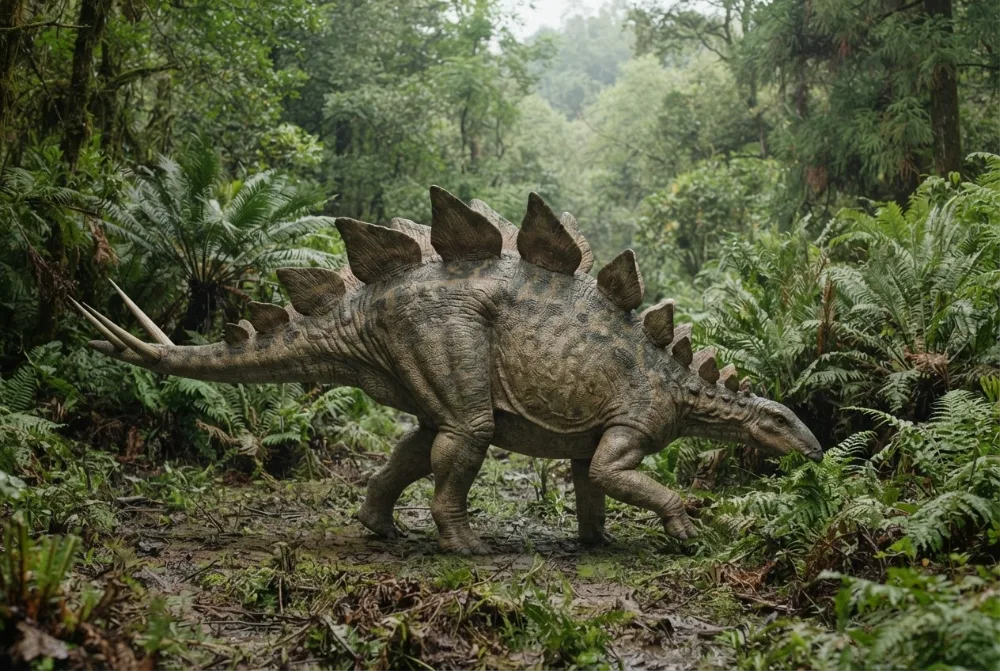
Tuojiangosaurus had about 17 pairs of plates and spikes along its back and tail.2
The spikes at the end of its tail pointed outward at about 45 degrees and are called a 'thagomizer'.2
Unlike Stegosaurus, the plates on Tuojiangosaurus were parallel to each other, not alternating.2
Its front legs were quite short compared to its back legs.2
Tuojiangosaurus lived during the Late Jurassic, about 157 to 154 million years ago.1
The first fossil was found in 1974 during construction of a dam in Zigong, Sichuan.2
Dipotso tse botswang haholo ka Tuojiangosaurus
?How big was Tuojiangosaurus?
It was about 6.5 to 7 metres long (21 to 23 feet) and weighed around 2.8 metric tons (3.1 short tons).2
?What did Tuojiangosaurus eat?
It ate low-lying plants like ferns, horsetails, and cycads. It had small snipping teeth and a beaked mouth for plucking vegetation.21
?Did Tuojiangosaurus have a thagomizer?
Yes, it had at least two spikes on each side of its tail tip, pointing outward at about 45 degrees. This spike cluster is called a thagomizer.2
?Where was Tuojiangosaurus found?
Its fossils were discovered in Sichuan Province, China, in 1974 during construction of the Wujiaba dam.2
?Could Tuojiangosaurus stand on its hind legs?
Probably not. Its backbone lacked the special vertebrae needed to rear up, so it likely only ate plants close to the ground.4
?How many plates did Tuojiangosaurus have?
It had about 17 pairs of plates and spikes running along its back and tail. The plates were parallel to each other, unlike Stegosaurus.2
Bakeng sa ditsebi tsa didinosaure
- Lebitso la saense
- Tuojiangosaurus
- E rehilwe ke
- Dong et al. 19775
- Sehlopha
- Didinosaure tse nang le dipoleiti
- Lelapa / leloko
- Stegosauridae5
- Tlhophiso
- Ornithischia > Stegosauria > Thyreophora5
- Dilemo tsa mafika
- dilemo tse dimilione tse 168 ho isa ho 162 (Bathonian / Callovian)5
- Dibopeho tsa mafika
- Shaximiao5
- Dinaha
- Tjhaena5
- Direkoto tsa difosili
- 1 ho The Paleobiology Database5
- Ho sibollwa
- Tuojiangosaurus was named and described in 1977 by Dong Zhiming, Zhou Shiwu, Li Xuanmin and Chang Yijong, exactly 100 years after Stegosaurus was named. The holotype skeleton is one of the most complete stegosaur skeletons found in Asia.2
- E sa ntse e phehwa kgang
- Scientists are not sure exactly where Tuojiangosaurus fits in the stegosaur family tree. Some studies place it outside Stegosauridae, while others group it with Huayangosaurus.2
Moo dintlha di tswang teng
- Tuojiangosaurus | Natural History Museum (nhm.ac.uk)
- Tuojiangosaurus (en.wikipedia.org)
- Tuojiangosaurus - Wikidata (wikidata.org)
- Tuojiangosaurus | Earth and Atmospheric Sciences | Research Starters | EBSCOhost (ebsco.com)
- Tuojiangosaurus in The Paleobiology Database (CC BY 4.0): dilemo, dibaka, dibopeho tsa mafika, tlhophiso.
Ntlha e nngwe le e nngwe leqepheng lena e na le nomoro e supang mohlodi wa yona. Haeba re fositse ho hong, re kopa tshwarelo, re balatedi ba didinosaure, ha re koranta ya saense. Re bolelle ho [email protected] mme re tla e lokisa.
 Rex o lapile! Dino Wiki ke projeke ya ntate bakeng sa mora wa hae ya ratang didinosaure, ke mahala, ha ho dipapatso, ha ho disebedi. Batho ba baholo ba ka fepa Rex seneke ho thusa hore e dule e le inthaneteng.Fepa Rex
 Stegosaurus
 Diracodon
 Hypsirophus
 Dacentrurus
 Miragaia
 Kentrosaurus
 Ichthyosaurus
 Khudiakovia
 Ophthalmosaurus
 Pterodactylus
 Peloneustes
 Rhamphocephalus