 Kwisi: O dinosaure efe?
 Ntwa ya didinosaure
 Peiso ya didinosaure
 Dipapadi tse nyane tsa didinosaure
 Albamo ya ditikara
 Manane a TOP a didinosaure
 Nkgethele!
E phetse neng?

E ne e le kgolo hakae?
E ne e le telele hakae?
E ne e phahame hakae?
kakanyo
E ne e le boima hakae?
 telele jwaloka dintja tse 6 ho tloha nkong ho isa mohatleng🍌telele jwaloka dibanana tse 31 di behilwe ka mola🍉boima jwaloka mahapu a 140🧸boima jwaloka bana ba kereshe ba 37🎒boima jwaloka bana ba sekolo ba 22🏃e ne e ka matha dimitara tse 100 ka metsotswana e 9.2 (motho ya lebelo ka ho fetisisa o hloka 9,6)
Viavenator e ne e le kgolo hakae ha e bapiswa le WENA?
Ke dipalo feela ho browser ya hao. Ha ho letho le bolokwang kapa le romelwang kae kapa kae.
E ne e le lebelo hakae?


Dintlha tse monate
Viavenator belongs to a group called Furileusauria, which means 'stiff back lizard' in the Mapudungun language, because their backbones were very rigid.2
It lived during the Santonian age, about 85.7 to 83.6 million years ago, filling a gap in the fossil record between earlier and later abelisaurids.32
The only known species is Viavenator exxoni, named after ExxonMobil for helping preserve fossils in the La Invernada area.12
Its skeleton shows special features like a deep notch in the skull bones and a downturned crest on the shin bone, which helped scientists identify it as a new species.2
Viavenator had a very stiff backbone with extra connections between the vertebrae, making its spine almost like a single rod.2
It was a medium to big sized theropod, part of the abelisaurid family that lived in the southern continents during the Cretaceous.2
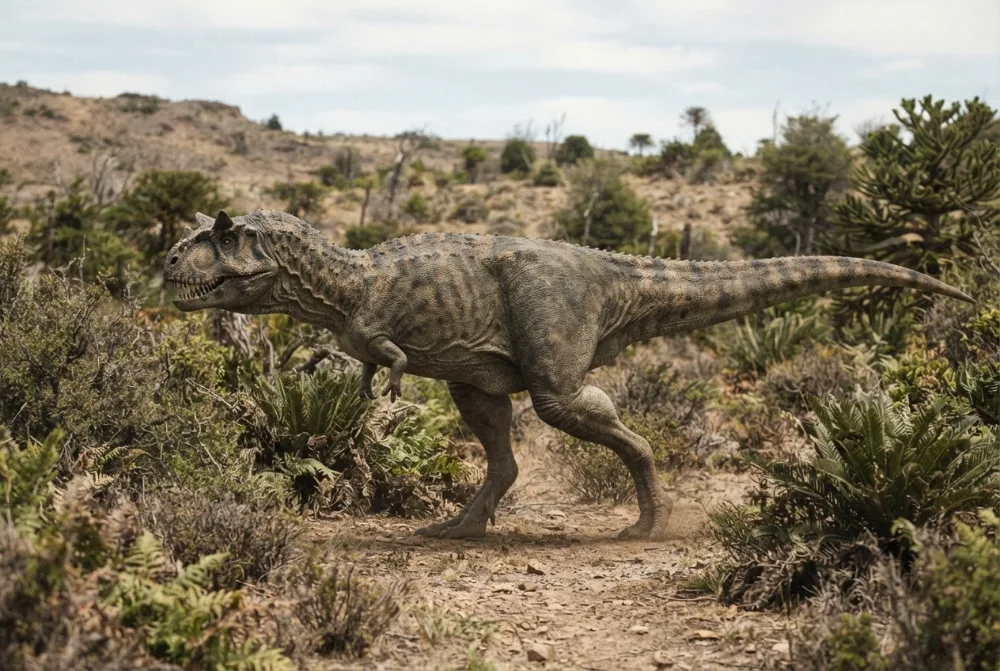
Dipotso tse botswang haholo ka Viavenator
?How big was Viavenator?
About 5.6 metres (18 feet) long.1
?What did Viavenator eat?
It was a carnivore, so it ate meat.1
?Why did Viavenator have a stiff back?
Its backbone was very rigid, with extra connections between vertebrae, which helped it move like a seesaw pivoting on its hips.2
?When did Viavenator live?
It lived during the Santonian age of the Late Cretaceous, about 85.7 to 83.6 million years ago.1
Bakeng sa ditsebi tsa didinosaure
- Lebitso la saense
- Viavenator
- E rehilwe ke
- Filippi et al. 20165
- Sehlopha
- Didinosaure tse jang nama
- Lelapa / leloko
- Abelisauridae5
- Tlhophiso
- Theropoda > Ceratosauria > Abelisauridae5
- Dilemo tsa mafika
- dilemo tse dimilione tse 86 ho isa ho 84 (Santonian)5
- Dibopeho tsa mafika
- Bajo de la Carpa5
- Dinaha
- Argentina5
- Direkoto tsa difosili
- 1 ho The Paleobiology Database5
- Ho sibollwa
- Viavenator was named and described in 2016 by Filippi and colleagues based on a partial skeleton found in the Bajo de la Carpa Formation of Argentina.13
- E sa ntse e phehwa kgang
- Scientists are still debating exactly how Viavenator is related to other abelisaurids, as it seems to be a transitional form between earlier and later species.2
Moo dintlha di tswang teng
- Viavenator (en.wikipedia.org)
- A new brachyrostran with hypertrophied axial structures reveals an unexpected radiation of latest Cretaceous abelisaurids (corporate.exxonmobil.com)
- PBDB Taxon (paleobiodb.org)
- Viavenator exxoni | Dinosaur Database by DinoAnimals.com (dinoanimals.com)
- Viavenator in The Paleobiology Database (CC BY 4.0): dilemo, dibaka, dibopeho tsa mafika, tlhophiso.
Ntlha e nngwe le e nngwe leqepheng lena e na le nomoro e supang mohlodi wa yona. Haeba re fositse ho hong, re kopa tshwarelo, re balatedi ba didinosaure, ha re koranta ya saense. Re bolelle ho [email protected] mme re tla e lokisa.
 Rex o lapile! Dino Wiki ke projeke ya ntate bakeng sa mora wa hae ya ratang didinosaure, ke mahala, ha ho dipapatso, ha ho disebedi. Batho ba baholo ba ka fepa Rex seneke ho thusa hore e dule e le inthaneteng.Fepa Rex
 Allosaurus
 Carnotaurus
 Dilophosaurus
 Giganotosaurus
 Compsognathus
 Paronychodon
 Tyrannosaurus
 Triceratops
 Velociraptor
 Spinosaurus
 Ankylosaurus
 Parasaurolophus