 Kwisi: O dinosaure efe?
 Ntwa ya didinosaure
 Peiso ya didinosaure
 Dipapadi tse nyane tsa didinosaure
 Albamo ya ditikara
 Manane a TOP a didinosaure
 Nkgethele!
Zhejiangopterus
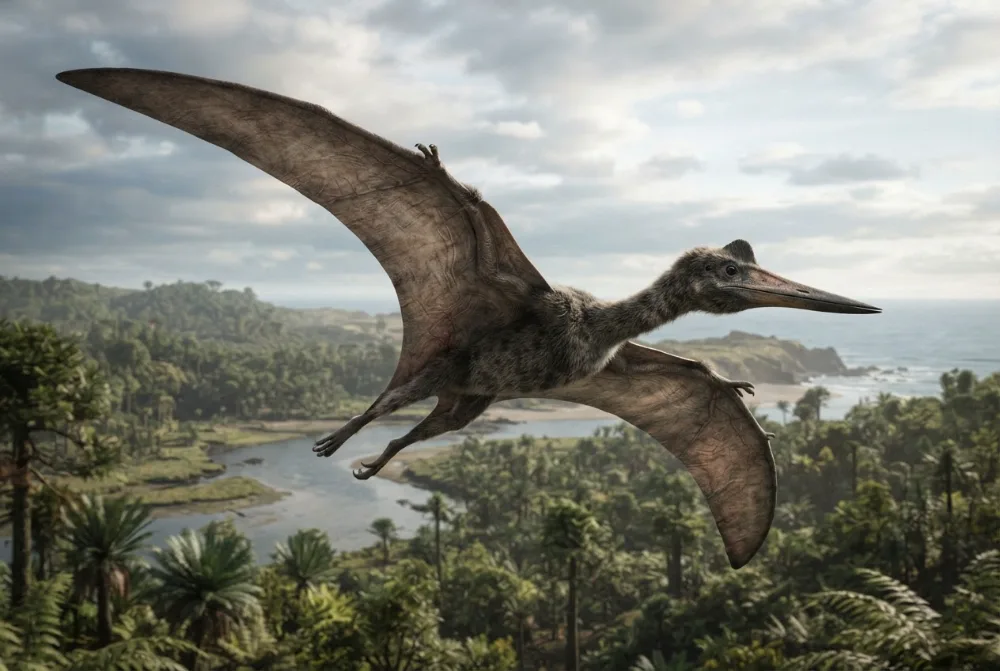
Zhejiangopterus was a huge flying reptile that lived in ancient China. It had a long, toothless beak like a modern bird and a wingspan wider than a car is long. It soared over the Late Cretaceous skies hunting for fish.31
E phetse neng?
E ne e le kgolo hakae?
Mapheo a yona a ne a pharaletse hakae?
E ne e le boima hakae?
 mapheo a pharaletse jwaloka dibaesekele tse 3 ka mola
 e batla e le boima jwaloka katse ya lapeng🍌boima jwaloka dibanana tse 66⚽e ne e ka fofa ho tshela lebala lohle la bolo ya maoto ka metsotswana e 5.5
Zhejiangopterus e ne e le kgolo hakae ha e bapiswa le WENA?
Ke dipalo feela ho browser ya hao. Ha ho letho le bolokwang kapa le romelwang kae kapa kae.
E ne e le lebelo hakae?


Dintlha tse monate
Zhejiangopterus had no teeth at all. Its beak was long, thin and pointed, perfect for grabbing fish.1
Its skull was long and low, with a single large oval opening that took up nearly half the length of the head.1
The wing finger metacarpal bone was longer than the combined radius and ulna bones in the arm.1
Its thigh bone was about one and a half times longer than its upper arm bone.1
Zhejiangopterus lived around 81.5 million years ago, during the Late Cretaceous period.1
It was discovered by a local villager named Chengfa Xu in 1986 while he was splitting rocks in a quarry.1
Dipotso tse botswang haholo ka Zhejiangopterus
?How big was Zhejiangopterus?
Its wingspan was first estimated at 5 meters (16.4 feet), but later estimates reduced it to about 3.5 meters (11.5 feet). Its body mass was around 7.9 kilograms (roughly 17 pounds).2
?Did Zhejiangopterus have teeth?
No, it had no teeth at all. Its beak was long, thin, and sharply pointed.2
?What did Zhejiangopterus eat?
It likely ate fish, grabbing them with its long, toothless beak.2
?When did Zhejiangopterus live?
It lived about 81.5 million years ago, during the Late Cretaceous Period.2
?Where was Zhejiangopterus found?
It was discovered in Zhejiang Province, China, near the city of Linhai.2
?Is Zhejiangopterus a dinosaur?
No, it is a pterosaur, a flying reptile that is not a dinosaur.2
Bakeng sa ditsebi tsa didinosaure
- Lebitso la saense
- Zhejiangopterus
- E rehilwe ke
- Cai and Wei 19943
- Sehlopha
- Dihahabi tse fofang
- Lelapa / leloko
- Azhdarchidae3
- Tlhophiso
- Pterosauria > Pterodactyloidea > Azhdarchidae3
- Dilemo tsa mafika
- dilemo tse dimilione tse 84 ho isa ho 72 (Campanian)3
- Dibopeho tsa mafika
- Tangshang3
- Dinaha
- Tjhaena3
- Direkoto tsa difosili
- 1 ho The Paleobiology Database3
- Ho sibollwa
- Zhejiangopterus was named in 1994 by Chinese paleontologists Cai Zhengquan and Wei Feng. The first fossils were found in 1986 by a villager named Chengfa Xu in a quarry near Linhai, Zhejiang, China.31
- E sa ntse e phehwa kgang
- Scientists are not sure whether Zhejiangopterus belongs to the family Nyctosauridae or Azhdarchidae. Different studies place it in different groups.31
Moo dintlha di tswang teng
- Zhejiangopterus linhaiensis (Pterosauria) from the Upper Cretaceous of Linhai, Zhejiang, China (naturalhistory.si.edu)
- Zhejiangopterus (en.wikipedia.org)
- Zhejiangopterus in The Paleobiology Database (CC BY 4.0): dilemo, dibaka, dibopeho tsa mafika, tlhophiso.
Ntlha e nngwe le e nngwe leqepheng lena e na le nomoro e supang mohlodi wa yona. Haeba re fositse ho hong, re kopa tshwarelo, re balatedi ba didinosaure, ha re koranta ya saense. Re bolelle ho [email protected] mme re tla e lokisa.
 Rex o lapile! Dino Wiki ke projeke ya ntate bakeng sa mora wa hae ya ratang didinosaure, ke mahala, ha ho dipapatso, ha ho disebedi. Batho ba baholo ba ka fepa Rex seneke ho thusa hore e dule e le inthaneteng.Fepa Rex
 Pteranodon
 Quetzalcoatlus
 Dorygnathus
 Rhamphorhynchus
 Anhanguera
 Pterodactylus
 Tyrannosaurus
 Triceratops
 Velociraptor
 Spinosaurus
 Ankylosaurus
 Parasaurolophus