 O dino efe? Kwisi
 Ntwa ya didino
 Peiso ya didino
 Metshamekwana ya didino
 Alebamo ya disetikara
 Manane a TOP a didino
 Ngakgamatsa!
Bohaiornis
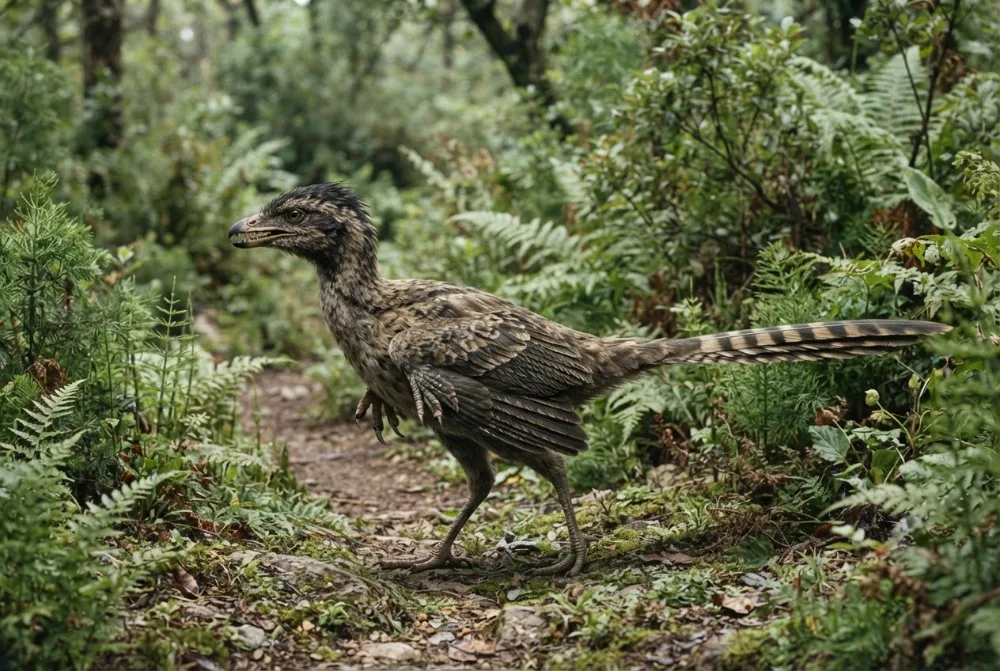
Bohaiornis was a feathered dinosaur that lived about 120 million years ago in what is now China. It was a bird-like predator with sharp teeth and long tail feathers. Scientists found a nearly complete skeleton that shows it was a fast, ground-dwelling hunter.15
E tshetse leng?
E ne e le kgolo go le kae?
E ne e le bokete go le kae?
Bohaiornis e ne e le kgolo go le kae fa e bapisiwa le WENA?
Ke dipalo fela mo sebatling sa gago. Ga go sepe se se bolokwang kgotsa se se romelwang gope.
E ne e le bonako go le kae?


Dintlha tse di monate
Bohaiornis had two long, ribbon-like feathers on its tail, not a fan of short feathers like many other birds.1
It was much larger than its close relative Eoenantiornis, which lived a bit earlier.1
The first skeleton found was almost complete, with all its bones still connected.2
Scientists once thought it had stones in its belly to help grind food, but those turned out to be mineral lumps that formed after death.1
Bohaiornis had a broad snout, which is unusual for early birds that ate meat.1
It lived during the Early Cretaceous, about 120 million years ago.1
Dipotso tse di botswang thata ka ga Bohaiornis
?How big was Bohaiornis?
Scientists do not give an exact size, but it was much larger than its close relative Eoenantiornis, and a second, even larger specimen has been found.14
?What did Bohaiornis eat?
It was probably a meat-eater, maybe a raptorial predator. Scientists once thought it had stomach stones to help grind food, but those turned out to be mineral lumps that formed after death.14
?Did Bohaiornis have feathers?
Yes. The first skeleton found had two long, ribbon-like feathers attached to its tail.1
?When did Bohaiornis live?
It lived during the Early Cretaceous, about 120 million years ago, in what is now China.1
Mothubi wa ditlhamane
Tlhamane: People might think Bohaiornis ate plants because it had stones in its stomach.
Boammaaruri: The stones were actually mineral concretions that formed after the animal died, and Bohaiornis was a meat-eater.1
Ya baitseanape ba didino
- Leina la saense
- Bohaiornis
- Leina le neilwe ke
- Hu et al. 20115
- Setlhopha
- Dinonyane tsa ntlha
- Lelapa / clade
- Bohaiornithidae5
- Thulaganyo
- Theropoda > Avialae5
- Bogolo jwa matlapa
- 121 go ya go 113 dimilione tsa dingwaga (Aptian)5
- Dibopego tsa matlapa
- Jiufotang5
- Dinaga
- Tšhaena5
- Direkoto tsa difosili
- 2 mo The Paleobiology Database5
- Go fitlhelwa
- Bohaiornis was named by Dongyu Hu, Li Li, Lianhaim Hou, and Xing Xu in 2011. They described a nearly complete skeleton from the Yixian Formation in China.21
- Go sa ntse go ganetsanwa
- Scientists still debate what exactly Bohaiornis ate, because its stomach contents are not clear.1
Kwa dintlha di tswang teng
- Bohaiornis (en.wikipedia.org)
- A new enantiornithine bird from the Lower Cretaceous of western L...: Ingenta Connect (ingentaconnect.com)
- Synthetic analysis of trophic diversity and evolution in Enantiornithes with new insights from Bohaiornithidae (pmc.ncbi.nlm.nih.gov)
- A new specimen of large-bodied basal Enantiornithine Bohaiornis from the Early Cretaceous of China and the inference of feeding ecology in Mesozoic birds | Journal of Paleontology | Cambridge Core (cambridge.org)
- Bohaiornis in The Paleobiology Database (CC BY 4.0): dingwaga, mafelo, dibopego tsa matlapa, thulaganyo.
Ntlha nngwe le nngwe mo tsebeng eno e na le nomoro e e supang motswedi wa yona. Fa re dirile phoso, maitshwarelo, re barati ba didino, ga re lokwalodikgang lwa saense. Re bolelele kwa [email protected] mme re tla e baakanya.
 Rex o tshwerwe ke tlala! Dino Wiki ke porojeke ya rre e a e diretseng morwawe yo o ratang didino, ke mahala, ga e na dipapatso e bile ga e na dilatedi. Batho ba bagolo ba ka fepa Rex senyamo go thusa gore e nne mo inthaneteng.Fepa Rex
 Archaeopteryx
 Hesperornis
 Ichthyornis
 Baptornis
 Jurapteryx
 Gobipteryx
 Stegosaurus
 Iguanodon
 Giganotosaurus
 Microraptor
 Deinonychus
 Baryonyx