 O dino efe? Kwisi
 Ntwa ya didino
 Peiso ya didino
 Metshamekwana ya didino
 Alebamo ya disetikara
 Manane a TOP a didino
 Ngakgamatsa!
E tshetse leng?

E ne e le kgolo go le kae?
E ne e le telele go le kae?
E ne e le kwa godimo go le kae?
kakanyo
E ne e le bokete go le kae?

 telele jaaka dintšwa di le 6 go tswa kwa nkong go ya kwa mogatleng🍌telele jaaka dibanana di le 33 di latelanabokete jaaka dintšwa di le 75🍉bokete jaaka magapu a le 300🧸bokete jaaka bana ba kreše ba le 79🎒bokete jaaka bana ba sekolo ba le 47🐻❄️bokete jaaka dibere tse ditshweu di le 3🏃e ne e ka taboga dimetara di le 100 mo metsotswaneng e le 12 (motho yo o bonako go gaisa o tlhoka 9,6)
Cedrorestes e ne e le kgolo go le kae fa e bapisiwa le WENA?
Ke dipalo fela mo sebatling sa gago. Ga go sepe se se bolokwang kgotsa se se romelwang gope.
E ne e le bonako go le kae?


Dintlha tse di monate
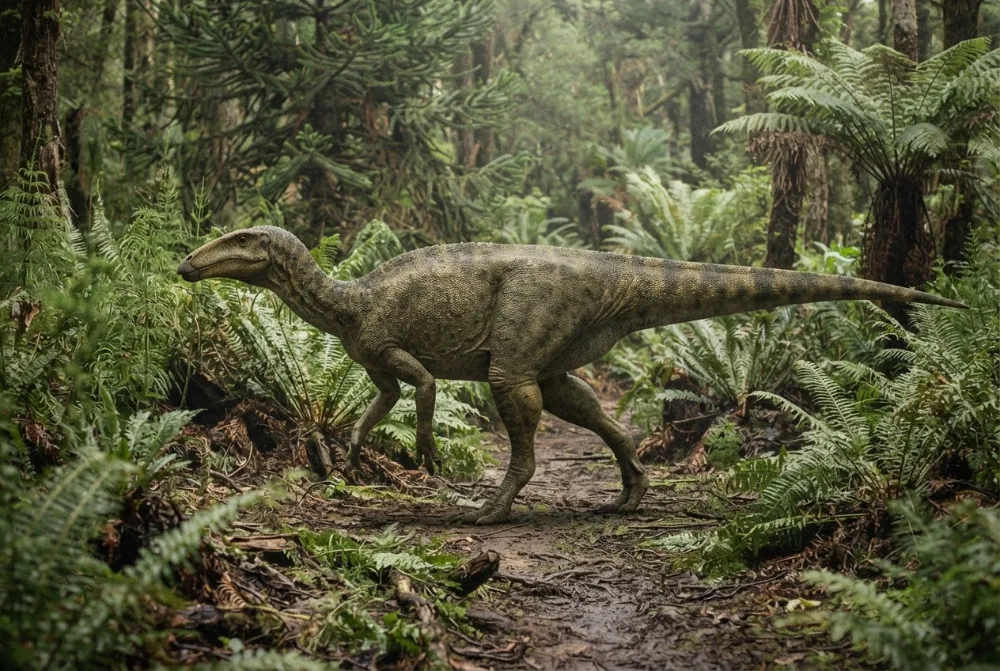
Cedrorestes is known from only one partial skeleton, including hip bones, a thighbone, and ribs.1
Its hip bone had a tall blade like Iguanodon but also a special bony bump that is usually seen in hadrosaurids, the duck-billed dinosaurs.1
The fossil was found scattered in mudstone and showed damage from weathering or trampling before it was buried.1
Cedrorestes lived alongside other dinosaurs like the armored Gastonia, the big predator Utahraptor, and the sauropod Cedarosaurus.1
The species name crichtoni honors Michael Crichton, the author of Jurassic Park.1
Scientists think Cedrorestes could move on two legs or on all fours, like many other iguanodontian dinosaurs.1
Dipotso tse di botswang thata ka ga Cedrorestes
?How big was Cedrorestes?
No one knows for sure because only a partial skeleton has been found. It was a large herbivore, but scientists need more fossils to estimate its size.1
?What did Cedrorestes eat?
It was a plant-eater. It had a beak for munching plants and could walk on two legs or on all fours to reach different kinds of vegetation.1
?Was Cedrorestes a dinosaur?
Yes, it was a dinosaur. It belonged to the group Iguanodontia, which are plant-eating ornithischian dinosaurs.1
?When did Cedrorestes live?
It lived during the Early Cretaceous Period, about 137 to 132 million years ago, in what is now Utah, USA.1
Ya baitseanape ba didino
- Leina la saense
- Cedrorestes
- Leina le neilwe ke
- Gilpin et al. 20074
- Setlhopha
- Dija-dimela tse di nang le melomo
- Lelapa / clade
- Hadrosauroidea4
- Thulaganyo
- Ornithischia > Ornithopoda > Iguanodontia4
- Bogolo jwa matlapa
- 137 go ya go 133 dimilione tsa dingwaga (Valanginian)4
- Dibopego tsa matlapa
- Cedar Mountain4
- Dinaga
- Amerika4
- Direkoto tsa difosili
- 1 mo The Paleobiology Database4
- Go fitlhelwa
- The fossil was found in 2001 near the top of the Yellow Cat Member in Utah. David Gilpin and colleagues named it Cedrorestes crichtoni in 2007.1
- Go sa ntse go ganetsanwa
- Scientists are not sure whether Cedrorestes was an early hadrosaurid or a close relative of hadrosaurids, because the skeleton is incomplete.1
Kwa dintlha di tswang teng
- Cedrorestes (en.wikipedia.org)
- Cedrorestes Gilpin et al. 2007 - Encyclopedia of Life (eol.org)
- Cedrorestes crichtoni (es.wikipedia.org)
- Cedrorestes in The Paleobiology Database (CC BY 4.0): dingwaga, mafelo, dibopego tsa matlapa, thulaganyo.
Ntlha nngwe le nngwe mo tsebeng eno e na le nomoro e e supang motswedi wa yona. Fa re dirile phoso, maitshwarelo, re barati ba didino, ga re lokwalodikgang lwa saense. Re bolelele kwa [email protected] mme re tla e baakanya.
 Rex o tshwerwe ke tlala! Dino Wiki ke porojeke ya rre e a e diretseng morwawe yo o ratang didino, ke mahala, ga e na dipapatso e bile ga e na dilatedi. Batho ba bagolo ba ka fepa Rex senyamo go thusa gore e nne mo inthaneteng.Fepa Rex
 Iguanodon
 Tenontosaurus
 Thescelosaurus
 Zalmoxes
 Camptosaurus
 Rhabdodon
 Stegosaurus
 Archaeopteryx
 Giganotosaurus
 Microraptor
 Deinonychus
 Baryonyx