 O dino efe? Kwisi
 Ntwa ya didino
 Peiso ya didino
 Metshamekwana ya didino
 Alebamo ya disetikara
 Manane a TOP a didino
 Ngakgamatsa!
E tshetse leng?

E ne e le kgolo go le kae?
E ne e le telele go le kae?
E ne e le kwa godimo go le kae?
E ne e le bokete go le kae?
 telele jaaka dikoloi di le 2 di emisitswe mo moleng🍌telele jaaka dibanana di le 56 di latelana
 bokete jaaka ditlou di le 1.5🍉bokete jaaka magapu a le 2000🎒bokete jaaka diphaposiborutelo tse di tletseng bana di le 12🐻❄️bokete jaaka dibere tse ditshweu di le 22🏃e ne e ka taboga dimetara di le 100 mo metsotswaneng e le 15 (motho yo o bonako go gaisa o tlhoka 9,6)
Deinocheirus e ne e le kgolo go le kae fa e bapisiwa le WENA?
Ke dipalo fela mo sebatling sa gago. Ga go sepe se se bolokwang kgotsa se se romelwang gope.
E ne e le bonako go le kae?


Dintlha tse di monate
For a long time, scientists only had a pair of arm bones with huge claws to study Deinocheirus. They did not know what the rest of the dinosaur looked like until 2014.1
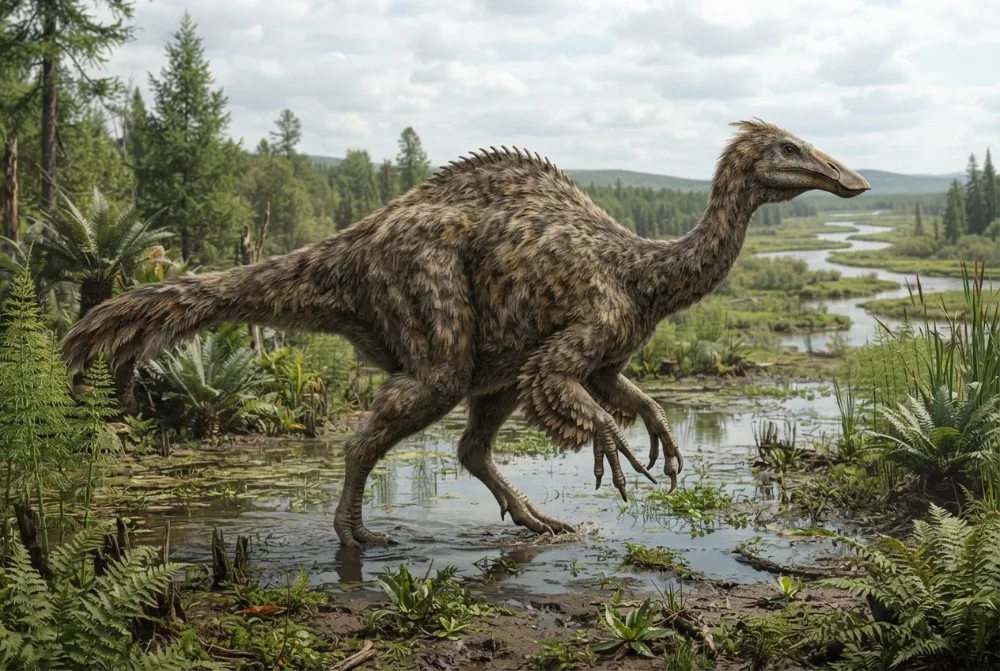
Deinocheirus had a large hump on its back, supported by its backbone. This made it look a bit like a camel.1
Its hands were huge and had long, sharp claws. The name Deinocheirus means 'terrible hand'.1
Deinocheirus lived during the Late Cretaceous period, about 70 to 66 million years ago.1
It was an omnivore, meaning it ate both plants and meat. Scientists think it used its beak to eat plants and small animals.15
Deinocheirus belonged to a group of dinosaurs called ornithomimosaurs, which are often called 'ostrich dinosaurs' because they looked a bit like ostriches.5
Dipotso tse di botswang thata ka ga Deinocheirus
?How big was Deinocheirus?
It was about 11 metres (36 feet) long and weighed around 6.5 tonnes (7.2 short tons). That is as long as a big bus.4
?What did Deinocheirus eat?
It was an omnivore, meaning it ate both plants and meat. It had a duck-like beak for cropping soft plants, and fish scales found with one specimen show it also ate fish.4
?Did Deinocheirus have feathers?
Yes, it probably had a fan of feathers on its tail. The tail ended in pygostyle-like vertebrae, which is a sign of feathers.4
?Why did Deinocheirus have such big claws?
Its huge, blunt claws were probably used for digging and gathering plants. The name Deinocheirus means 'terrible hand' because of those big claws.4
?Was Deinocheirus a dinosaur?
Yes, it was a dinosaur. It belonged to a group called ornithomimosaurs, which are often called 'ostrich dinosaurs'.41
?When did Deinocheirus live?
It lived during the Late Cretaceous period, about 70 to 66 million years ago.1
?Could Deinocheirus run fast?
No, it was not built for speed. It had short legs and a bulky body, so it moved slowly.4
?What hunted Deinocheirus?
Bite marks on its bones show that the tyrannosaurid Tarbosaurus probably attacked or scavenged it.4
Ya baitseanape ba didino
- Leina la saense
- Deinocheirus
- Leina le neilwe ke
- Kielan-Jaworowska 19695
- Setlhopha
- Didino tsa mpshe
- Lelapa / clade
- Deinocheiridae5
- Thulaganyo
- Theropoda > Ornithomimosauria5
- Bogolo jwa matlapa
- 100 go ya go 66 dimilione tsa dingwaga (Cenomanian / Maastrichtian)5
- Dibopego tsa matlapa
- Nemegt, Baynshire5
- Dinaga
- Mongolia5
- Direkoto tsa difosili
- 5 mo The Paleobiology Database5
- Go fitlhelwa
- Deinocheirus was named by Polish paleontologist Zofia Kielan-Jaworowska in 1969. The first fossils were found in the Gobi Desert in Mongolia.51
Kwa dintlha di tswang teng
- Deinocheirus | Natural History Museum (nhm.ac.uk)
- PBDB Taxon (paleobiodb.org)
- Deinocheirus — size, diet & habitat | DinoLifePedia (dinolifepedia.com)
- Deinocheirus (en.wikipedia.org)
- Deinocheirus in The Paleobiology Database (CC BY 4.0): dingwaga, mafelo, dibopego tsa matlapa, thulaganyo.
Ntlha nngwe le nngwe mo tsebeng eno e na le nomoro e e supang motswedi wa yona. Fa re dirile phoso, maitshwarelo, re barati ba didino, ga re lokwalodikgang lwa saense. Re bolelele kwa [email protected] mme re tla e baakanya.
 Rex o tshwerwe ke tlala! Dino Wiki ke porojeke ya rre e a e diretseng morwawe yo o ratang didino, ke mahala, ga e na dipapatso e bile ga e na dilatedi. Batho ba bagolo ba ka fepa Rex senyamo go thusa gore e nne mo inthaneteng.Fepa Rex
 Gallimimus
 Ornithomimus
 Struthiomimus
 Dromiceiomimus
 Archaeornithomimus
 Anserimimus
 Tyrannosaurus
 Triceratops
 Velociraptor
 Spinosaurus
 Ankylosaurus
 Parasaurolophus