 O dino efe? Kwisi
 Ntwa ya didino
 Peiso ya didino
 Metshamekwana ya didino
 Alebamo ya disetikara
 Manane a TOP a didino
 Ngakgamatsa!
E tshetse leng?

E ne e le kgolo go le kae?
E ne e le telele go le kae?
E ne e le kwa godimo go le kae?
E ne e le bokete go le kae?
 telele jaaka dintšwa di le 5 go tswa kwa nkong go ya kwa mogatleng🍌telele jaaka dibanana di le 27 di latelana🍉bokete jaaka magapu a le 70🧸bokete jaaka bana ba kreše ba le 18🎒bokete jaaka bana ba sekolo ba le 11🏃e ne e ka taboga dimetara di le 100 mo metsotswaneng e le 5.1 (motho yo o bonako go gaisa o tlhoka 9,6)
Struthiomimus e ne e le kgolo go le kae fa e bapisiwa le WENA?
Ke dipalo fela mo sebatling sa gago. Ga go sepe se se bolokwang kgotsa se se romelwang gope.
E ne e le bonako go le kae?


Dintlha tse di monate
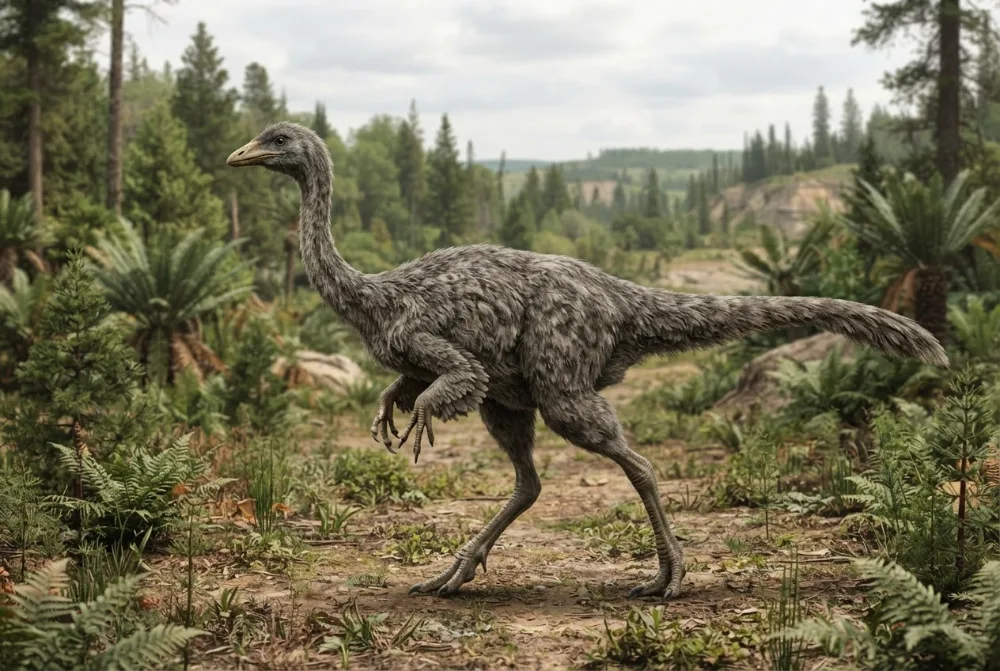
Struthiomimus looked a bit like a featherless ostrich with a long tail.1
Its neck made up about 40% of the length of its body in front of the hips.2
It had three fingers on each hand that were roughly the same length, which is unusual for a theropod.2
Its tail was relatively stiff and probably helped it keep balance while running.2
Some scientists think its hands worked like a hook or clamp to pull branches close, but others think they supported wing feathers.2
Dipotso tse di botswang thata ka ga Struthiomimus
?How big was Struthiomimus?
About 4.3 metres (14 feet) long, 1.4 metres (4.5 feet) tall at the hips, and weighed around 150 kilograms (330 pounds). A larger specimen weighed about 234 kilograms (515 pounds).21
?How fast could Struthiomimus run?
It could run between 50 and 80 km/h (31 to 50 mph), using its long legs to escape predators like tyrannosaurs.2
?What did Struthiomimus eat?
It was probably an omnivore, eating both plants and small animals like insects, mammals, and reptiles. Its toothless beak was good for cropping plants and maybe filtering food from water.21
?Did Struthiomimus have feathers?
Yes, it likely had feathers all over its body. Its arm bones show adaptations that may have supported wing feathers.2
?Where did Struthiomimus live?
It lived in western North America, in what is now Canada and the United States, during the Late Cretaceous period.21
?Why is it called Struthiomimus?
Its name means 'ostrich mimic' because it looked a lot like a modern ostrich, with long legs, a long neck, and a toothless beak.21
?Was Struthiomimus bigger than a human?
Yes, it was about 4.3 metres long and stood about 1.4 metres tall at the hips, which is taller than most people.2
Mothubi wa ditlhamane
Tlhamane: Struthiomimus was a fierce meat-eater like other theropods.
Boammaaruri: It had no teeth and a beak, and most scientists think it ate both plants and small animals, not just meat.2
Ya baitseanape ba didino
- Leina la saense
- Struthiomimus
- Leina le neilwe ke
- Osborn 19163
- Setlhopha
- Didino tsa mpshe
- Lelapa / clade
- Ornithomimidae3
- Thulaganyo
- Theropoda > Ornithomimosauria3
- Bogolo jwa matlapa
- 84 go ya go 66 dimilione tsa dingwaga (Campanian / Maastrichtian)3
- Dibopego tsa matlapa
- Oldman, Kirtland, Dinosaur Park3
- Dinaga
- Khanata, Amerika3
- Direkoto tsa difosili
- 18 mo The Paleobiology Database3
- Go fitlhelwa
- Lawrence Lambe found the first remains in 1901 and named them Ornithomimus altus. In 1914, Barnum Brown found a nearly complete skeleton in Alberta, and Henry Fairfield Osborn named it Struthiomimus in 1917.2
- Go sa ntse go ganetsanwa
- Scientists still debate what Struthiomimus ate. Some think it was a plant-eater, others think it was a meat-eater, and some even suggest it filtered food from water.2
Kwa dintlha di tswang teng
- Struthiomimus | Natural History Museum (nhm.ac.uk)
- Struthiomimus (en.wikipedia.org)
- Struthiomimus in The Paleobiology Database (CC BY 4.0): dingwaga, mafelo, dibopego tsa matlapa, thulaganyo.
Ntlha nngwe le nngwe mo tsebeng eno e na le nomoro e e supang motswedi wa yona. Fa re dirile phoso, maitshwarelo, re barati ba didino, ga re lokwalodikgang lwa saense. Re bolelele kwa [email protected] mme re tla e baakanya.
 Rex o tshwerwe ke tlala! Dino Wiki ke porojeke ya rre e a e diretseng morwawe yo o ratang didino, ke mahala, ga e na dipapatso e bile ga e na dilatedi. Batho ba bagolo ba ka fepa Rex senyamo go thusa gore e nne mo inthaneteng.Fepa Rex
 Gallimimus
 Ornithomimus
 Deinocheirus
 Dromiceiomimus
 Archaeornithomimus
 Anserimimus
 Tyrannosaurus
 Triceratops
 Velociraptor
 Spinosaurus
 Ankylosaurus
 Parasaurolophus