 O dino efe? Kwisi
 Ntwa ya didino
 Peiso ya didino
 Metshamekwana ya didino
 Alebamo ya disetikara
 Manane a TOP a didino
 Ngakgamatsa!
E tshetse leng?

E ne e le kgolo go le kae?
E ne e le bokete go le kae?
Eopengornis e ne e le kgolo go le kae fa e bapisiwa le WENA?
Ke dipalo fela mo sebatling sa gago. Ga go sepe se se bolokwang kgotsa se se romelwang gope.
E ne e le bonako go le kae?


Dintlha tse di monate
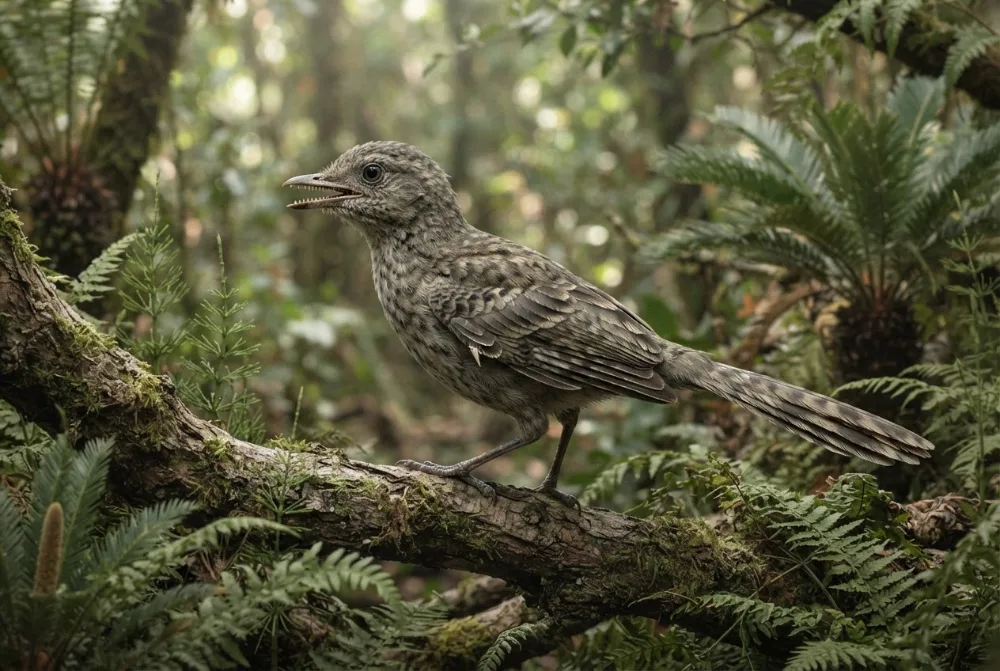
Eopengornis had special tail feathers with a strong central shaft, called a rachis, which helped it fly and show off.12
It belonged to a group of early birds called enantiornithes, which were very common during the time of dinosaurs.1
The only known species is called Eopengornis martini.1
Its fossils were found in rocks that are about 132 to 125 million years old, from a time called the Hauterivian.5
Eopengornis is part of the pengornithid family, a group of early birds that lived in Asia.1
Ya baitseanape ba didino
- Leina la saense
- Eopengornis
- Leina le neilwe ke
- Wang et al. 20145
- Setlhopha
- Dinonyane tsa ntlha
- Lelapa / clade
- Pengornithidae5
- Thulaganyo
- Theropoda > Avialae5
- Bogolo jwa matlapa
- 133 go ya go 126 dimilione tsa dingwaga (Hauterivian)5
- Dibopego tsa matlapa
- Huajiying5
- Dinaga
- Tšhaena5
- Direkoto tsa difosili
- 1 mo The Paleobiology Database5
- Go fitlhelwa
- Eopengornis was named and described by scientists Wang, O'Connor, Zheng, Wang, Hu, and Zhou in 2014, based on a fossil found in China.15
- Go sa ntse go ganetsanwa
- Scientists are still studying exactly how Eopengornis used its strong tail feathers for flight and display.12
Kwa dintlha di tswang teng
- Eopengornis (en.wikipedia.org)
- Insights into the evolution of rachis dominated tail feathers from a new basal enantiornithine (Aves: Ornithothoraces) (bionames.org)
- Quantitative investigation of pengornithid enantiornithine diet reveals macrocarnivorous ecology evolved in birds by Early Cretaceous (pmc.ncbi.nlm.nih.gov)
- Quantitative investigation of pengornithid enantiornithine diet reveals macrocarnivorous ecology evolved in birds by Early Cretaceous: iScience (cell.com)
- Eopengornis in The Paleobiology Database (CC BY 4.0): dingwaga, mafelo, dibopego tsa matlapa, thulaganyo.
Ntlha nngwe le nngwe mo tsebeng eno e na le nomoro e e supang motswedi wa yona. Fa re dirile phoso, maitshwarelo, re barati ba didino, ga re lokwalodikgang lwa saense. Re bolelele kwa [email protected] mme re tla e baakanya.
 Rex o tshwerwe ke tlala! Dino Wiki ke porojeke ya rre e a e diretseng morwawe yo o ratang didino, ke mahala, ga e na dipapatso e bile ga e na dilatedi. Batho ba bagolo ba ka fepa Rex senyamo go thusa gore e nne mo inthaneteng.Fepa Rex
 Archaeopteryx
 Hesperornis
 Ichthyornis
 Baptornis
 Jurapteryx
 Gobipteryx
 Stegosaurus
 Iguanodon
 Giganotosaurus
 Microraptor
 Deinonychus
 Baryonyx