 O dino efe? Kwisi
 Ntwa ya didino
 Peiso ya didino
 Metshamekwana ya didino
 Alebamo ya disetikara
 Manane a TOP a didino
 Ngakgamatsa!
Eucoelophysis
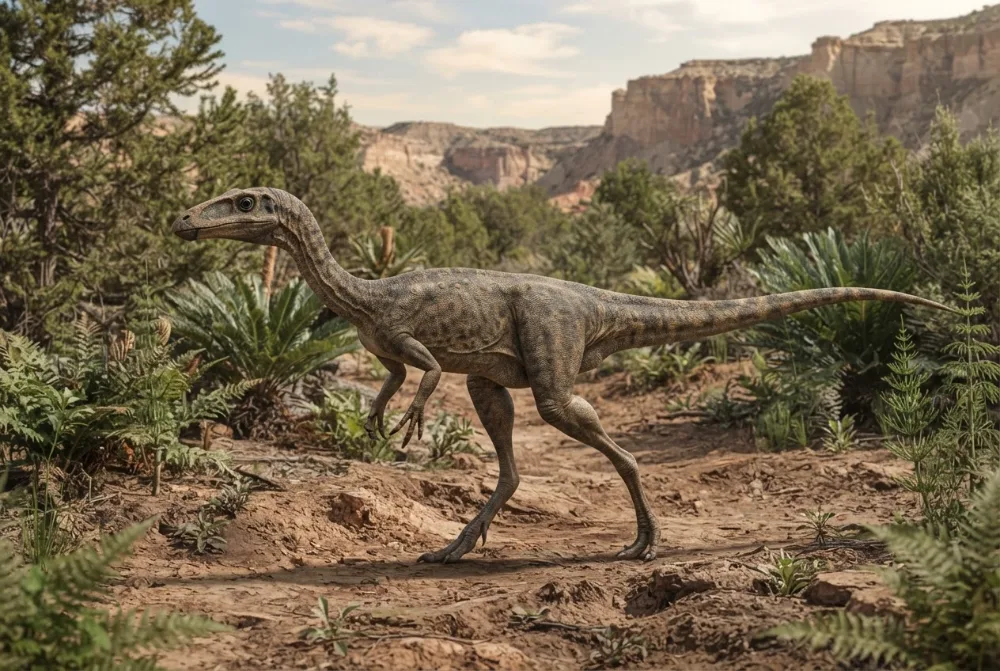
Eucoelophysis was a small, plant-eating dinosaur that lived about 212 million years ago in what is now New Mexico. It had a beak and walked on two legs, looking a bit like a long-legged lizard. Scientists once thought it was a meat-eater, but now they know it munched on plants.12
E tshetse leng?
E ne e le kgolo go le kae?
E ne e le telele go le kae?
E ne e le kwa godimo go le kae?
kakanyo
 telele jaaka dintšwa di le 3 go tswa kwa nkong go ya kwa mogatleng🍌telele jaaka dibanana di le 17 di latelana🏃e ne e ka taboga dimetara di le 100 mo metsotswaneng e le 7.8 (motho yo o bonako go gaisa o tlhoka 9,6)
Eucoelophysis e ne e le kgolo go le kae fa e bapisiwa le WENA?
Ke dipalo fela mo sebatling sa gago. Ga go sepe se se bolokwang kgotsa se se romelwang gope.
E ne e le bonako go le kae?


Dintlha tse di monate
Its fossils were first found in the 1880s by David Baldwin, but were mixed up with another dinosaur called Coelophysis.1
For a long time, scientists thought Eucoelophysis was a meat-eating dinosaur, but in 2007 a study showed it was actually a plant-eater related to Silesaurus.1
Eucoelophysis lived during the Late Triassic period, about 212 million years ago.1
The name Eucoelophysis means 'true hollow form' because it was thought to be the real Coelophysis at first.1
Only a few bones of Eucoelophysis have been found, including parts of the hip and hind legs.1
Eucoelophysis is now placed in a group called Silesauridae, which are close relatives of dinosaurs.1
Dipotso tse di botswang thata ka ga Eucoelophysis
?Was Eucoelophysis a dinosaur?
No, it is not a dinosaur. Scientists now place it in a group called Silesauridae, which are close relatives of dinosaurs but not true dinosaurs.1
?How big was Eucoelophysis?
The exact size is not known from the few bones found, but it was a small animal, probably about the size of a modern turkey or a small dog.1
?What did Eucoelophysis eat?
It was a plant-eater. It had a beak and munched on plants, unlike the meat-eating dinosaurs it was once mistaken for.1
?When did Eucoelophysis live?
It lived during the Late Triassic period, about 212 million years ago, in what is now New Mexico.1
Ya baitseanape ba didino
- Leina la saense
- Eucoelophysis
- Leina le neilwe ke
- Sullivan and Lucas 19992
- Setlhopha
- Dija-dimela tse di nang le melomo
- Lelapa / clade
- Silesauridae2
- Thulaganyo
- Ornithischia2
- Bogolo jwa matlapa
- 227 go ya go 201 dimilione tsa dingwaga (Norian / Rhaetian)2
- Dibopego tsa matlapa
- Chinle2
- Dinaga
- Amerika2
- Direkoto tsa difosili
- 2 mo The Paleobiology Database2
- Go fitlhelwa
- Eucoelophysis was named in 1999 by Robert Sullivan and Spencer Lucas based on a skeleton found in New Mexico. The species name baldwini honors David Baldwin, who collected the first fossils in the 1880s.12
- Go sa ntse go ganetsanwa
- Scientists are still debating whether some fossils from the Snyder Quarry and Hayden Quarry belong to Eucoelophysis or to other animals.1
Kwa dintlha di tswang teng
- Eucoelophysis (en.wikipedia.org)
- Eucoelophysis in The Paleobiology Database (CC BY 4.0): dingwaga, mafelo, dibopego tsa matlapa, thulaganyo.
Ntlha nngwe le nngwe mo tsebeng eno e na le nomoro e e supang motswedi wa yona. Fa re dirile phoso, maitshwarelo, re barati ba didino, ga re lokwalodikgang lwa saense. Re bolelele kwa [email protected] mme re tla e baakanya.
 Rex o tshwerwe ke tlala! Dino Wiki ke porojeke ya rre e a e diretseng morwawe yo o ratang didino, ke mahala, ga e na dipapatso e bile ga e na dilatedi. Batho ba bagolo ba ka fepa Rex senyamo go thusa gore e nne mo inthaneteng.Fepa Rex
 Iguanodon
 Tenontosaurus
 Thescelosaurus
 Zalmoxes
 Camptosaurus
 Rhabdodon
 Nothosaurus
 Massospondylus
 Plateosaurus
 Coelophysis
 Podokesaurus
 Simosaurus