 O dino efe? Kwisi
 Ntwa ya didino
 Peiso ya didino
 Metshamekwana ya didino
 Alebamo ya disetikara
 Manane a TOP a didino
 Ngakgamatsa!
Gobihadros
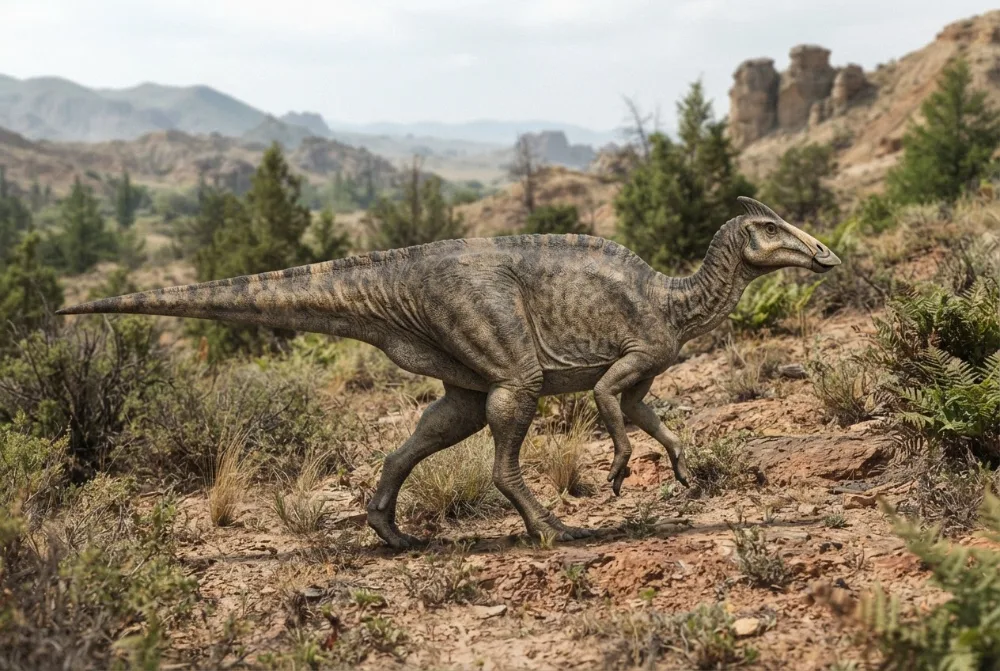
Gobihadros was a small, plant-eating dinosaur that lived in what is now Mongolia. It had a beak like a duck and could walk on two legs or all fours. Scientists found a nearly complete skeleton, so we know a lot about its body.1
E tshetse leng?
E ne e le kgolo go le kae?
E ne e le telele go le kae?
E ne e le kwa godimo go le kae?
kakanyo
 telele jaaka dintšwa di le 8 go tswa kwa nkong go ya kwa mogatleng🍌telele jaaka dibanana di le 42 di latelana🏃e ne e ka taboga dimetara di le 100 mo metsotswaneng e le 12 (motho yo o bonako go gaisa o tlhoka 9,6)
Gobihadros e ne e le kgolo go le kae fa e bapisiwa le WENA?
Ke dipalo fela mo sebatling sa gago. Ga go sepe se se bolokwang kgotsa se se romelwang gope.
E ne e le bonako go le kae?


Dintlha tse di monate
Gobihadros is the first non-hadrosaurid hadrosauroid from the Late Cretaceous of central Asia known from a complete, articulated skull and skeleton.1
It had up to three functional teeth in each tooth position in its lower jaw, which is unusual for a hadrosauroid.1
The upper jaw of Gobihadros had a 'double-layer' oral margin, a feature also seen in later hadrosaurids.1
Its ilium (hip bone) had a sigmoidal (S-shaped) upper outline and a fan-shaped rear process, which helped scientists identify it as a new species.1
Gobihadros had a spike-like thumb claw on its hand, which it may have used for defense or digging.1
The fossils were collected by a joint Mongolian-Japanese expedition between 1993 and 2004.1
Dipotso tse di botswang thata ka ga Gobihadros
?How big was Gobihadros?
About 7.5 metres (25 feet) long for the largest fully grown individuals, though some specimens were smaller, like 3 metres (9.8 feet) for an immature one.3
?What did Gobihadros eat?
It was a plant-eater. It had a beak like a duck and up to three functional teeth in each spot in its lower jaw to chew plants.3
?Did Gobihadros have a thumb spike?
Yes, it had a conical, spike-like claw on its first finger, which it may have used for defense or digging.3
?When did Gobihadros live?
It lived during the Late Cretaceous period, about 100 to 84 million years ago (Cenomanian to Santonian stages).3
Ya baitseanape ba didino
- Leina la saense
- Gobihadros
- Leina le neilwe ke
- Tsogtbaatar et al. 20194
- Setlhopha
- Dija-dimela tse di nang le melomo
- Lelapa / clade
- Hadrosauroidea4
- Thulaganyo
- Ornithischia > Ornithopoda > Iguanodontia4
- Bogolo jwa matlapa
- 100 go ya go 84 dimilione tsa dingwaga (Cenomanian / Santonian)4
- Dibopego tsa matlapa
- Baynshire4
- Dinaga
- Mongolia4
- Direkoto tsa difosili
- 6 mo The Paleobiology Database4
- Go fitlhelwa
- Gobihadros was named in 2019 by Khishigjav Tsogtbaatar, David B. Weishampel, David C. Evans, and Mahito Watabe. The type specimen, a nearly complete skeleton, was found at Bayshin Tsav in the Gobi Desert, Mongolia.41
- Go sa ntse go ganetsanwa
- Scientists are not sure whether Gobihadros was a direct ancestor of later hadrosaurids or just a close cousin.1
Kwa dintlha di tswang teng
- journals.plos.org (journals.plos.org)
- PBDB Taxon (paleobiodb.org)
- Gobihadros (en.wikipedia.org)
- Gobihadros in The Paleobiology Database (CC BY 4.0): dingwaga, mafelo, dibopego tsa matlapa, thulaganyo.
Ntlha nngwe le nngwe mo tsebeng eno e na le nomoro e e supang motswedi wa yona. Fa re dirile phoso, maitshwarelo, re barati ba didino, ga re lokwalodikgang lwa saense. Re bolelele kwa [email protected] mme re tla e baakanya.
 Rex o tshwerwe ke tlala! Dino Wiki ke porojeke ya rre e a e diretseng morwawe yo o ratang didino, ke mahala, ga e na dipapatso e bile ga e na dilatedi. Batho ba bagolo ba ka fepa Rex senyamo go thusa gore e nne mo inthaneteng.Fepa Rex
 Iguanodon
 Tenontosaurus
 Thescelosaurus
 Zalmoxes
 Camptosaurus
 Rhabdodon
 Tyrannosaurus
 Triceratops
 Velociraptor
 Spinosaurus
 Ankylosaurus
 Parasaurolophus