 O dino efe? Kwisi
 Ntwa ya didino
 Peiso ya didino
 Metshamekwana ya didino
 Alebamo ya disetikara
 Manane a TOP a didino
 Ngakgamatsa!
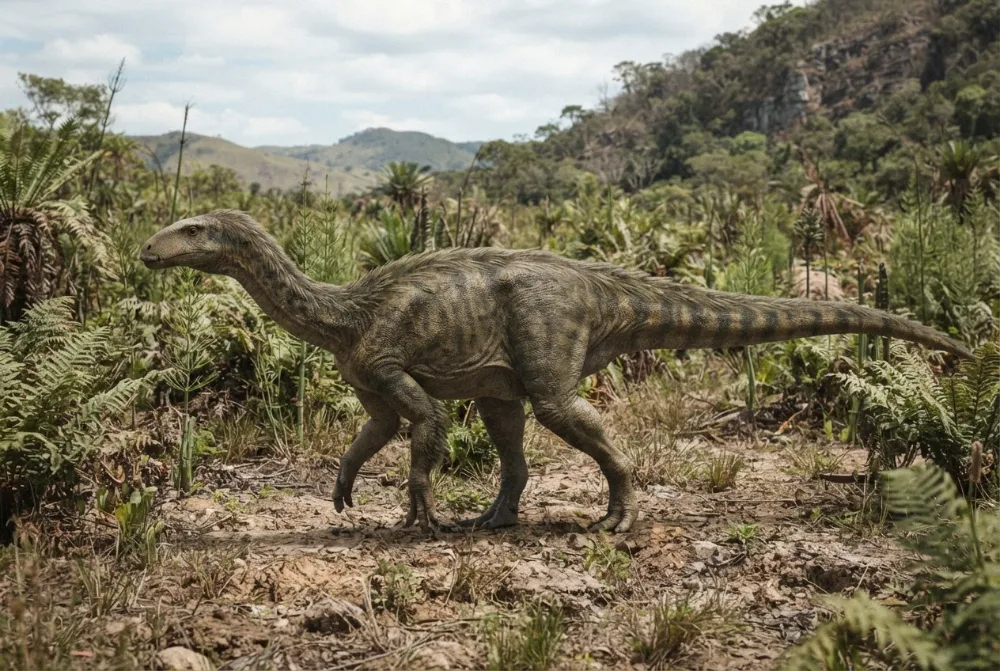
Guaibasaurus
Guaibasaurus was one of the earliest plant-eating dinosaurs. It lived in what is now Brazil during the Late Triassic, around 225 million years ago. This small dinosaur had a long neck and may have walked on two legs or four.321
E tshetse leng?
E ne e le kgolo go le kae?
E ne e le telele go le kae?
E ne e le kwa godimo go le kae?
kakanyo
E ne e le bokete go le kae?

 telele jaaka dintšwa di le 3 go tswa kwa nkong go ya kwa mogatleng🍌telele jaaka dibanana di le 17 di latelana🍉bokete jaaka magapu a le 7🏃e ne e ka taboga dimetara di le 100 mo metsotswaneng e le 11 (motho yo o bonako go gaisa o tlhoka 9,6)
Guaibasaurus e ne e le kgolo go le kae fa e bapisiwa le WENA?
Ke dipalo fela mo sebatling sa gago. Ga go sepe se se bolokwang kgotsa se se romelwang gope.
E ne e le bonako go le kae?


Dintlha tse di monate
Guaibasaurus fossils have been found in a sleeping posture, with legs tucked under the body and arms bent to the side, similar to modern birds.2
This dinosaur lived about 225.42 million years ago, based on uranium-lead dating of the rocks where its fossils were found.2
Scientists are not sure if Guaibasaurus was an early theropod or an early sauropodomorph. Most studies place it among the sauropodomorphs.21
The name Guaibasaurus comes from the Rio Guaíba basin in Brazil, where the first fossil was discovered during a scientific project.21
Only one species of Guaibasaurus is known, called Guaibasaurus candelariensis. The species name honors the nearby city of Candelária.2
Dipotso tse di botswang thata ka ga Guaibasaurus
?How big was Guaibasaurus?
Scientists give different estimates. Gregory S. Paul said it was about 2 metres long (6.6 ft) and weighed 10 kg (22 lbs), while Molina-Pérez and Larramendi said it was about 3 metres long (10 ft) and 35 kg (77 lbs).2
?What did Guaibasaurus eat?
It was a plant-eater, or herbivore.1
?When did Guaibasaurus live?
It lived during the Late Triassic Period, about 225.42 million years ago.2
?Why did Guaibasaurus sleep like a bird?
One fossil was found with its legs tucked under its body and arms bent to the side, just like resting birds. Scientists think it may have slept this way to keep warm.2
Ya baitseanape ba didino
- Leina la saense
- Guaibasaurus
- Leina le neilwe ke
- Bonaparte et al. 19993
- Setlhopha
- Melala-meleele
- Lelapa / clade
- Guaibasauridae3
- Thulaganyo
- Sauropodomorpha3
- Bogolo jwa matlapa
- 227 go ya go 206 dimilione tsa dingwaga (Norian)3
- Dibopego tsa matlapa
- Caturrita3
- Dinaga
- Borasele3
- Direkoto tsa difosili
- 3 mo The Paleobiology Database3
- Go fitlhelwa
- Guaibasaurus was named in 1999 by paleontologists José F. Bonaparte, Jorge Ferigolo, and Ana Maria Ribeiro. They described it based on a partial skeleton found in the Caturrita Formation of Brazil.213
- Go sa ntse go ganetsanwa
- Scientists still debate whether Guaibasaurus was a very early sauropodomorph or a primitive theropod. Its exact place on the dinosaur family tree is not settled.21
Kwa dintlha di tswang teng
- Guaibasaurus | Natural History Museum (nhm.ac.uk)
- Guaibasaurus (en.wikipedia.org)
- Guaibasaurus in The Paleobiology Database (CC BY 4.0): dingwaga, mafelo, dibopego tsa matlapa, thulaganyo.
Ntlha nngwe le nngwe mo tsebeng eno e na le nomoro e e supang motswedi wa yona. Fa re dirile phoso, maitshwarelo, re barati ba didino, ga re lokwalodikgang lwa saense. Re bolelele kwa [email protected] mme re tla e baakanya.
 Rex o tshwerwe ke tlala! Dino Wiki ke porojeke ya rre e a e diretseng morwawe yo o ratang didino, ke mahala, ga e na dipapatso e bile ga e na dilatedi. Batho ba bagolo ba ka fepa Rex senyamo go thusa gore e nne mo inthaneteng.Fepa Rex
 Brachiosaurus
 Diplodocus
 Brontosaurus
 Argentinosaurus
 Camarasaurus
 Morosaurus
 Nothosaurus
 Coelophysis
 Podokesaurus
 Simosaurus
 Eudimorphodon
 Herrerasaurus