 O dino efe? Kwisi
 Ntwa ya didino
 Peiso ya didino
 Metshamekwana ya didino
 Alebamo ya disetikara
 Manane a TOP a didino
 Ngakgamatsa!
Iberomesornis
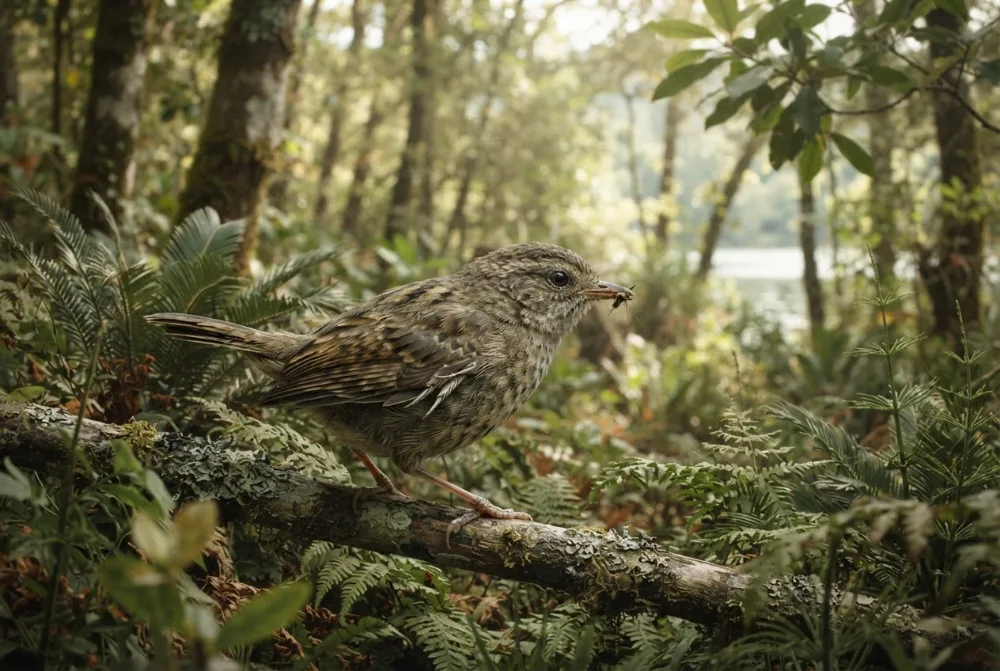
Iberomesornis was a tiny bird that lived about 125 million years ago in what is now Spain. It was no bigger than a sparrow and fluttered through warm forests near lakes, snatching insects. It was an early bird, but not a dinosaur like T. rex, it was a type of bird called an enantiornithine.1
E tshetse leng?
E ne e le kgolo go le kae?
E ne e le telele go le kae?
E ne e le bokete go le kae?
Iberomesornis e ne e le kgolo go le kae fa e bapisiwa le WENA?
Ke dipalo fela mo sebatling sa gago. Ga go sepe se se bolokwang kgotsa se se romelwang gope.
E ne e le bonako go le kae?


Dintlha tse di monate
Iberomesornis had a single claw on each wing, which is unusual for modern birds.1
Its tail was short and ended in a pygostyle, a fused bone that supports tail feathers, making it more advanced than Archaeopteryx.1
It had strong, clawed feet for perching on branches, with long curved toes and a special toe that helped it grip.1
The fossil was found in rocks that were once a forest around a lake, with a warm climate and a dry season.1
Its ribcage did not have bony uncinate processes, but scientists think it had cartilage there instead.1
Iberomesornis is one of the earliest known enantiornithine birds, a group that lived alongside dinosaurs.1
Dipotso tse di botswang thata ka ga Iberomesornis
?How big was Iberomesornis?
It was tiny, no bigger than a large modern sparrow. Its wingspan was about 20 centimetres (8 inches) and it weighed 15 to 20 grams (0.5 to 0.7 ounces).1
?What did Iberomesornis eat?
Nobody knows for sure because its skull has not been found. It probably hunted insects and other small animals, catching them in the air or from the ground.1
?Could Iberomesornis fly?
Yes, it could flap its wings and fly. A 2025 study found that it had strong muscles for flapping flight, even though it lacked a bony keel on its breastbone.2
?When did Iberomesornis live?
It lived about 125 million years ago, during the Early Cretaceous period. Its fossils were found in Spain.1
Mothubi wa ditlhamane
Tlhamane: Some people think Iberomesornis was a dinosaur like Velociraptor.
Boammaaruri: It was a bird, specifically an enantiornithine, which is a type of bird that lived in the Cretaceous. Birds are related to dinosaurs, but they are not the same as non-avian dinosaurs.1
Ya baitseanape ba didino
- Leina la saense
- Iberomesornis
- Leina le neilwe ke
- Sanz et al. 19903
- Setlhopha
- Dinonyane tsa ntlha
- Lelapa / clade
- Enantiornithes3
- Thulaganyo
- Theropoda > Avialae3
- Bogolo jwa matlapa
- 126 go ya go 121 dimilione tsa dingwaga (Barremian)3
- Dibopego tsa matlapa
- La Huérguina3
- Dinaga
- Sepania3
- Direkoto tsa difosili
- 2 mo The Paleobiology Database3
- Go fitlhelwa
- The fossil was found in 1985 by Armando Díaz Romeral in Spain. It was named Iberomesornis romerali in 1992 by José Luis Sanz and José Fernando Bonaparte.1
- Go sa ntse go ganetsanwa
- Scientists are not sure what Iberomesornis ate because its skull has not been found, so they guess it ate insects and small animals.1
Kwa dintlha di tswang teng
- Iberomesornis (en.wikipedia.org)
- Micro-CT reconstruction reveals new information about the phylogenetic position and locomotion of the Early Cretaceous bird Iberomesornis romerali (dinosaurier-info.de)
- Iberomesornis in The Paleobiology Database (CC BY 4.0): dingwaga, mafelo, dibopego tsa matlapa, thulaganyo.
Ntlha nngwe le nngwe mo tsebeng eno e na le nomoro e e supang motswedi wa yona. Fa re dirile phoso, maitshwarelo, re barati ba didino, ga re lokwalodikgang lwa saense. Re bolelele kwa [email protected] mme re tla e baakanya.
 Rex o tshwerwe ke tlala! Dino Wiki ke porojeke ya rre e a e diretseng morwawe yo o ratang didino, ke mahala, ga e na dipapatso e bile ga e na dilatedi. Batho ba bagolo ba ka fepa Rex senyamo go thusa gore e nne mo inthaneteng.Fepa Rex
 Archaeopteryx
 Hesperornis
 Ichthyornis
 Baptornis
 Jurapteryx
 Gobipteryx
 Stegosaurus
 Iguanodon
 Giganotosaurus
 Microraptor
 Deinonychus
 Baryonyx