 O dino efe? Kwisi
 Ntwa ya didino
 Peiso ya didino
 Metshamekwana ya didino
 Alebamo ya disetikara
 Manane a TOP a didino
 Ngakgamatsa!
E tshetse leng?

E ne e le kgolo go le kae?
E ne e le telele go le kae?
Jeholosaurus e ne e le kgolo go le kae fa e bapisiwa le WENA?
Ke dipalo fela mo sebatling sa gago. Ga go sepe se se bolokwang kgotsa se se romelwang gope.
E ne e le bonako go le kae?


Dintlha tse di monate
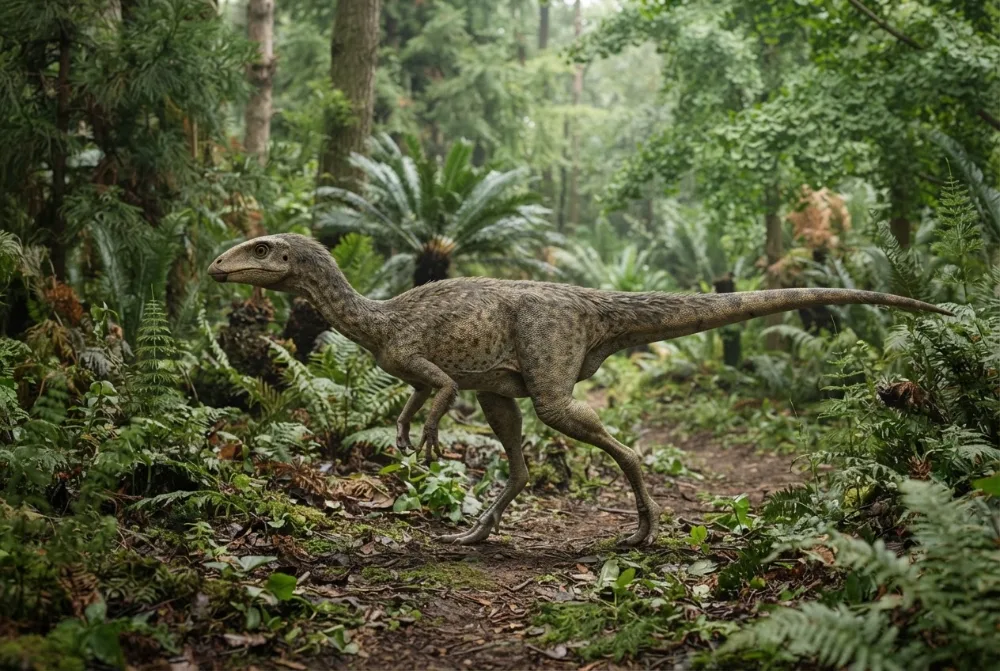
Jeholosaurus had a very fast tooth replacement rate, with new teeth growing every 46 days, faster than most early plant-eaters.1
Its eye socket was huge, making up 40% of the skull length, which is a sign it was a young animal.1
The front teeth were narrow and long, like a meat-eater's, but the back teeth were fan-shaped for chewing plants.1
The hip bone pointed backward, which is typical for ornithischian dinosaurs, but it also had a forward-pointing bone that supported its belly.1
All known fossils are from young animals, so scientists don't know exactly how big an adult could get.1
Dipotso tse di botswang thata ka ga Jeholosaurus
?How big was Jeholosaurus?
The known fossils are from young animals, so the adult size is unknown. The largest specimen is about 71 centimetres long, with a skull of 6.3 centimetres.1
?What did Jeholosaurus eat?
It mostly ate plants, using its beak and fan-shaped cheek teeth. But its front teeth were sharp like a meat-eater's, so it might have also eaten small animals or bugs.1
?Was Jeholosaurus a dinosaur?
Yes, Jeholosaurus was a small ornithischian dinosaur, a group of plant-eating dinosaurs with bird-like hips.1
?Why did Jeholosaurus have a beak?
The beak helped it nip off plants. Its cheek teeth were fan-shaped for grinding them up, and it may have had fleshy cheeks to hold food while chewing.1
Mothubi wa ditlhamane
Tlhamane: Jeholosaurus was a meat-eater because it had sharp front teeth.
Boammaaruri: Its back teeth were for chewing plants, and it likely ate plants, though it might have eaten some insects or small animals too.1
Ya baitseanape ba didino
- Leina la saense
- Jeholosaurus
- Leina le neilwe ke
- Xu et al. 20003
- Setlhopha
- Dija-dimela tse di nang le melomo
- Lelapa / clade
- Thescelosauridae3
- Thulaganyo
- Ornithischia3
- Bogolo jwa matlapa
- 126 go ya go 120 dimilione tsa dingwaga (Barremian / Aptian)3
- Dibopego tsa matlapa
- Yixian3
- Dinaga
- Tšhaena3
- Direkoto tsa difosili
- 2 mo The Paleobiology Database3
- Go fitlhelwa
- The first fossils were found in 2000 at Lujiatun near Beipiao City, China, and named by Xu Xing and colleagues the same year.1
- Go sa ntse go ganetsanwa
- Scientists still debate whether Jeholosaurus was a plant-eater or an omnivore, because its front teeth were sharp and its back teeth were for plants.1
Kwa dintlha di tswang teng
- Jeholosaurus (en.wikipedia.org)
- Cranial anatomy of Jeholosaurus shangyuanensis (Dinosauria: Ornithischia) from the Early Cretaceous of China | Zootaxa (mapress.com)
- Jeholosaurus in The Paleobiology Database (CC BY 4.0): dingwaga, mafelo, dibopego tsa matlapa, thulaganyo.
Ntlha nngwe le nngwe mo tsebeng eno e na le nomoro e e supang motswedi wa yona. Fa re dirile phoso, maitshwarelo, re barati ba didino, ga re lokwalodikgang lwa saense. Re bolelele kwa [email protected] mme re tla e baakanya.
 Rex o tshwerwe ke tlala! Dino Wiki ke porojeke ya rre e a e diretseng morwawe yo o ratang didino, ke mahala, ga e na dipapatso e bile ga e na dilatedi. Batho ba bagolo ba ka fepa Rex senyamo go thusa gore e nne mo inthaneteng.Fepa Rex
 Iguanodon
 Tenontosaurus
 Thescelosaurus
 Zalmoxes
 Camptosaurus
 Rhabdodon
 Stegosaurus
 Archaeopteryx
 Giganotosaurus
 Microraptor
 Deinonychus
 Baryonyx