 O dino efe? Kwisi
 Ntwa ya didino
 Peiso ya didino
 Metshamekwana ya didino
 Alebamo ya disetikara
 Manane a TOP a didino
 Ngakgamatsa!
Jiuquanornis
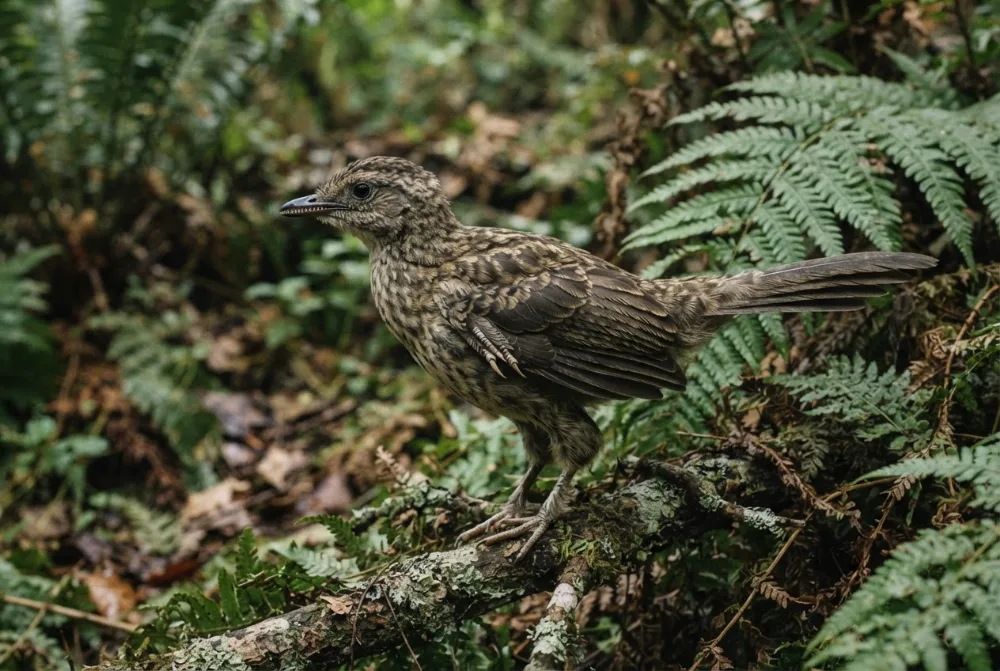
Jiuquanornis was a small, bird-like dinosaur that lived about 120 million years ago. It had a U-shaped wishbone and a sternum that looked like those of some modern ground birds. Scientists think it might have been a fast runner that ate meat.12
E tshetse leng?
E ne e le bonako go le kae?


Dintlha tse di monate
Jiuquanornis is known from a single fossil that was first described in 2013. The fossil includes parts of the sternum, furcula, and forelimb.1
Its sternum had long, thin projections called trabeculae, which are also seen in modern ground-dwelling birds like chickens and tinamous.1
Jiuquanornis had a U-shaped furcula (wishbone) with a low angle of about 36 degrees, and it lacked a hypocleidium, a small projection found in some birds.1
Scientists think Jiuquanornis was a basal ornithuromorph, meaning it was an early relative of modern birds but not a direct ancestor.1
The fossil of Jiuquanornis was found in the Xiagou Formation, which is about 121 to 113 million years old, from the Early Cretaceous period.21
Jiuquanornis was named after the city of Jiuquan, which is near the fossil site. The species name niui honors Professor Shao-Wu Niu for his geological work.1
The fossil of Jiuquanornis was originally thought to be too incomplete to name, but scientists later decided it was different enough from other birds to be a new species.1
Ya baitseanape ba didino
- Leina la saense
- Jiuquanornis
- Leina le neilwe ke
- Wang et al. 20132
- Setlhopha
- Dinonyane tsa ntlha
- Lelapa / clade
- Ornithuromorpha2
- Thulaganyo
- Theropoda > Avialae2
- Bogolo jwa matlapa
- 121 go ya go 113 dimilione tsa dingwaga (Aptian)2
- Dibopego tsa matlapa
- Xiagou2
- Dinaga
- Tšhaena2
- Direkoto tsa difosili
- 1 mo The Paleobiology Database2
- Go fitlhelwa
- Jiuquanornis was named in 2013 by Wang and colleagues. The fossil, specimen GSGM-05-CM-021, was found in the Xiagou Formation near Changma in Gansu Province, China. It was first described as an unnamed bird in 2005, but later recognized as a new species.12
- Go sa ntse go ganetsanwa
- Scientists are not sure whether Jiuquanornis lived on the ground or in the water, because its fossil is too incomplete to tell. Its sternum shape suggests it might have been a fast runner, but more fossils are needed.1
Kwa dintlha di tswang teng
- Previously Unrecognized Ornithuromorph Bird Diversity in the Early Cretaceous Changma Basin, Gansu Province, Northwestern China (journals.plos.org)
- Jiuquanornis in The Paleobiology Database (CC BY 4.0): dingwaga, mafelo, dibopego tsa matlapa, thulaganyo.
Ntlha nngwe le nngwe mo tsebeng eno e na le nomoro e e supang motswedi wa yona. Fa re dirile phoso, maitshwarelo, re barati ba didino, ga re lokwalodikgang lwa saense. Re bolelele kwa [email protected] mme re tla e baakanya.
 Rex o tshwerwe ke tlala! Dino Wiki ke porojeke ya rre e a e diretseng morwawe yo o ratang didino, ke mahala, ga e na dipapatso e bile ga e na dilatedi. Batho ba bagolo ba ka fepa Rex senyamo go thusa gore e nne mo inthaneteng.Fepa Rex
 Archaeopteryx
 Hesperornis
 Ichthyornis
 Baptornis
 Jurapteryx
 Gobipteryx
 Stegosaurus
 Iguanodon
 Giganotosaurus
 Microraptor
 Deinonychus
 Baryonyx