 O dino efe? Kwisi
 Ntwa ya didino
 Peiso ya didino
 Metshamekwana ya didino
 Alebamo ya disetikara
 Manane a TOP a didino
 Ngakgamatsa!
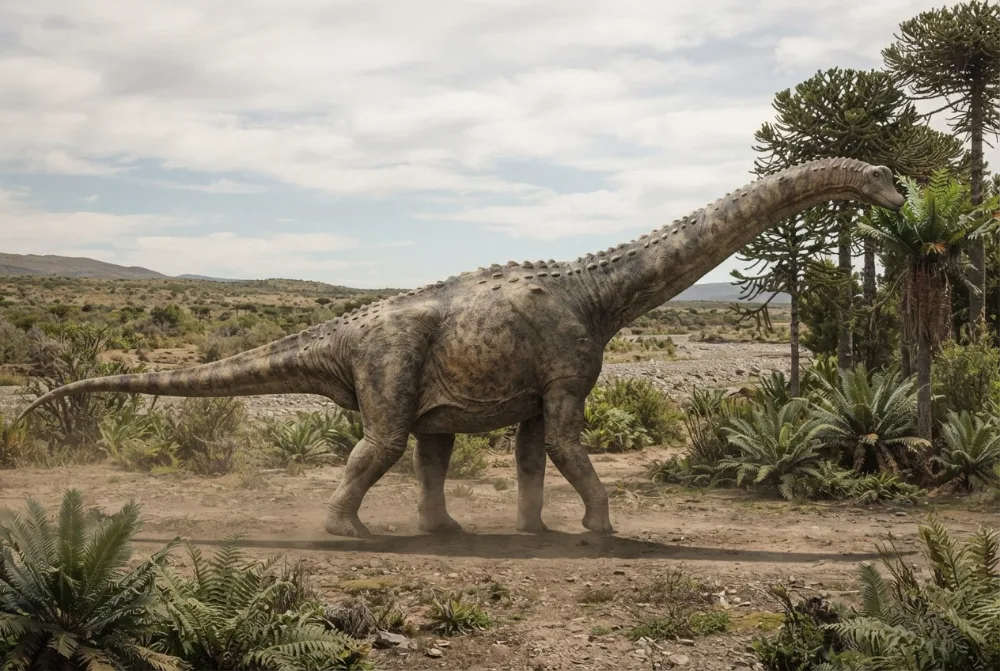
Kaijutitan
Kaijutitan was a giant, long-necked plant-eater that lived in what is now Argentina. It is one of the earliest known titanosaurs, a group that includes the biggest dinosaurs ever. Its neck bones had a strange split shape, like a fork.42
E tshetse leng?
E ne e le kgolo go le kae?
E ne e le bokete go le kae?

Kaijutitan e ne e le kgolo go le kae fa e bapisiwa le WENA?
Ke dipalo fela mo sebatling sa gago. Ga go sepe se se bolokwang kgotsa se se romelwang gope.
E ne e le bonako go le kae?


Dintlha tse di monate
Kaijutitan is the latest known basal titanosaur, meaning it lived near the end of the time when early titanosaurs existed.2
Its neck vertebrae had bifid (split) neural spines, a feature that evolved several times among sauropods but is rare in titanosaurs.2
The fossil includes part of the skull, which is very unusual for large titanosaurs because their skulls are rarely preserved.2
Kaijutitan lived about 89 to 86 million years ago, during the Coniacian stage of the Late Cretaceous.4
Its bones were found scattered in an area of about 20 square metres, suggesting the carcass fell apart before being buried.2
The species name maui honors the Museo Municipal Argentino Urquiza (MAU), where the fossil is stored.1
Dipotso tse di botswang thata ka ga Kaijutitan
?How big was Kaijutitan?
Scientists don't know its exact size yet, but it was a huge sauropod, one of the giant titanosaurs. Its bones show it was an adult of huge body size.31
?What did Kaijutitan eat?
Kaijutitan was a plant-eater, like all sauropods. It used its long neck to reach leaves from tall trees.1
Ya baitseanape ba didino
- Leina la saense
- Kaijutitan
- Leina le neilwe ke
- Filippi et al. 20194
- Setlhopha
- Melala-meleele
- Lelapa / clade
- Lithostrotia4
- Thulaganyo
- Sauropodomorpha > Sauropoda > Titanosauria > Macronaria4
- Bogolo jwa matlapa
- 90 go ya go 86 dimilione tsa dingwaga (Coniacian)4
- Dibopego tsa matlapa
- Sierra Barrosa4
- Dinaga
- Arejentina4
- Direkoto tsa difosili
- 1 mo The Paleobiology Database4
- Go fitlhelwa
- Kaijutitan was named in 2019 by paleontologists Leonardo Filippi, Leonardo Salgado, and Alberto Garrido. The skeleton was found by a team from the Museo Municipal Argentino Urquiza and the Museo Provincial de Ciencias Naturales in Argentina.42
- Go sa ntse go ganetsanwa
- Scientists are not sure exactly how big Kaijutitan was, because only a partial skeleton has been found.2
Kwa dintlha di tswang teng
- Kaijutitan (en.wikipedia.org)
- A new giant basal titanosaur sauropod in the Upper Cretaceous (Coniacian) of the NeuquEn Basin, Argentina (rid.unrn.edu.ar)
- KAIJUTITAN MAUI, A SAUROPOD TITANOSAUR FROM THE UPPER CRETACEOUS (SIERRA BARROSA FORMATION, NEUQUÉN BASIN) OF NORTHERN PATAGONIA ARGENTINA: HISTOLOGICAL AND TAPHONOMIC CONSIDERATIONS | Publicación Electrónica de la Asociación Paleontológica Argentina (peapaleontologica.org.ar)
- Kaijutitan in The Paleobiology Database (CC BY 4.0): dingwaga, mafelo, dibopego tsa matlapa, thulaganyo.
Ntlha nngwe le nngwe mo tsebeng eno e na le nomoro e e supang motswedi wa yona. Fa re dirile phoso, maitshwarelo, re barati ba didino, ga re lokwalodikgang lwa saense. Re bolelele kwa [email protected] mme re tla e baakanya.
 Rex o tshwerwe ke tlala! Dino Wiki ke porojeke ya rre e a e diretseng morwawe yo o ratang didino, ke mahala, ga e na dipapatso e bile ga e na dilatedi. Batho ba bagolo ba ka fepa Rex senyamo go thusa gore e nne mo inthaneteng.Fepa Rex
 Brachiosaurus
 Diplodocus
 Brontosaurus
 Argentinosaurus
 Camarasaurus
 Morosaurus
 Tyrannosaurus
 Triceratops
 Velociraptor
 Spinosaurus
 Ankylosaurus
 Parasaurolophus