 O dino efe? Kwisi
 Ntwa ya didino
 Peiso ya didino
 Metshamekwana ya didino
 Alebamo ya disetikara
 Manane a TOP a didino
 Ngakgamatsa!
Kentrosaurus
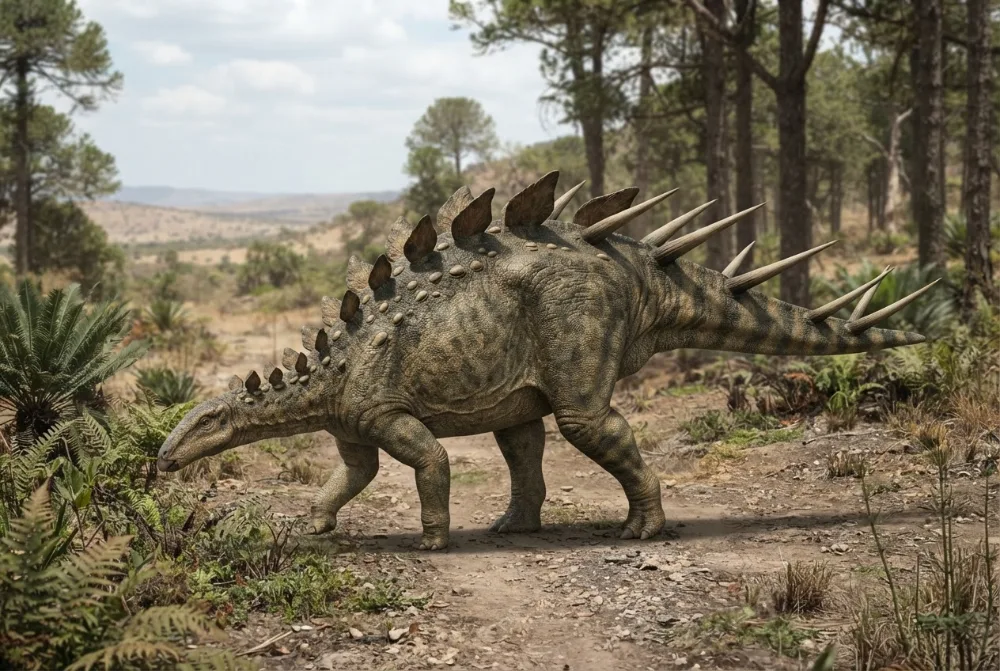
Kentrosaurus was a plated dinosaur that lived in what is now Tanzania, Africa, about 152 million years ago. It had a row of small plates on its neck and back that turned into long, sharp spikes on its tail. It used those tail spikes to fight off hungry meat-eaters!1
E tshetse leng?
E ne e le kgolo go le kae?
E ne e le telele go le kae?
E ne e le kwa godimo go le kae?
E ne e le bokete go le kae?

 telele jaaka dintšwa di le 5 go tswa kwa nkong go ya kwa mogatleng🍌telele jaaka dibanana di le 28 di latelanabokete jaaka dintšwa di le 80🍉bokete jaaka magapu a le 320🧸bokete jaaka bana ba kreše ba le 84🎒bokete jaaka bana ba sekolo ba le 50🐻❄️bokete jaaka dibere tse ditshweu di le 4🏃e ne e ka taboga dimetara di le 100 mo metsotswaneng e le 18 (motho yo o bonako go gaisa o tlhoka 9,6)
Kentrosaurus e ne e le kgolo go le kae fa e bapisiwa le WENA?
Ke dipalo fela mo sebatling sa gago. Ga go sepe se se bolokwang kgotsa se se romelwang gope.
E ne e le bonako go le kae?


Dintlha tse di monate
Kentrosaurus had a long spike on each shoulder, in addition to the spikes on its tail.1
The name Kentrosaurus was almost changed because it sounded like Centrosaurus, a horned dinosaur. But the spelling is different, so Kentrosaurus stayed.1
Scientists think there were two types of Kentrosaurus, one with stouter thigh bones and one with slimmer ones. This might mean males and females looked different.1
Over 1200 bones of Kentrosaurus were found in Tanzania by German expeditions between 1909 and 1912.1
Kentrosaurus lived alongside giant long-necked sauropods like Giraffatitan and Tornieria.1
The plates on its neck and back were probably covered in horn, like a cow's horn.1
Dipotso tse di botswang thata ka ga Kentrosaurus
?How big was Kentrosaurus?
Kentrosaurus was about 4 to 5 metres (13 to 16 feet) long and weighed roughly 700 to 1,600 kilograms (1,500 to 3,500 pounds). Some specimens suggest even larger individuals existed.13
?What did Kentrosaurus eat?
Kentrosaurus was a herbivore, meaning it ate plants. It used its toothless beak to bite off leaves and other plant material, which it swallowed in large chunks without much chewing.14
?Did Kentrosaurus have spikes?
Yes, Kentrosaurus had a double row of spikes along its back, from its mid-section to the tip of its tail, plus a long spike on each shoulder. These spikes were likely used for defense.14
?Could Kentrosaurus swim?
There is no direct evidence that Kentrosaurus could swim. It was a land-dwelling dinosaur that walked on four legs, and its body was not specially adapted for swimming.1
?Was Kentrosaurus bigger than a T. rex?
No, Kentrosaurus was much smaller than Tyrannosaurus rex. Kentrosaurus was about 4 to 5 metres long, while T. rex could be over 12 metres long; they lived in different times and places.1
?Did Kentrosaurus have feathers?
No, Kentrosaurus did not have feathers. It had bony plates and spikes covered in horn, and its skin was likely scaly, like other stegosaurs.1
?When did Kentrosaurus live?
Kentrosaurus lived during the Late Jurassic period, about 152 million years ago, in what is now Tanzania, Africa.1
?Why did Kentrosaurus have plates?
The plates on Kentrosaurus's neck and back might have been for temperature regulation, since they contained blood vessels, or for protection and display. No one knows for sure.4
Mothubi wa ditlhamane
Tlhamane: Some people think Kentrosaurus had all its spikes and plates in a single row down its back.
Boammaaruri: Scientists think Kentrosaurus had two rows of plates and spikes, one on each side of its back.1
Ya baitseanape ba didino
- Leina la saense
- Kentrosaurus
- Leina le neilwe ke
- Hennig 19155
- Setlhopha
- Didino tse di nang le dipoleiti
- Lelapa / clade
- Stegosauridae5
- Thulaganyo
- Ornithischia > Stegosauria > Thyreophora5
- Bogolo jwa matlapa
- 162 go ya go 143 dimilione tsa dingwaga (Oxfordian / Tithonian)5
- Dibopego tsa matlapa
- Tendaguru5
- Dinaga
- Tanzania5
- Direkoto tsa difosili
- 27 mo The Paleobiology Database5
- E itsiwe gape e le
- Doryphorosaurus, Kentrurosaurus (maina a bogologolo jaanong a balwa jaaka phologolo e le nngwe)5
- Go fitlhelwa
- German paleontologist Edwin Hennig named Kentrosaurus in 1915. The first fossils were found by the German Tendaguru Expedition in 1909.15
- Go sa ntse go ganetsanwa
- Scientists are not sure exactly where each plate and spike was placed on the body, because most were found scattered.1
Kwa dintlha di tswang teng
- Kentrosaurus (en.wikipedia.org)
- Kentrosaurus | Natural History Museum (nhm.ac.uk)
- Kentrosaurus | dinosaur genus | Britannica (britannica.com)
- Kentrosaurus - Dinosaur - Enchanted Learning Software (enchantedlearning.com)
- Kentrosaurus in The Paleobiology Database (CC BY 4.0): dingwaga, mafelo, dibopego tsa matlapa, thulaganyo.
Ntlha nngwe le nngwe mo tsebeng eno e na le nomoro e e supang motswedi wa yona. Fa re dirile phoso, maitshwarelo, re barati ba didino, ga re lokwalodikgang lwa saense. Re bolelele kwa [email protected] mme re tla e baakanya.
 Rex o tshwerwe ke tlala! Dino Wiki ke porojeke ya rre e a e diretseng morwawe yo o ratang didino, ke mahala, ga e na dipapatso e bile ga e na dilatedi. Batho ba bagolo ba ka fepa Rex senyamo go thusa gore e nne mo inthaneteng.Fepa Rex
 Stegosaurus
 Diracodon
 Hypsirophus
 Dacentrurus
 Miragaia
 Hesperosaurus
 Brachiosaurus
 Diplodocus
 Allosaurus
 Brontosaurus
 Compsognathus
 Camarasaurus