 O dino efe? Kwisi
 Ntwa ya didino
 Peiso ya didino
 Metshamekwana ya didino
 Alebamo ya disetikara
 Manane a TOP a didino
 Ngakgamatsa!
Miragaia
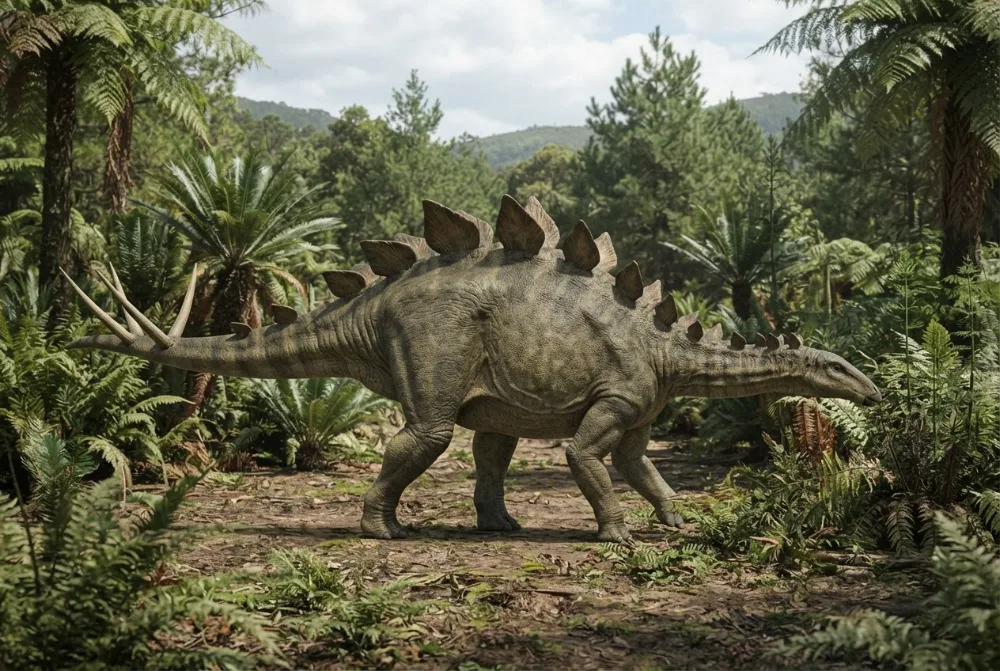
Miragaia was a stegosaur, a plant-eating dinosaur with plates and spines on its back. It had an unusually long neck, much longer than most other stegosaurs. This gentle giant lived in what is now Portugal and the United States during the Late Jurassic period.12
E tshetse leng?
E ne e le kgolo go le kae?
E ne e le telele go le kae?
E ne e le kwa godimo go le kae?
kakanyo
 telele jaaka dintšwa di le 6 go tswa kwa nkong go ya kwa mogatleng🍌telele jaaka dibanana di le 36 di latelana🏃e ne e ka taboga dimetara di le 100 mo metsotswaneng e le 24 (motho yo o bonako go gaisa o tlhoka 9,6)
Miragaia e ne e le kgolo go le kae fa e bapisiwa le WENA?
Ke dipalo fela mo sebatling sa gago. Ga go sepe se se bolokwang kgotsa se se romelwang gope.
E ne e le bonako go le kae?


Dintlha tse di monate
Miragaia had at least 17 neck vertebrae, giving it a very long neck for a stegosaur. Most stegosaurs had fewer than 13.1
The name Miragaia comes from the village where it was found, Miragaia in Portugal, and also means 'wonderful goddess of the Earth'.1
Miragaia belonged to a group called Dacentrurinae, which includes its close relative Dacentrurus. Scientists used to think many stegosaur fossils from Portugal and Spain were Dacentrurus, but now they know some are Miragaia.1
A nearly complete skeleton of Miragaia was discovered in 1959 in Atouguia da Baleia, Peniche, Portugal, but it was not described until many years later.1
Miragaia shared features with a stegosaur from Wyoming called Alcovasaurus longispinus, suggesting that a land bridge once connected North America and Iberia (Portugal and Spain).1
The plates on Miragaia's back were probably used for display, and the spines on its tail (called a thagomizer) could have been a weapon against predators.1
Mothubi wa ditlhamane
Tlhamane: Miragaia is sometimes thought to be a species of Dacentrurus.
Boammaaruri: Scientists now agree that Miragaia is a separate, valid genus, different from Dacentrurus in many ways, such as its longer neck and different vertebrae.1
Ya baitseanape ba didino
- Leina la saense
- Miragaia
- Leina le neilwe ke
- Mateus et al. 20093
- Setlhopha
- Didino tse di nang le dipoleiti
- Lelapa / clade
- Stegosauridae3
- Thulaganyo
- Ornithischia > Stegosauria > Thyreophora3
- Bogolo jwa matlapa
- 155 go ya go 121 dimilione tsa dingwaga (Kimmeridgian / Barremian)3
- Dibopego tsa matlapa
- Morrison3
- Dinaga
- Amerika3
- Direkoto tsa difosili
- 31 mo The Paleobiology Database3
- Go fitlhelwa
- Miragaia was named in 2009 by Octávio Mateus and colleagues, based on a partial skeleton found near the village of Miragaia in the Lourinhã Formation of Portugal. The holotype specimen includes much of the front half of the skeleton.1
- Go sa ntse go ganetsanwa
- Scientists still debate exactly how many species of Miragaia existed, and whether some fossils from North America belong to this genus or to its close relative Dacentrurus.2
Kwa dintlha di tswang teng
- Dacentrurine stegosaurs (Dinosauria): A new specimen of Miragaia longicollum from the Late Jurassic of Portugal resolves taxonomical validity and shows the occurrence of the clade in North America (pmc.ncbi.nlm.nih.gov)
- Dacentrurine Stegosaurs in North America: New Occurrences from the Upper Jurassic of USA (Morrison Formation) (dinodata.de)
- Miragaia in The Paleobiology Database (CC BY 4.0): dingwaga, mafelo, dibopego tsa matlapa, thulaganyo.
Ntlha nngwe le nngwe mo tsebeng eno e na le nomoro e e supang motswedi wa yona. Fa re dirile phoso, maitshwarelo, re barati ba didino, ga re lokwalodikgang lwa saense. Re bolelele kwa [email protected] mme re tla e baakanya.
 Rex o tshwerwe ke tlala! Dino Wiki ke porojeke ya rre e a e diretseng morwawe yo o ratang didino, ke mahala, ga e na dipapatso e bile ga e na dilatedi. Batho ba bagolo ba ka fepa Rex senyamo go thusa gore e nne mo inthaneteng.Fepa Rex
 Stegosaurus
 Diracodon
 Hypsirophus
 Dacentrurus
 Kentrosaurus
 Hesperosaurus
 Iguanodon
 Archaeopteryx
 Giganotosaurus
 Microraptor
 Deinonychus
 Baryonyx