 O dino efe? Kwisi
 Ntwa ya didino
 Peiso ya didino
 Metshamekwana ya didino
 Alebamo ya disetikara
 Manane a TOP a didino
 Ngakgamatsa!
Kourisodon
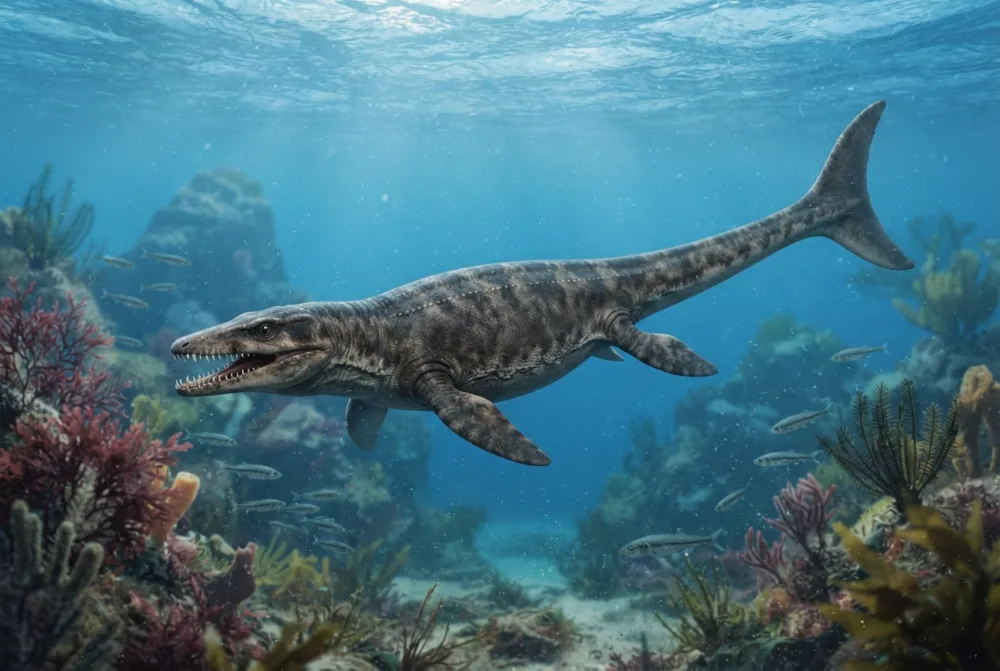
Kourisodon was a small, fast-swimming marine lizard that lived in the late Cretaceous seas. It had sharp, blade-like teeth for slicing through fish and other prey. Even though it was a mosasaur, not a dinosaur, it was a fierce predator in its ocean home.1
E tshetse leng?
E ne e le kgolo go le kae?
E ne e le telele go le kae?
 telele jaaka dintšwa di le 4 go tswa kwa nkong go ya kwa mogatleng🍌telele jaaka dibanana di le 21 di latelana🏊e ne e ka thuma boleele jwa letamo le legolo la go thuma (50 m) mo metsotswaneng e le 4.9
Kourisodon e ne e le kgolo go le kae fa e bapisiwa le WENA?
Ke dipalo fela mo sebatling sa gago. Ga go sepe se se bolokwang kgotsa se se romelwang gope.
E ne e le bonako go le kae?


Dintlha tse di monate
Kourisodon was a small mosasaur, only about 3.75 metres (12.3 feet) long, much smaller than giants like Mosasaurus.1
Its name means 'razor tooth' in Greek, because its teeth were shaped like blades.1
Fossils of Kourisodon have been found in both Canada and Japan, showing it lived in the Pacific Ocean.12
The first Kourisodon fossil was discovered along the Puntledge River on Vancouver Island, and the species was named K. puntledgensis after that river.1
A life-sized replica of the Puntledge River specimen is on display at the Canadian Fossil Discovery Centre in Morden, Manitoba.1
Kourisodon lived alongside long-necked plesiosaurs (elasmosaurids), turtles, and other mosasaurs, but no short-necked plesiosaurs (polycotylids) were found in its Canadian home.1
Ya baitseanape ba didino
- Leina la saense
- Kourisodon
- Leina le neilwe ke
- Nicholls and Meckert 20023
- Setlhopha
- Dimosasoro
- Lelapa / clade
- Mosasauridae3
- Thulaganyo
- Mosasauroidea3
- Bogolo jwa matlapa
- 86 go ya go 66 dimilione tsa dingwaga (Santonian / Maastrichtian)3
- Dibopego tsa matlapa
- Pender, Hiketa, Mutsuo3
- Dinaga
- Japane, Khanata3
- Direkoto tsa difosili
- 3 mo The Paleobiology Database3
- Go fitlhelwa
- Kourisodon was named in 2002 by paleontologists Elizabeth Nicholls and Dirk Meckert, based on a fossil found on Vancouver Island, Canada. The type species is K. puntledgensis.13
- Go sa ntse go ganetsanwa
- Scientists are not sure if the Japanese fossils belong to a second, unnamed species of Kourisodon, because they have slightly different teeth.1
Kwa dintlha di tswang teng
- Kourisodon (en.wikipedia.org)
- Kourisodon sp. (Mosasauridae) from the Upper Cretaceous Izumi Group (Upper Campanian) of Kanewari, Tawa, Sanuki City, Kagawa Prefecture, Southwest Japan (gbank.gsj.jp)
- Kourisodon in The Paleobiology Database (CC BY 4.0): dingwaga, mafelo, dibopego tsa matlapa, thulaganyo.
Ntlha nngwe le nngwe mo tsebeng eno e na le nomoro e e supang motswedi wa yona. Fa re dirile phoso, maitshwarelo, re barati ba didino, ga re lokwalodikgang lwa saense. Re bolelele kwa [email protected] mme re tla e baakanya.
 Rex o tshwerwe ke tlala! Dino Wiki ke porojeke ya rre e a e diretseng morwawe yo o ratang didino, ke mahala, ga e na dipapatso e bile ga e na dilatedi. Batho ba bagolo ba ka fepa Rex senyamo go thusa gore e nne mo inthaneteng.Fepa Rex
 Mosasaurus
 Prognathodon
 Tylosaurus
 Platecarpus
 Clidastes
 Globidens
 Tyrannosaurus
 Triceratops
 Velociraptor
 Spinosaurus
 Ankylosaurus
 Parasaurolophus