 O dino efe? Kwisi
 Ntwa ya didino
 Peiso ya didino
 Metshamekwana ya didino
 Alebamo ya disetikara
 Manane a TOP a didino
 Ngakgamatsa!
E tshetse leng?

E ne e le kgolo go le kae?
E ne e le telele go le kae?
E ne e le kwa godimo go le kae?
kakanyo
Kunpengornis e ne e le kgolo go le kae fa e bapisiwa le WENA?
Ke dipalo fela mo sebatling sa gago. Ga go sepe se se bolokwang kgotsa se se romelwang gope.
E ne e le bonako go le kae?


Dintlha tse di monate
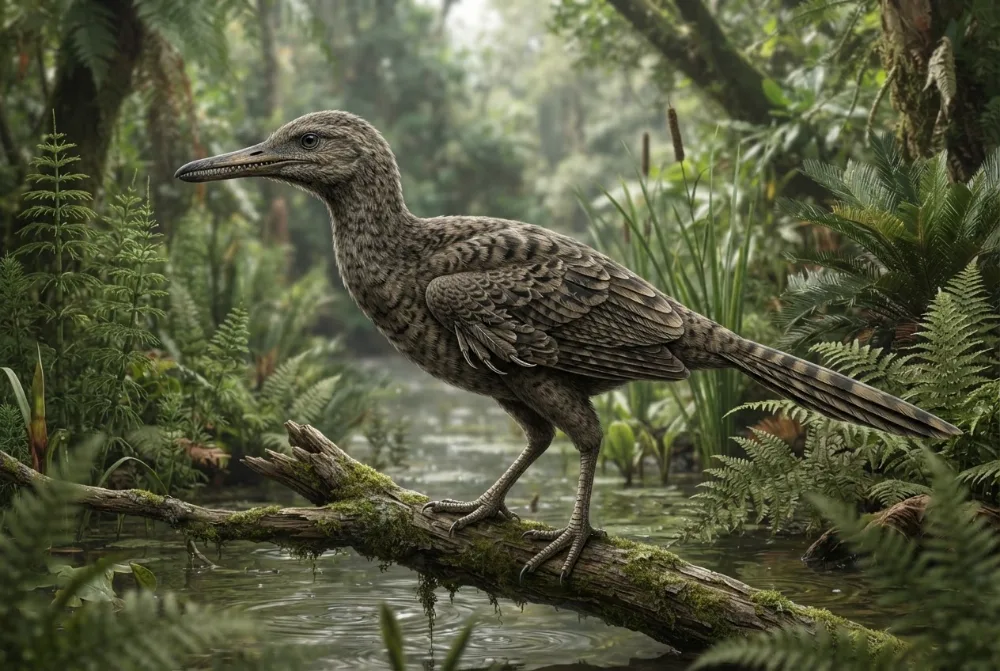
Kunpengornis is the fourth Early Cretaceous bird found with direct evidence of eating fish.2
It lived in a lake environment in what is now China, about 121 to 113 million years ago.2
Kunpengornis had a long, pointed beak and small teeth only in the back half of its upper jaw.2
Its name comes from Kunpeng, a giant mythical bird from Chinese folklore.1
The only known fossil is a nearly complete skeleton found by a farmer and donated to a museum.2
Kunpengornis was not fully grown when it died; its bones were still fusing together.2
Dipotso tse di botswang thata ka ga Kunpengornis
?Was Kunpengornis a dinosaur?
Yes, Kunpengornis is a bird, and birds are a type of dinosaur called avialan dinosaurs.1
?What did Kunpengornis eat?
Kunpengornis ate fish. Fossilized fish bones were found in its stomach, proving it was a fish-eater.12
?How big was Kunpengornis?
Kunpengornis was a medium-sized bird, but its exact size is not given in the sources. Its skull was about 2.6 times longer than it was tall, and its rostrum (beak) made up nearly 60 percent of the skull length.2
Mothubi wa ditlhamane
Tlhamane: Kunpengornis is a dinosaur.
Boammaaruri: Kunpengornis is a bird (avialan), not a non-avian dinosaur. Birds evolved from dinosaurs but are in a different group.1
Ya baitseanape ba didino
- Leina la saense
- Kunpengornis
- Leina le neilwe ke
- Huang et al. 20264
- Setlhopha
- Dinonyane tsa ntlha
- Lelapa / clade
- Euornithes4
- Thulaganyo
- Theropoda > Avialae4
- Bogolo jwa matlapa
- 121 go ya go 113 dimilione tsa dingwaga (Aptian)4
- Dibopego tsa matlapa
- Jiufotang4
- Dinaga
- Tšhaena4
- Direkoto tsa difosili
- 1 mo The Paleobiology Database4
- Go fitlhelwa
- A local farmer found the nearly complete skeleton in Liaoning, China. It was given to the Anhui Geological Museum in 2023. Scientists named it Kunpengornis anhuimusei in 2026.23
- Go sa ntse go ganetsanwa
- Scientists are not sure exactly how Kunpengornis is related to other early fish-eating birds. It may have been part of a group that includes Yanornis and Piscivoravis.2
Kwa dintlha di tswang teng
- Kunpengornis (en.wikipedia.org)
- A new euornithine from the Lower Cretaceous (Aptian) of China reveals the first radiation of fish-eating birds (dinosaurier-info.de)
- PBDB Taxon (paleobiodb.org)
- Kunpengornis in The Paleobiology Database (CC BY 4.0): dingwaga, mafelo, dibopego tsa matlapa, thulaganyo.
Ntlha nngwe le nngwe mo tsebeng eno e na le nomoro e e supang motswedi wa yona. Fa re dirile phoso, maitshwarelo, re barati ba didino, ga re lokwalodikgang lwa saense. Re bolelele kwa [email protected] mme re tla e baakanya.
 Rex o tshwerwe ke tlala! Dino Wiki ke porojeke ya rre e a e diretseng morwawe yo o ratang didino, ke mahala, ga e na dipapatso e bile ga e na dilatedi. Batho ba bagolo ba ka fepa Rex senyamo go thusa gore e nne mo inthaneteng.Fepa Rex
 Archaeopteryx
 Hesperornis
 Ichthyornis
 Baptornis
 Jurapteryx
 Gobipteryx
 Stegosaurus
 Iguanodon
 Giganotosaurus
 Microraptor
 Deinonychus
 Baryonyx