 O dino efe? Kwisi
 Ntwa ya didino
 Peiso ya didino
 Metshamekwana ya didino
 Alebamo ya disetikara
 Manane a TOP a didino
 Ngakgamatsa!
E tshetse leng?

E ne e le bonako go le kae?


Dintlha tse di monate
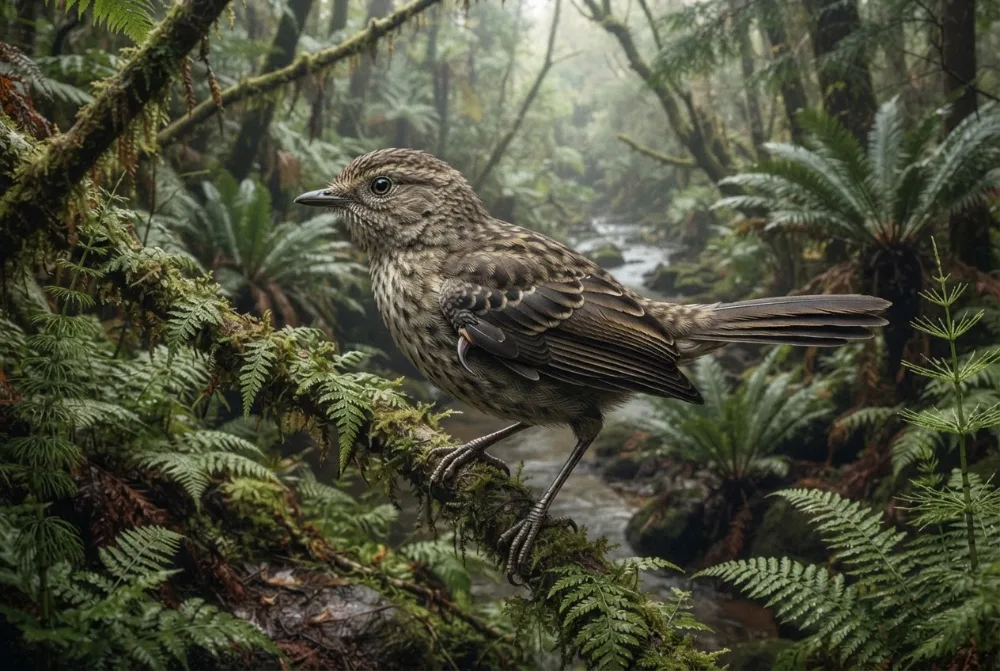
Musivavis is known from a single, nearly complete skeleton that is beautifully preserved on one slab of rock.2
It was much smaller than its closest relatives, the bohaiornithids, which were large-bodied enantiornithine birds.2
Its name comes from Latin words meaning 'mosaic' and 'bird', because it has a mix of features from different bird groups.2
Musivavis lived about 122 to 119 million years ago during the Aptian age of the Early Cretaceous.1
It had a furcula (wishbone) with a very deep groove and a sharp keel running along its entire underside.2
The specimen was a young adult, but scientists think it was almost full size when it died.2
Ya baitseanape ba didino
- Leina la saense
- Musivavis
- Leina le neilwe ke
- Wang et al. 20224
- Setlhopha
- Dinonyane tsa ntlha
- Lelapa / clade
- Enantiornithes4
- Thulaganyo
- Theropoda > Avialae4
- Bogolo jwa matlapa
- 121 go ya go 113 dimilione tsa dingwaga (Aptian)4
- Dibopego tsa matlapa
- Jiufotang4
- Dinaga
- Tšhaena4
- Direkoto tsa difosili
- 1 mo The Paleobiology Database4
- Go fitlhelwa
- Musivavis was named in 2022 by Wang and colleagues based on a nearly complete skeleton found in the Jiufotang Formation of Liaoning, China.12
- Go sa ntse go ganetsanwa
- Scientists are not sure exactly where Musivavis fits in the enantiornithine family tree, because different bird groups evolved similar features separately.2
Kwa dintlha di tswang teng
- Musivavis (en.wikipedia.org)
- A new bohaiornithid-like bird from the Lower Cretaceous of China fills a gap in enantiornithine disparity | Journal of Paleontology | Cambridge Core (cambridge.org)
- PBDB Taxon (paleobiodb.org)
- Musivavis in The Paleobiology Database (CC BY 4.0): dingwaga, mafelo, dibopego tsa matlapa, thulaganyo.
Ntlha nngwe le nngwe mo tsebeng eno e na le nomoro e e supang motswedi wa yona. Fa re dirile phoso, maitshwarelo, re barati ba didino, ga re lokwalodikgang lwa saense. Re bolelele kwa [email protected] mme re tla e baakanya.
 Rex o tshwerwe ke tlala! Dino Wiki ke porojeke ya rre e a e diretseng morwawe yo o ratang didino, ke mahala, ga e na dipapatso e bile ga e na dilatedi. Batho ba bagolo ba ka fepa Rex senyamo go thusa gore e nne mo inthaneteng.Fepa Rex
 Archaeopteryx
 Hesperornis
 Ichthyornis
 Baptornis
 Jurapteryx
 Gobipteryx
 Stegosaurus
 Iguanodon
 Giganotosaurus
 Microraptor
 Deinonychus
 Baryonyx