 O dino efe? Kwisi
 Ntwa ya didino
 Peiso ya didino
 Metshamekwana ya didino
 Alebamo ya disetikara
 Manane a TOP a didino
 Ngakgamatsa!
Pluridens
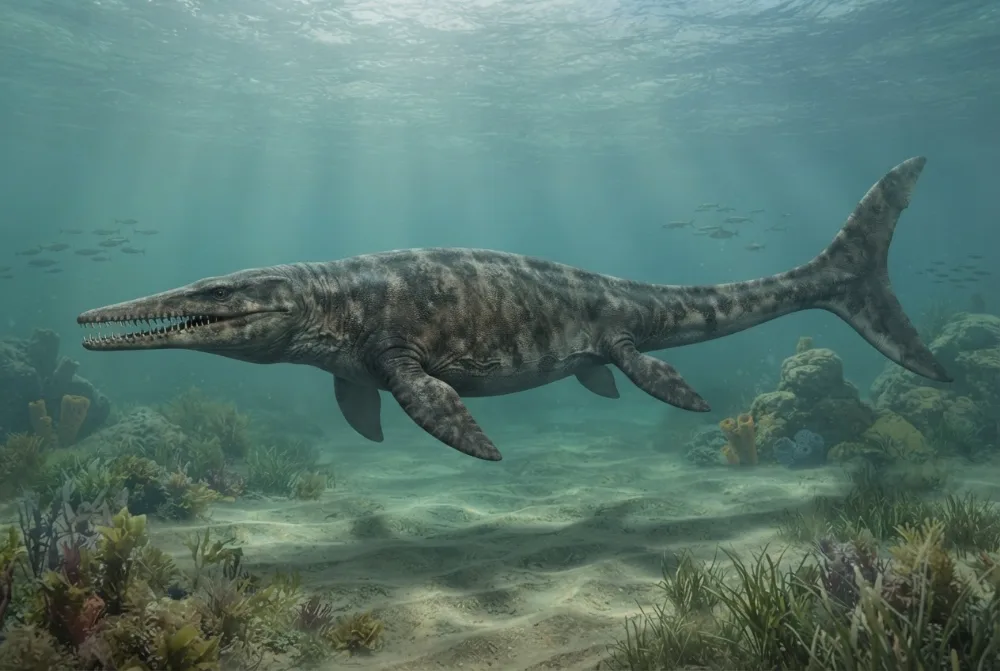
Pluridens was a giant sea lizard that swam in the warm, shallow seas of West Africa near the end of the age of dinosaurs. It had a very long, slender jaw packed with lots of small teeth, perfect for catching slippery fish and squid.1
E tshetse leng?
E ne e le kgolo go le kae?
E ne e le telele go le kae?
 telele jaaka dintšwa di le 6 go tswa kwa nkong go ya kwa mogatleng🍌telele jaaka dibanana di le 33 di latelana🏊e ne e ka thuma boleele jwa letamo le legolo la go thuma (50 m) mo metsotswaneng e le 4.7
Pluridens e ne e le kgolo go le kae fa e bapisiwa le WENA?
Ke dipalo fela mo sebatling sa gago. Ga go sepe se se bolokwang kgotsa se se romelwang gope.
E ne e le bonako go le kae?


Dintlha tse di monate
Pluridens had almost twice as many teeth as most other mosasaurs, with at least 28 teeth in each lower jaw bone.1
Its lower jaw was very slender and long, shaped almost like a circle in cross-section near the tip.1
Some Pluridens jaws show injuries that scientists think came from fighting over mates or territory.1
The first Pluridens fossil was a nearly complete lower jaw found in Niger, Africa.1
Scientists think Pluridens may have fed like early ichthyosaurs, using its long jaws to snap up prey.1
Dipotso tse di botswang thata ka ga Pluridens
?How big was Pluridens?
About 5 to 6 metres (16 to 20 feet) long, and some individuals may have been over 9 metres (30 feet).1
?What did Pluridens eat?
It ate small prey like fish and squid, using its many small, sharp teeth to grab them.2
?Did Pluridens have good eyesight?
No, it had small eyes and probably relied on touch and sensing water movements to hunt, like modern sea snakes.32
?When did Pluridens go extinct?
It died out about 66 million years ago, when the asteroid hit and wiped out most species on Earth.2
Ya baitseanape ba didino
- Leina la saense
- Pluridens
- Leina le neilwe ke
- Lingham-Soliar 19984
- Setlhopha
- Dimosasoro
- Lelapa / clade
- Mosasauridae4
- Thulaganyo
- Mosasauroidea4
- Bogolo jwa matlapa
- 84 go ya go 66 dimilione tsa dingwaga (Campanian / Maastrichtian)4
- Dibopego tsa matlapa
- Couche III, Farin-Doutchi, Nkporo Shale4
- Dinaga
- Moroko, Niger, Naejeria4
- Direkoto tsa difosili
- 4 mo The Paleobiology Database4
- Go fitlhelwa
- Pluridens was named by Theagarten Lingham-Soliar in 1998 based on a lower jaw from the Maastrichtian of Niger.14
- Go sa ntse go ganetsanwa
- Scientists are not sure exactly how long Pluridens could grow, because only jaws and skulls have been found so far.1
Kwa dintlha di tswang teng
- Pluridens (en.wikipedia.org)
- Giant sea lizard fossil shows diversity of life before asteroid hit (bath.ac.uk)
- Alternative formats If you require this document in an alternative format, please contact: [email protected] (purehost.bath.ac.uk)
- Pluridens in The Paleobiology Database (CC BY 4.0): dingwaga, mafelo, dibopego tsa matlapa, thulaganyo.
Ntlha nngwe le nngwe mo tsebeng eno e na le nomoro e e supang motswedi wa yona. Fa re dirile phoso, maitshwarelo, re barati ba didino, ga re lokwalodikgang lwa saense. Re bolelele kwa [email protected] mme re tla e baakanya.
 Rex o tshwerwe ke tlala! Dino Wiki ke porojeke ya rre e a e diretseng morwawe yo o ratang didino, ke mahala, ga e na dipapatso e bile ga e na dilatedi. Batho ba bagolo ba ka fepa Rex senyamo go thusa gore e nne mo inthaneteng.Fepa Rex
 Mosasaurus
 Prognathodon
 Tylosaurus
 Platecarpus
 Clidastes
 Globidens
 Tyrannosaurus
 Triceratops
 Velociraptor
 Spinosaurus
 Ankylosaurus
 Parasaurolophus