 O dino efe? Kwisi
 Ntwa ya didino
 Peiso ya didino
 Metshamekwana ya didino
 Alebamo ya disetikara
 Manane a TOP a didino
 Ngakgamatsa!
Qantassaurus
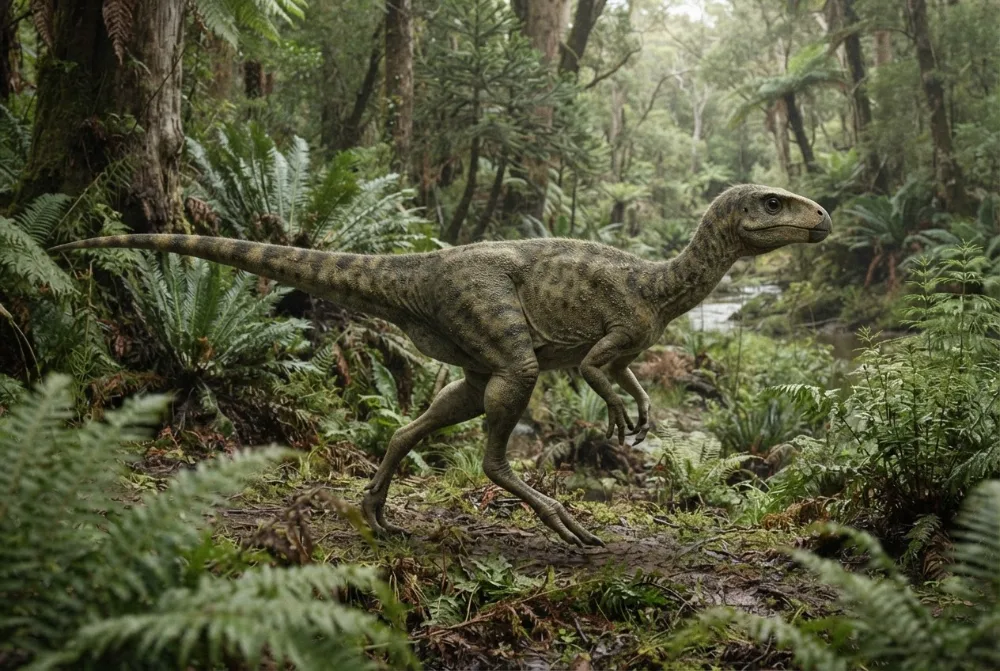
Qantassaurus was a small, fast plant-eater that lived in Australia during the Early Cretaceous. It had a very short, deep lower jaw with only ten cheek teeth, which made it different from other small ornithopods. It probably ate ferns and horsetails that grew close to the ground.1
E tshetse leng?
E ne e le kgolo go le kae?
E ne e le telele go le kae?
E ne e le kwa godimo go le kae?
E ne e le bokete go le kae?
 telele jaaka dikatse tsa mo gae di le 4 go tswa kwa nkong go ya kwa mogatleng🍌telele jaaka dibanana di le 11 di latelana🍉bokete jaaka magapu a le 6🏃e ne e ka taboga dimetara di le 100 mo metsotswaneng e le 8.8 (motho yo o bonako go gaisa o tlhoka 9,6)
Qantassaurus e ne e le kgolo go le kae fa e bapisiwa le WENA?
Ke dipalo fela mo sebatling sa gago. Ga go sepe se se bolokwang kgotsa se se romelwang gope.
E ne e le bonako go le kae?


Dintlha tse di monate
Qantassaurus is known only from its lower jaw bones, and scientists have found three of them.1
Its lower jaw was unusually short and deep, with the top and bottom edges slanting toward the front.1
It had only ten cheek teeth on each side of its lower jaw, fewer than most other small ornithopods.1
Qantassaurus lived in a rift valley between Australia and Antarctica as the two continents were slowly pulling apart.1
The fossils were found in rocks that are about 125 to 127 million years old, from the late Barremian age.2
Its teeth are very similar to those of another Australian dinosaur, Atlascopcosaurus, but the jaws are different shapes.1
Qantassaurus was named after the airline Qantas, which helped transport the fossils.1
Dipotso tse di botswang thata ka ga Qantassaurus
?How big was Qantassaurus?
About 1.8 metres long and about 1 metre tall.3
?Why is it called Qantassaurus?
It was named after the Australian airline Qantas, which helped transport the fossils.13
?Could Qantassaurus run fast?
Yes, it probably was a fast runner because it had long thighs and long shins, like its relatives.3
Ya baitseanape ba didino
- Leina la saense
- Qantassaurus
- Leina le neilwe ke
- Rich and Vickers-Rich 19994
- Setlhopha
- Dija-dimela tse di nang le melomo
- Lelapa / clade
- Elasmaria4
- Thulaganyo
- Ornithischia > Ornithopoda > Iguanodontia4
- Bogolo jwa matlapa
- 126 go ya go 121 dimilione tsa dingwaga (Barremian)4
- Dibopego tsa matlapa
- Wonthaggi4
- Dinaga
- Ositerelia4
- Direkoto tsa difosili
- 2 mo The Paleobiology Database4
- Go fitlhelwa
- Qantassaurus was named by scientists Thomas Rich and Patricia Vickers-Rich in 1999. The first fossil, a complete left lower jaw, was found at the Flat Rocks site near Inverloch, Victoria, Australia.41
- Go sa ntse go ganetsanwa
- Scientists are not sure exactly how big Qantassaurus grew, because only jaw bones have been found.1
Kwa dintlha di tswang teng
- Dinosaur - Qantassaurus intrepidus - The Australian Museum (australian.museum)
- New small-bodied ornithopods (Dinosauria, Neornithischia) from the Early Cretaceous Wonthaggi Formation (Strzelecki Group) of the Australian-Antarctic rift system, with revision of Qantassaurus intrepidus Rich and Vickers-Rich, 1999 | Journal of Paleontology | Cambridge Core (cambridge.org)
- Qantassaurus (Wikipedia) (Wikipedia)
- Qantassaurus in The Paleobiology Database (CC BY 4.0): dingwaga, mafelo, dibopego tsa matlapa, thulaganyo.
Ntlha nngwe le nngwe mo tsebeng eno e na le nomoro e e supang motswedi wa yona. Fa re dirile phoso, maitshwarelo, re barati ba didino, ga re lokwalodikgang lwa saense. Re bolelele kwa [email protected] mme re tla e baakanya.
 Rex o tshwerwe ke tlala! Dino Wiki ke porojeke ya rre e a e diretseng morwawe yo o ratang didino, ke mahala, ga e na dipapatso e bile ga e na dilatedi. Batho ba bagolo ba ka fepa Rex senyamo go thusa gore e nne mo inthaneteng.Fepa Rex
 Iguanodon
 Tenontosaurus
 Thescelosaurus
 Zalmoxes
 Camptosaurus
 Rhabdodon
 Stegosaurus
 Archaeopteryx
 Giganotosaurus
 Microraptor
 Deinonychus
 Baryonyx