 O dino efe? Kwisi
 Ntwa ya didino
 Peiso ya didino
 Metshamekwana ya didino
 Alebamo ya disetikara
 Manane a TOP a didino
 Ngakgamatsa!
Rukwatitan
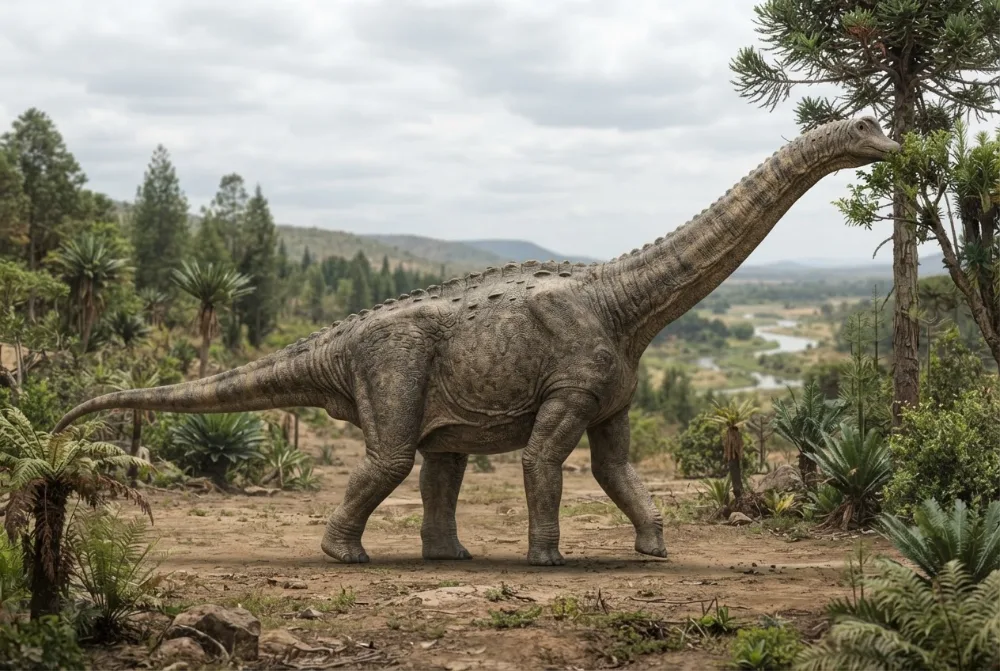
Rukwatitan was a long-necked dinosaur that lived in what is now Tanzania. It was a titanosaur, a type of sauropod, and it was about as long as a school bus. Its name means 'twice buried' because its bones were buried, then moved by a river and buried again.21
E tshetse leng?
E ne e le kgolo go le kae?
E ne e le telele go le kae?
E ne e le kwa godimo go le kae?
kakanyo
 telele jaaka dikoloi di le 2 di emisitswe mo moleng🍌telele jaaka dibanana di le 51 di latelana🏃e ne e ka taboga dimetara di le 100 mo metsotswaneng e le 14 (motho yo o bonako go gaisa o tlhoka 9,6)
Rukwatitan e ne e le kgolo go le kae fa e bapisiwa le WENA?
Ke dipalo fela mo sebatling sa gago. Ga go sepe se se bolokwang kgotsa se se romelwang gope.
E ne e le bonako go le kae?


Dintlha tse di monate
Rukwatitan's name includes 'bisepultus', which means 'twice buried' because part of its skeleton was first buried in mud, then washed away and reburied by a river.1
It lived about 100 million years ago, during the middle Cretaceous period.2
Its upper arm bone (humerus) had a square cross-section, which is unusual for sauropods.1
Rukwatitan shared its home with a crocodile-like reptile called Rukwasuchus, whose fossils were found at the same site.1
It was a basal (early) titanosaur, meaning it belonged to the group that later included the largest dinosaurs ever.1
The neck vertebrae of Rukwatitan had undivided air pockets (pleurocoels), which helped lighten its skeleton.1
Rukwatitan was about 9 meters (30 feet) long, roughly the length of a school bus.2
Ya baitseanape ba didino
- Leina la saense
- Rukwatitan
- Leina le neilwe ke
- Gorscak et al. 20143
- Setlhopha
- Melala-meleele
- Lelapa / clade
- Rinconsauria3
- Thulaganyo
- Sauropodomorpha > Sauropoda > Titanosauria > Macronaria3
- Bogolo jwa matlapa
- 100 go ya go 72 dimilione tsa dingwaga (Cenomanian / Campanian)3
- Dibopego tsa matlapa
- Galula3
- Dinaga
- Tanzania3
- Direkoto tsa difosili
- 1 mo The Paleobiology Database3
- Go fitlhelwa
- Rukwatitan was discovered by Joseph J.W. Sertich on June 9, 2007, in southwestern Tanzania. It was named and described by Eric Gorscak and colleagues in 2014.1
- Go sa ntse go ganetsanwa
- Scientists are still debating exactly where Rukwatitan fits in the titanosaur family tree. Some studies place it as a non-lithostrotian titanosaur, while others group it with rinconsaurs.31
Kwa dintlha di tswang teng
- UJVP_A_845568_O (people.ohio.edu)
- Rukwatitan (en.wikipedia.org)
- Rukwatitan in The Paleobiology Database (CC BY 4.0): dingwaga, mafelo, dibopego tsa matlapa, thulaganyo.
Ntlha nngwe le nngwe mo tsebeng eno e na le nomoro e e supang motswedi wa yona. Fa re dirile phoso, maitshwarelo, re barati ba didino, ga re lokwalodikgang lwa saense. Re bolelele kwa [email protected] mme re tla e baakanya.
 Rex o tshwerwe ke tlala! Dino Wiki ke porojeke ya rre e a e diretseng morwawe yo o ratang didino, ke mahala, ga e na dipapatso e bile ga e na dilatedi. Batho ba bagolo ba ka fepa Rex senyamo go thusa gore e nne mo inthaneteng.Fepa Rex
 Brachiosaurus
 Diplodocus
 Brontosaurus
 Argentinosaurus
 Camarasaurus
 Morosaurus
 Tyrannosaurus
 Triceratops
 Velociraptor
 Spinosaurus
 Ankylosaurus
 Parasaurolophus