 O dino efe? Kwisi
 Ntwa ya didino
 Peiso ya didino
 Metshamekwana ya didino
 Alebamo ya disetikara
 Manane a TOP a didino
 Ngakgamatsa!
Scansoriopteryx
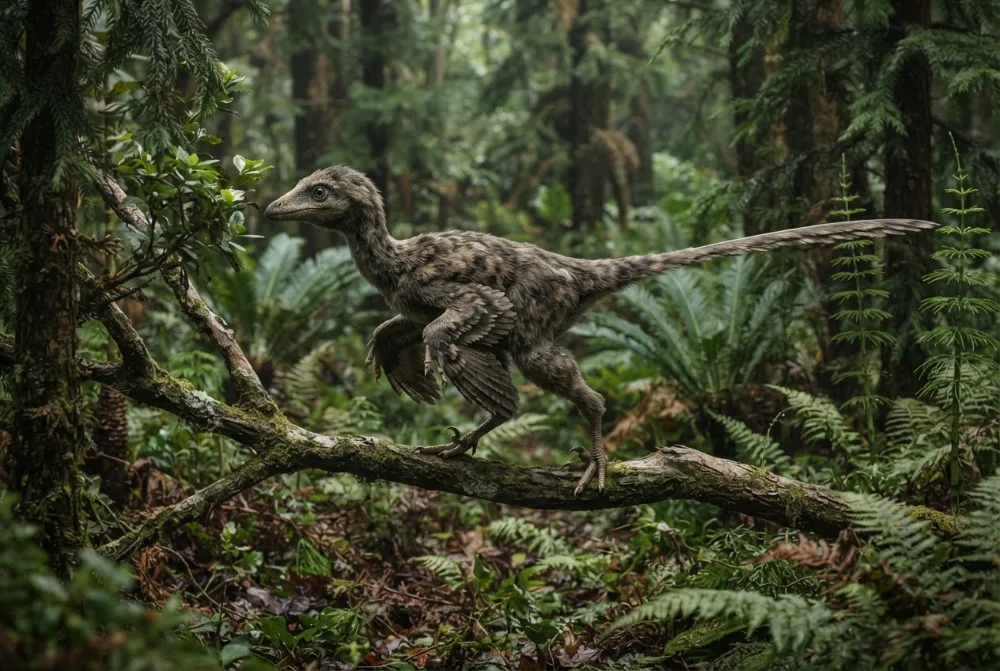
Scansoriopteryx was a tiny, sparrow-sized dinosaur that lived in trees. It had a super long third finger that may have helped it glide from branch to branch. This little dinosaur was covered in fluffy, down-like feathers.1
E tshetse leng?
E ne e le bonako go le kae?


Dintlha tse di monate
Scansoriopteryx had a very unusual hand: its third finger was nearly twice as long as its second finger, unlike most other meat-eating dinosaurs.1
Its long third finger may have supported a membrane like a bat's wing, helping it glide between trees.1
The only known fossil is a baby, so scientists are not sure how big a full-grown Scansoriopteryx was.1
Scansoriopteryx had a backward-pointing toe, like modern birds, which helped it grip branches tightly.1
Its tail was short and stiff, and may have been used as a prop when climbing, like a woodpecker's tail.1
The name Scansoriopteryx means 'climbing wing', because scientists think it was a tree-climber that could glide.1
Dipotso tse di botswang thata ka ga Scansoriopteryx
?How big was Scansoriopteryx?
The only known fossil is a baby, so scientists are not sure how big a full-grown Scansoriopteryx was. The baby was about the size of a sparrow.1
?Did Scansoriopteryx have feathers?
Yes. The type specimen of Scansoriopteryx contains fossilized impressions of wispy, down-like feathers, especially on the forearm and hand.1
?Could Scansoriopteryx fly?
No, it could not fly. Scientists think it could only leap or glide from branch to branch using its long fingers and feathers.1
?What did Scansoriopteryx eat?
Nobody knows for sure. It had at least twelve teeth in its lower jaw, so it probably ate small animals or insects.1
?When did Scansoriopteryx live?
Scansoriopteryx lived during the mid to late Jurassic Period, about 160 million years ago.1
?Why did Scansoriopteryx have a long finger?
Its third finger was nearly twice as long as the second finger. It may have supported a membranous wing, like a bat's, to help it glide between trees.1
Mothubi wa ditlhamane
Tlhamane: Some people think Scansoriopteryx could fly like a bird.
Boammaaruri: Scansoriopteryx probably could not fly. It may have glided short distances using its long fingers and feathers, but it did not have powered flight.1
Ya baitseanape ba didino
- Leina la saense
- Scansoriopteryx
- Leina le neilwe ke
- Czerkas and Yuan 20023
- Setlhopha
- Didino tse di jang nama
- Lelapa / clade
- Scansoriopterygidae3
- Thulaganyo
- Theropoda3
- Bogolo jwa matlapa
- 126 go ya go 120 dimilione tsa dingwaga (Barremian / Aptian)3
- Dibopego tsa matlapa
- Yixian3
- Dinaga
- Tšhaena3
- Direkoto tsa difosili
- 1 mo The Paleobiology Database3
- Go fitlhelwa
- Scansoriopteryx was named in 2002 by Stephen Czerkas and Yuan Chongxi. The only fossil was bought from a dealer and likely came from the Yixian Formation in Liaoning, China.1
- Go sa ntse go ganetsanwa
- Scientists debate whether Scansoriopteryx is the same animal as another dinosaur called Epidendrosaurus. They are very similar, and both may be the same species.1
Kwa dintlha di tswang teng
- Scansoriopteryx (en.wikipedia.org)
- PBDB Taxon (paleobiodb.org)
- Scansoriopteryx in The Paleobiology Database (CC BY 4.0): dingwaga, mafelo, dibopego tsa matlapa, thulaganyo.
Ntlha nngwe le nngwe mo tsebeng eno e na le nomoro e e supang motswedi wa yona. Fa re dirile phoso, maitshwarelo, re barati ba didino, ga re lokwalodikgang lwa saense. Re bolelele kwa [email protected] mme re tla e baakanya.
 Rex o tshwerwe ke tlala! Dino Wiki ke porojeke ya rre e a e diretseng morwawe yo o ratang didino, ke mahala, ga e na dipapatso e bile ga e na dilatedi. Batho ba bagolo ba ka fepa Rex senyamo go thusa gore e nne mo inthaneteng.Fepa Rex
 Allosaurus
 Carnotaurus
 Dilophosaurus
 Giganotosaurus
 Compsognathus
 Paronychodon
 Stegosaurus
 Iguanodon
 Archaeopteryx
 Microraptor
 Deinonychus
 Baryonyx