 O dino efe? Kwisi
 Ntwa ya didino
 Peiso ya didino
 Metshamekwana ya didino
 Alebamo ya disetikara
 Manane a TOP a didino
 Ngakgamatsa!
E tshetse leng?

E ne e le kgolo go le kae?
E ne e le telele go le kae?
E ne e le kwa godimo go le kae?
kakanyo
E ne e le bokete go le kae?
 telele jaaka dikoloi di le 4 di emisitswe mo moleng🍌telele jaaka dibanana di le 99 di latelana
 bokete jaaka ditlou di le 1.5🍉bokete jaaka magapu a le 1600🎒bokete jaaka diphaposiborutelo tse di tletseng bana di le 10🐻❄️bokete jaaka dibere tse ditshweu di le 18🏃e ne e ka taboga dimetara di le 100 mo metsotswaneng e le 22 (motho yo o bonako go gaisa o tlhoka 9,6)
Tambatitanis e ne e le kgolo go le kae fa e bapisiwa le WENA?
Ke dipalo fela mo sebatling sa gago. Ga go sepe se se bolokwang kgotsa se se romelwang gope.
E ne e le bonako go le kae?


Dintlha tse di monate
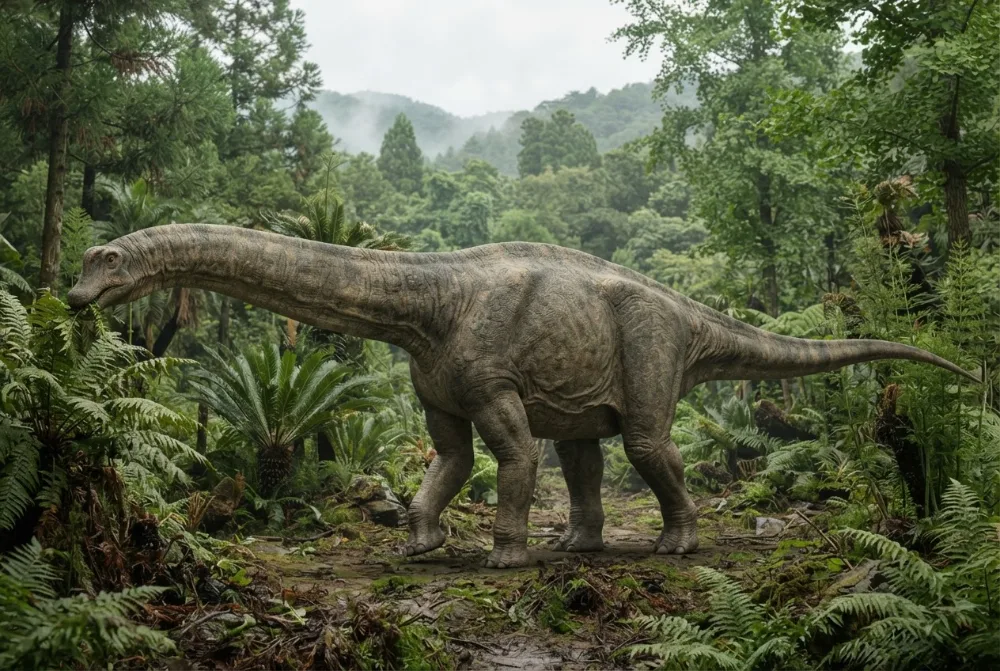
Tambatitanis is known from a partial skeleton that includes 22 tail bones and 17 chevrons (bones under the tail).1
Its front chevron is the longest of any sauropod when compared to body size.2
The fossil was found in a riverbed and took five field seasons to dig out because water covered it most of the year.1
Tambatitanis lived about 113 to 110 million years ago, during the Early Cretaceous.4
Scientists think Tambatitanis might belong to a group of sauropods called Euhelopodidae, which are only found in East Asia.2
The name Tambatitanis comes from Tamba, the area in Japan where it was found, and the Greek word for giant.1
Dipotso tse di botswang thata ka ga Tambatitanis
?How big was Tambatitanis?
Nobody knows for sure because only a partial skeleton has been found. It was a large sauropod, but its exact length and weight are not known.1
?What did Tambatitanis eat?
It was a plant-eater. It used its peg-like teeth to munch on leaves.1
?Where was Tambatitanis found?
Its fossils were discovered in a riverbed in Tamba-Sasayama, Hyōgo Prefecture, Japan. It took five field seasons to dig them out because water covered the site most of the year.1
?Is Tambatitanis a dinosaur?
Yes, it is a dinosaur. It is a titanosauriform sauropod from the Early Cretaceous.1
Ya baitseanape ba didino
- Leina la saense
- Tambatitanis
- Leina le neilwe ke
- Saegusa and Ikeda 20144
- Setlhopha
- Melala-meleele
- Lelapa / clade
- Euhelopodidae4
- Thulaganyo
- Sauropodomorpha > Sauropoda > Macronaria4
- Bogolo jwa matlapa
- 113 go ya go 110 dimilione tsa dingwaga (Albian)4
- Dibopego tsa matlapa
- Ohyamashimo4
- Dinaga
- Japane4
- Direkoto tsa difosili
- 1 mo The Paleobiology Database4
- Go fitlhelwa
- Tambatitanis was discovered in August 2006 by Shigeru Murakami and Kiyoshi Adachi in a riverbed in Hyogo, Japan. It was named and described by Haruo Saegusa and Tadahiro Ikeda in 2014.1
- Go sa ntse go ganetsanwa
- Scientists are not sure whether Tambatitanis was a basal titanosauriform or a true titanosaur. Its exact place in the family tree is still debated.1
Kwa dintlha di tswang teng
- Tambatitanis (en.wikipedia.org)
- A new titanosauriform sauropod (Dinosauria: Saurischia) from the Lower Cretaceous of Hyogo, Japan | Zootaxa (mapress.com)
- Tambatitanis amicitiae | Dinosaur Database by DinoAnimals.com (dinoanimals.com)
- Tambatitanis in The Paleobiology Database (CC BY 4.0): dingwaga, mafelo, dibopego tsa matlapa, thulaganyo.
Ntlha nngwe le nngwe mo tsebeng eno e na le nomoro e e supang motswedi wa yona. Fa re dirile phoso, maitshwarelo, re barati ba didino, ga re lokwalodikgang lwa saense. Re bolelele kwa [email protected] mme re tla e baakanya.
 Rex o tshwerwe ke tlala! Dino Wiki ke porojeke ya rre e a e diretseng morwawe yo o ratang didino, ke mahala, ga e na dipapatso e bile ga e na dilatedi. Batho ba bagolo ba ka fepa Rex senyamo go thusa gore e nne mo inthaneteng.Fepa Rex
 Brachiosaurus
 Diplodocus
 Brontosaurus
 Argentinosaurus
 Camarasaurus
 Morosaurus
 Stegosaurus
 Iguanodon
 Archaeopteryx
 Giganotosaurus
 Microraptor
 Deinonychus