 Ban dino nga? Kiis
 Xeexu dino
 Rawante dino
 Fo yu ndaw yu dino
 Albomu sitikeer
 Limu TOP yu dino
 Bett ma!
Aegirosaurus
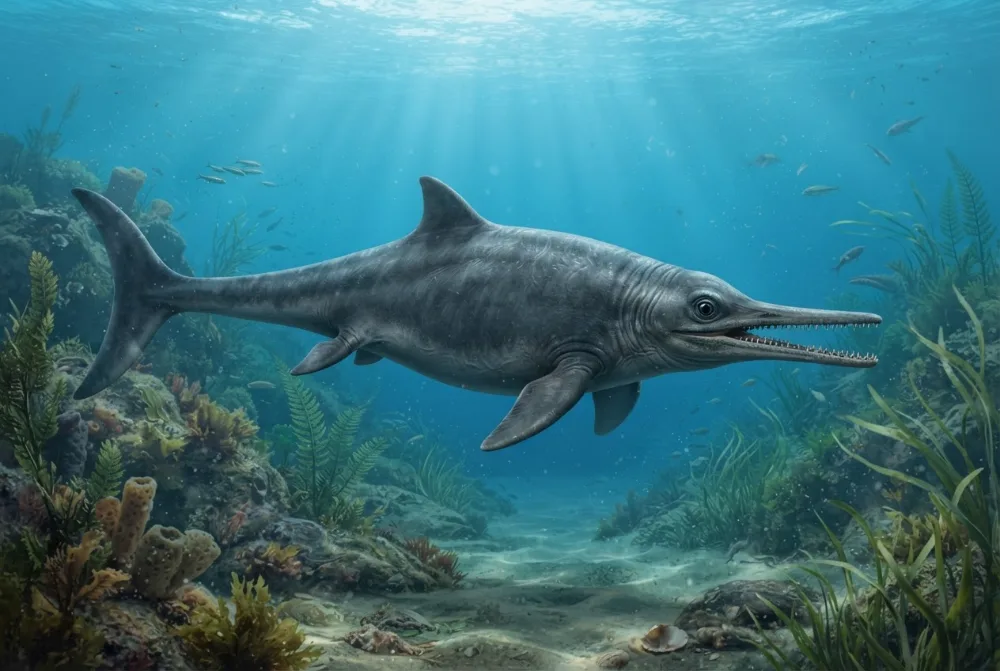
Aegirosaurus was a sleek, dolphin-like marine reptile that swam in the warm seas of Europe during the time of the dinosaurs. It had a long, slender snout packed with tiny, sharp teeth for catching fish and squid.1
Kañ la dundoon?
Naka la réyoon?
Naka la guddoon?
 gudd ni 4 muusu kër, bakkan ba geen🍌gudd ni 11 banaana yu ñu topp-toppale🏊mënoon na féey guddaayu pisin bu mag (50 m) ci 4,4 segond
Naka la Aegirosaurus réyoon, bu ñu ko méngalee ak YAW?
Ay kalkil rekk ci sa navigatëer. Dara du ñu denc, dara du ñu yónne fenn.
Naka la gaawoon?


Xibaar yu neex
Aegirosaurus had a very long snout that made up 62 to 73 percent of its lower jaw length.1
Its front flippers were narrow and elongated, but its hind flippers were wide because of extra soft tissue.1
Aegirosaurus had a crescent-shaped tail fin, like a fish, to help it swim fast.1
Fossils of Aegirosaurus show skin impressions, including what might be tiny scales on the upper part of its tail fin.1
This ichthyosaur lived from the Late Jurassic to the Early Cretaceous, about 149 to 133 million years ago.3
Aegirosaurus is one of the few ichthyosaurs known from the Valanginian stage of the Early Cretaceous.1
Laaj yi ñu gën a laaj ci Aegirosaurus
?How big was Aegirosaurus?
Aegirosaurus was a medium sized ichthyosaur. The largest known specimen was about 2 metres (6.6 ft) long, and a complete skeleton is 1.77 metres (5.8 ft) long.1
?What did Aegirosaurus eat?
Aegirosaurus ate small fish and squid. Its long, slender snout was packed with tiny, sharp teeth, and its tooth wear suggests it was a generalist feeder.1
?When did Aegirosaurus live?
Aegirosaurus lived from the Late Jurassic to the Early Cretaceous, about 149 to 133 million years ago.1
?Where was Aegirosaurus found?
Fossils of Aegirosaurus have been found in Germany and France. Its remains were discovered in the Solnhofen limestone of Bavaria, Germany, and in southeastern France.1
Ku tas léeb yu dul dëgg
Léeb: Aegirosaurus was a dinosaur.
Dëgg: Aegirosaurus was an ichthyosaur, a marine reptile that lived in the sea, not a dinosaur. Dinosaurs lived on land.1
Ngir ñi xam dino lool
- Turu xam-xam
- Aegirosaurus
- Ku ko tudde
- Bardet and Fernandez 20003
- Kurél
- Iktiyosoor yi
- Njaboot / klad
- Ophthalmosauridae3
- Klasifikasiyoŋ
- Ichthyosauria > Ichthyosauromorpha3
- Màggaayu doj yi
- 149 ba 133 milyoŋ at (Tithonian / Valanginian)3
- Formasiyoŋi doj
- Solnhofen3
- Réew yi
- Almaañ, Faraas3
- Fosil yu ñu gis
- 3 ci The Paleobiology Database3
- Gisees
- The first fossil was named Ichthyosaurus leptospondylus by Wagner in 1853. In 2000, scientists Bardet and Fernández gave it the new genus name Aegirosaurus after studying a nearly complete skeleton with soft tissue impressions.12
- Ñu ngi koy werante ba tey
- Scientists are not sure whether Aegirosaurus had scales on its tail fin, because only one fossil shows possible scale impressions.1
Fa xibaar yi jóge
- Aegirosaurus (en.wikipedia.org)
- A new ichthyosaur from the Upper Jurassic lithographic limestones of Bavaria | Journal of Paleontology | Cambridge Core (cambridge.org)
- Aegirosaurus in The Paleobiology Database (CC BY 4.0): at, béréb yi, formasiyoŋi doj, klasifikasiyoŋ.
Bépp xibaar ci xët wii am na lim bu wone fa mu jóge. Su nu juumee, baal nu, nun ñu bëgg dino lanu, du ab sërnaalu xam-xam. Wax nu ko ci [email protected] nu defar ko.
 Rex xiif na! Dino Wiki, mbiru ab baay la ngir doomam ju góor ju bëgg dinosoor, ci neen te amul kaamuñaate, amul tracker. Mag ñi mën nañu jox Rex tuuti ñam ngir dimbali ko mu des ci internet.Dundal Rex
 Ichthyosaurus
 Platypterygius
 Stenopterygius
 Khudiakovia
 Ophthalmosaurus
 Chonespondylus
 Stegosaurus
 Iguanodon
 Archaeopteryx
 Giganotosaurus
 Microraptor
 Deinonychus