 Ban dino nga? Kiis
 Xeexu dino
 Rawante dino
 Fo yu ndaw yu dino
 Albomu sitikeer
 Limu TOP yu dino
 Bett ma!
Anhanguera
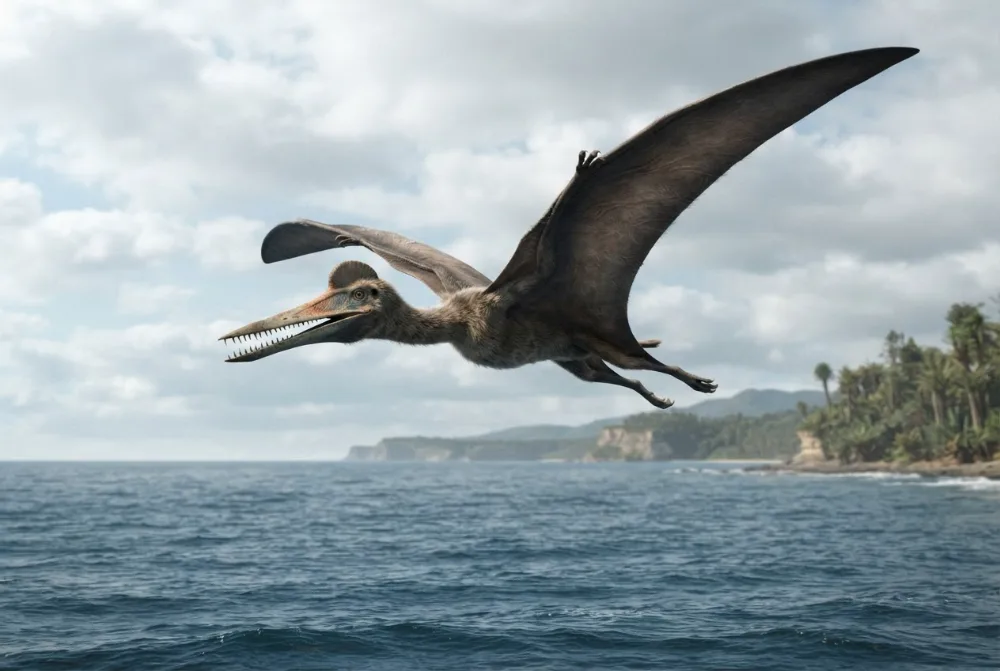
Anhanguera was a flying reptile that soared over ancient seas. It had a long, toothy beak and a wingspan as wide as a car. It was not a dinosaur, but a pterosaur, a close cousin of dinosaurs.1
Kañ la dundoon?
Naka la réyoon?
Naka la guddoon?
Naka la diisoon?
 gudd ni 4 muusu kër, bakkan ba geen🍌gudd ni 11 banaana yu ñu topp-toppale🍉diis ni 6 xaal⚽mënoon na naaw ci kaw teraŋ futbal bépp ci 5,7 segond
Naka la Anhanguera réyoon, bu ñu ko méngalee ak YAW?
Ay kalkil rekk ci sa navigatëer. Dara du ñu denc, dara du ñu yónne fenn.
Naka la gaawoon?


Xibaar yu neex
Anhanguera had a crest on the front of its upper jaw, but it was set farther back on the skull than in its close relatives Coloborhynchus and Ornithocheirus.1
Some Anhanguera fossils have a small, blunt crest at the back of the skull, similar to other pteranodontoids.1
A study in 2003 showed that Anhanguera likely held its head at an angle to the ground, based on its inner ear structure, which helped it keep its balance.1
Anhanguera had bony rings in its eye sockets called scleral rings, which may have supported its eyes, similar to modern birds.1
The name Anhanguera comes from the Tupi language and means 'old spirit' or 'spirit protector of the animals'.1
Anhanguera lived during the Early to Late Cretaceous, from about 112 to 93 million years ago.1
Laaj yi ñu gën a laaj ci Anhanguera
?How big was Anhanguera?
Anhanguera had a wingspan of about 4.6 meters (15 ft).1
?What did Anhanguera eat?
Anhanguera ate fish. It had sharp, curved teeth to pierce and grip slippery fish.13
?Why did Anhanguera have a crest?
Scientists aren't sure. It might have been for display to attract mates or show off, or it might have helped the animal eat.3
?Could Anhanguera fly?
Yes, Anhanguera was a flying reptile. It had thin, light bones to save weight and a large brain area for coordinating flight, similar to birds.3
?When did Anhanguera live?
Anhanguera lived during the Early to Late Cretaceous, from about 112 to 93 million years ago.1
Ngir ñi xam dino lool
- Turu xam-xam
- Anhanguera
- Ku ko tudde
- Campos and Kellner 19854
- Kurél
- Reptil yuy naaw
- Njaboot / klad
- Ornithocheiroidea4
- Klasifikasiyoŋ
- Pterosauria > Pterodactyloidea4
- Màggaayu doj yi
- 137 ba 94 milyoŋ at (Valanginian / Cenomanian)4
- Formasiyoŋi doj
- Romualdo, West Melbury Marly Chalk, Toolebuc4
- Réew yi
- Beresil, Angalteer, Ostarali, Marog, Misra, Kolombi4
- Fosil yu ñu gis
- 18 ci The Paleobiology Database4
- Gisees
- Anhanguera was named in 1985 by Brazilian paleontologists Diogenes de Almeida Campos and Alexander Wilhelm Armin Kellner, based on a complete skull found in the Romualdo Formation of Brazil.14
- Ñu ngi koy werante ba tey
- Scientists are not sure whether the crests on the jaws were present in all Anhanguera individuals or only in some, possibly depending on age or sex.1
Fa xibaar yi jóge
- Anhanguera (pterosaur) (en.wikipedia.org)
- _Anhanguera_ (pterosaur) — Grokipedia (grokipedia.com)
- Watch a pterosaur fly | Natural History Museum (nhm.ac.uk)
- Anhanguera in The Paleobiology Database (CC BY 4.0): at, béréb yi, formasiyoŋi doj, klasifikasiyoŋ.
Bépp xibaar ci xët wii am na lim bu wone fa mu jóge. Su nu juumee, baal nu, nun ñu bëgg dino lanu, du ab sërnaalu xam-xam. Wax nu ko ci [email protected] nu defar ko.
 Rex xiif na! Dino Wiki, mbiru ab baay la ngir doomam ju góor ju bëgg dinosoor, ci neen te amul kaamuñaate, amul tracker. Mag ñi mën nañu jox Rex tuuti ñam ngir dimbali ko mu des ci internet.Dundal Rex
 Pteranodon
 Quetzalcoatlus
 Dorygnathus
 Rhamphorhynchus
 Pterodactylus
 Eudimorphodon
 Stegosaurus
 Iguanodon
 Archaeopteryx
 Giganotosaurus
 Microraptor
 Deinonychus