 Ban dino nga? Kiis
 Xeexu dino
 Rawante dino
 Fo yu ndaw yu dino
 Albomu sitikeer
 Limu TOP yu dino
 Bett ma!
Pterodactylus
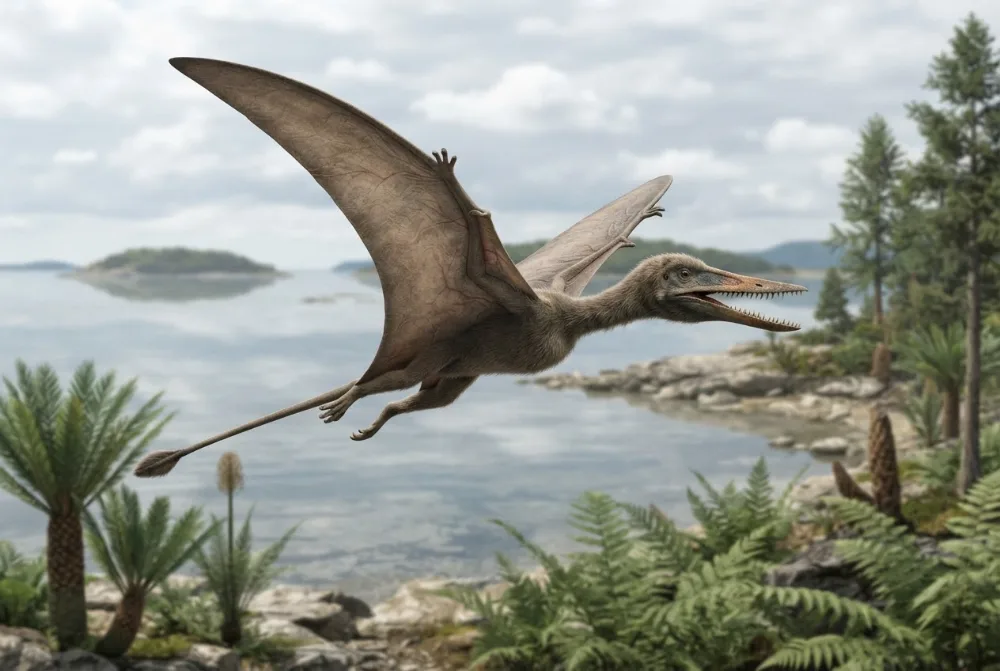
Pterodactylus was one of the first flying reptiles ever discovered. It lived during the Late Jurassic period, about 150 million years ago, and had wings made of skin and muscle that stretched from its long fourth finger to its back legs. It was a small pterosaur that probably ate insects and other small animals.12
Kañ la dundoon?
Naka la réyoon?
Naka la guddoon?
Naka la diisoon?
 gudd ni 2 muusu kër, bakkan ba geen🍌gudd ni 6 banaana yu ñu topp-toppalelu tollu ci diisaayu muusu kër🍌diis ni 17 banaana⚽mënoon na naaw ci kaw teraŋ futbal bépp ci 9 segond
Naka la Pterodactylus réyoon, bu ñu ko méngalee ak YAW?
Ay kalkil rekk ci sa navigatëer. Dara du ñu denc, dara du ñu yónne fenn.
Naka la gaawoon?


Xibaar yu neex
Pterodactylus was the first pterosaur ever named and identified as a flying reptile, in 1809 by French scientist Georges Cuvier.1
Its fossils are often found in the Solnhofen limestone of Germany, which preserved soft body parts like jellyfish and feathers.12
Pterodactylus lived alongside other pterosaurs such as Rhamphorhynchus and Anurognathus, as well as the early bird Archaeopteryx.1
Unlike birds, pterosaurs like Pterodactylus were reptiles and their wings were made of skin and muscle, not feathers.2
Pterodactylus had a relatively high bite force for its size, which helped it crush the shells of invertebrates.1
The name Pterodactylus means 'winged finger' because its wing was supported by one very long finger.1
Laaj yi ñu gën a laaj ci Pterodactylus
?How big was Pterodactylus?
Pterodactylus was a small pterosaur with an estimated adult wingspan of about 1.04 metres (3.4 feet).1
?What did Pterodactylus eat?
Pterodactylus was a generalist carnivore that probably ate invertebrates and small vertebrates. It had a relatively high bite force that helped it crush the shells of invertebrates.1
?When did Pterodactylus live?
Pterodactylus lived during the Late Jurassic period, about 150.8 to 148.5 million years ago.1
?Where were Pterodactylus fossils found?
Most Pterodactylus fossils have been found in the Solnhofen limestone of Bavaria, Germany. A few fragmentary remains have also been tentatively identified from elsewhere in Europe and Africa.1
?Was Pterodactylus a dinosaur?
No, Pterodactylus was not a dinosaur. It was a pterosaur, a type of flying reptile that lived at the same time as dinosaurs.12
?How did Pterodactylus fly?
Pterodactylus had wings made of skin and muscle that stretched from its very long fourth finger to its hind legs. The wings were supported by fibres inside and ridges on the outside.1
?Why is it called Pterodactylus?
The name Pterodactylus means 'winged finger' because its wing was supported by one very long finger.1
?Who discovered Pterodactylus?
The first Pterodactylus fossil was described by Italian scientist Cosimo Alessandro Collini in 1784. It was later named Pterodactylus by French scientist Georges Cuvier in 1809.1
?Did Pterodactylus have teeth?
Yes, Pterodactylus had teeth. The shape, size and arrangement of its teeth show it was a carnivore that ate small animals.1
?What animals lived with Pterodactylus?
Pterodactylus lived alongside other small pterosaurs like Rhamphorhynchus and Anurognathus, as well as the early bird Archaeopteryx and small dinosaurs like Compsognathus.1
Ku tas léeb yu dul dëgg
Léeb: Many people think all pterosaurs are called pterodactyls and that they are dinosaurs.
Dëgg: Pterodactylus is just one genus of pterosaur, and pterosaurs are flying reptiles, not dinosaurs.2
Ngir ñi xam dino lool
- Turu xam-xam
- Pterodactylus
- Ku ko tudde
- Cuvier 18094
- Kurél
- Reptil yuy naaw
- Njaboot / klad
- Monofenestrata4
- Klasifikasiyoŋ
- Pterosauria4
- Màggaayu doj yi
- 201 ba 133 milyoŋ at (Hettangian / Valanginian)4
- Formasiyoŋi doj
- Solnhofener Plattenkalk, Solnhofen, Tendaguru4
- Réew yi
- Almaañ, Tansani, Faraas, Portigaal, Angalteer4
- Fosil yu ñu gis
- 15 ci The Paleobiology Database4
- Ñu ngi koy wooye itam
- Diopecephalus, Macrotrachelus, Pterotherium (tur yu njëkk yi, léegi ñu ngi leen jàppe ni benn rab rekk)4
- Gisees
- The first known pterosaur fossil was discovered in the Solnhofen limestone of Germany in 1784. It was later named Pterodactylus by Georges Cuvier in 1809, making it the first pterosaur ever scientifically described.12
- Ñu ngi koy werante ba tey
- Scientists still debate exactly how many species of Pterodactylus existed, with some suggesting that many fossils belong to just one species, Pterodactylus antiquus.1
Fa xibaar yi jóge
- Pterodactylus (en.wikipedia.org)
- Pterosaurs: The truth about these ‘flying dinosaurs’ | Natural History Museum (nhm.ac.uk)
- Pterodactyl: The Misunderstood Pterosaur | Strange Animals (strangeanimals.info)
- Pterodactylus in The Paleobiology Database (CC BY 4.0): at, béréb yi, formasiyoŋi doj, klasifikasiyoŋ.
Bépp xibaar ci xët wii am na lim bu wone fa mu jóge. Su nu juumee, baal nu, nun ñu bëgg dino lanu, du ab sërnaalu xam-xam. Wax nu ko ci [email protected] nu defar ko.
 Rex xiif na! Dino Wiki, mbiru ab baay la ngir doomam ju góor ju bëgg dinosoor, ci neen te amul kaamuñaate, amul tracker. Mag ñi mën nañu jox Rex tuuti ñam ngir dimbali ko mu des ci internet.Dundal Rex
 Pteranodon
 Quetzalcoatlus
 Dorygnathus
 Rhamphorhynchus
 Anhanguera
 Eudimorphodon
 Ichthyosaurus
 Khudiakovia
 Ophthalmosaurus
 Peloneustes
 Gongbusaurus
 Shunosaurus