 Ban dino nga? Kiis
 Xeexu dino
 Rawante dino
 Fo yu ndaw yu dino
 Albomu sitikeer
 Limu TOP yu dino
 Bett ma!
Apatornis
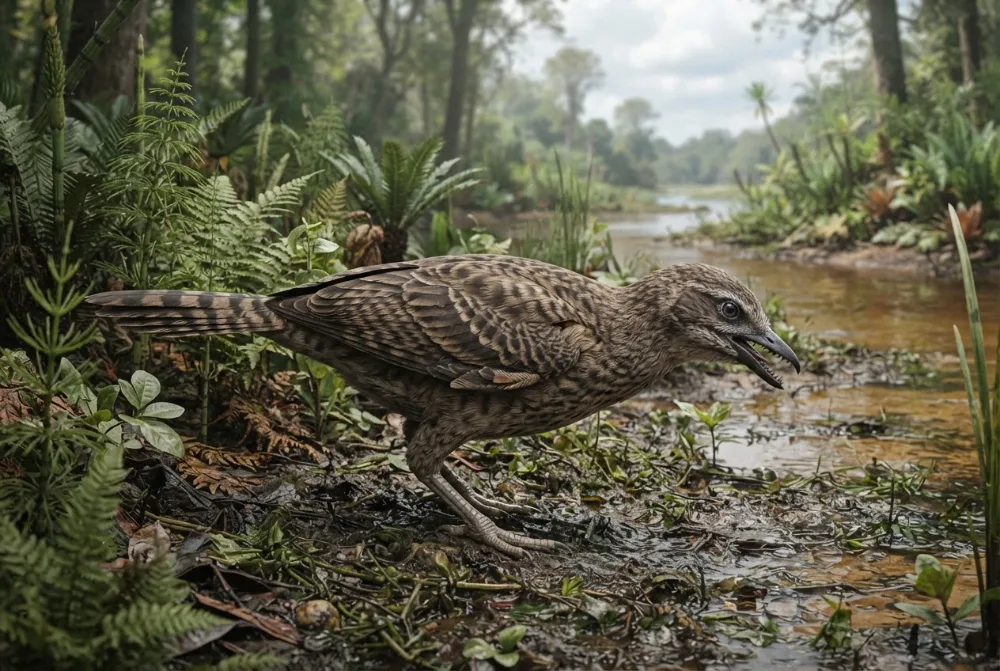
Apatornis was a small, toothed bird that lived in the Late Cretaceous period, about 83.5 million years ago. It was a fast, ground-dwelling hunter that probably chased after small prey. Even though it could fly, it spent much of its time on the ground.12
Kañ la dundoon?
Naka la réyoon?
Naka la guddoon?
Naka la kawewoon?
jortu
Naka la Apatornis réyoon, bu ñu ko méngalee ak YAW?
Ay kalkil rekk ci sa navigatëer. Dara du ñu denc, dara du ñu yónne fenn.
Naka la gaawoon?


Xibaar yu neex
Apatornis had at least one more rib attached to its hip vertebrae than its close relative Ichthyornis, and maybe more, because the whole hip bone wasn't preserved.1
Unlike Ichthyornis, Apatornis did not have ossified tendons covering the top of its sacral region, which is a unique feature.1
The only known fossil of Apatornis is a synsacrum, which is the fused vertebrae over the hips, and it was found in the Smoky Hill Chalk of Kansas.1
Apatornis was originally classified as a species of Ichthyornis, but scientists now think it's more closely related to modern birds.1
The type specimen of Apatornis was discovered by Othniel Charles Marsh in October 1872 at Butte Creek in Kansas.1
Apatornis lived during the Coniacian to Santonian stages, about 89.8 to 83.6 million years ago.2
Laaj yi ñu gën a laaj ci Apatornis
?How big was Apatornis?
It was very small, about 18 to 20 centimetres long, which is roughly the size of a modern sparrow.1
?What did Apatornis eat?
It was a ground-dwelling carnivore that probably chased after small prey like insects or tiny vertebrates.2
?Could Apatornis fly?
Yes, it could fly, but it spent much of its time on the ground hunting for food.1
?Is Apatornis a dinosaur?
Yes, Apatornis is a genus of ornithuran dinosaurs, specifically a small, toothed bird from the Late Cretaceous.1
Ku tas léeb yu dul dëgg
Léeb: Apatornis was a close relative of Ichthyornis.
Dëgg: Scientists used to think so, but in 2004, Julia Clarke showed that Apatornis is actually more closely related to modern birds than to Ichthyornis.1
Ngir ñi xam dino lool
- Turu xam-xam
- Apatornis
- Ku ko tudde
- Marsh 18732
- Kurél
- Picc yu jëkk yi
- Njaboot / klad
- Ornithurae2
- Klasifikasiyoŋ
- Theropoda > Avialae2
- Màggaayu doj yi
- 90 ba 84 milyoŋ at (Coniacian / Santonian)2
- Formasiyoŋi doj
- Niobrara2
- Réew yi
- Amerig2
- Fosil yu ñu gis
- 1 ci The Paleobiology Database2
- Gisees
- Apatornis was named by Othniel Charles Marsh in 1873. He found the first fossil, a synsacrum, in October 1872 at Butte Creek in Kansas, USA.1
- Ñu ngi koy werante ba tey
- Scientists are still debating whether Apatornis is a valid genus or just a variation of Ichthyornis, because the only fossil is so incomplete.1
Fa xibaar yi jóge
- Apatornis (en.wikipedia.org)
- Apatornis in The Paleobiology Database (CC BY 4.0): at, béréb yi, formasiyoŋi doj, klasifikasiyoŋ.
Bépp xibaar ci xët wii am na lim bu wone fa mu jóge. Su nu juumee, baal nu, nun ñu bëgg dino lanu, du ab sërnaalu xam-xam. Wax nu ko ci [email protected] nu defar ko.
 Rex xiif na! Dino Wiki, mbiru ab baay la ngir doomam ju góor ju bëgg dinosoor, ci neen te amul kaamuñaate, amul tracker. Mag ñi mën nañu jox Rex tuuti ñam ngir dimbali ko mu des ci internet.Dundal Rex
 Archaeopteryx
 Hesperornis
 Ichthyornis
 Baptornis
 Jurapteryx
 Gobipteryx
 Tyrannosaurus
 Triceratops
 Velociraptor
 Spinosaurus
 Ankylosaurus
 Parasaurolophus