 Ban dino nga? Kiis
 Xeexu dino
 Rawante dino
 Fo yu ndaw yu dino
 Albomu sitikeer
 Limu TOP yu dino
 Bett ma!
Kañ la dundoon?

Naka la réyoon?
Naka la guddoon?
Naka la kawewoon?
jortu
Naka la diisoon?
 gudd ni 4 muusu kër, bakkan ba geen🍌gudd ni 10 banaana yu ñu topp-toppale🍌diis ni 88 banaana🏊mënoon na féey guddaayu pisin bu mag (50 m) ci 11 segond
Naka la Hesperornis réyoon, bu ñu ko méngalee ak YAW?
Ay kalkil rekk ci sa navigatëer. Dara du ñu denc, dara du ñu yónne fenn.
Naka la gaawoon?


Xibaar yu neex
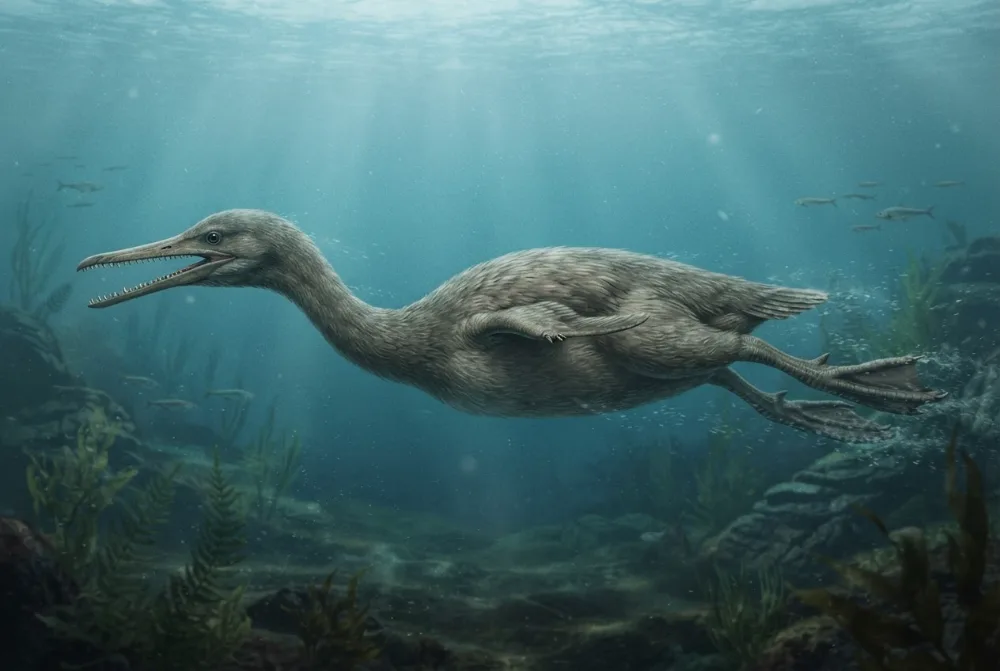
Hesperornis was one of the first birds to give up flying and become a full-time swimmer.2
Its legs were placed far back on its body, like a loon, making it clumsy on land but a powerful diver.1
The first fossils of Hesperornis were found by famous fossil hunter Othniel Charles Marsh in 1870 in Kansas.12
Several species of Hesperornis lived from about 90 to 66 million years ago, during the Late Cretaceous.5
Hesperornis fossils have been found in many places, including Canada, the United States, Russia, and Sweden.5
Laaj yi ñu gën a laaj ci Hesperornis
?How big was Hesperornis?
About 1.5 to 2 metres (4.9 to 6.6 ft) long and weighed around 10.6 kilograms (23 lb).1
?Did Hesperornis have teeth?
Yes, it had teeth in its beak, which is rare for birds. The teeth sat in a groove, not in individual sockets.1
?Could Hesperornis fly?
No, it could not fly. Its wings were tiny and useless for flight, and its breastbone lacked a keel for flight muscles.13
?What did Hesperornis eat?
It ate fish, which it caught with its tooth-lined beak while diving in the sea.4
?When did Hesperornis live?
It lived during the Late Cretaceous period, about 83.6 to 72 million years ago, and possibly into the early Maastrichtian.1
?Where was Hesperornis found?
Fossils have been found in Kansas, Canada, Russia, Sweden, and other places, mostly in marine rocks.1
?Could Hesperornis walk on land?
It was clumsy on land. Its legs were placed far back, so it probably pushed itself along on its belly like a seal.1
Ku tas léeb yu dul dëgg
Léeb: Some people think Hesperornis was a dinosaur.
Dëgg: Hesperornis was a bird, not a dinosaur. Birds evolved from dinosaurs, but Hesperornis itself is classified as a bird.1
Ngir ñi xam dino lool
- Turu xam-xam
- Hesperornis
- Ku ko tudde
- Marsh 18725
- Kurél
- Picc yu jëkk yi
- Njaboot / klad
- Hesperornithidae5
- Klasifikasiyoŋ
- Theropoda > Avialae5
- Màggaayu doj yi
- 90 ba 66 milyoŋ at (Coniacian / Maastrichtian)5
- Formasiyoŋi doj
- Pierre Shale, Rybushka, Niobrara5
- Réew yi
- Kanadaa, Amerig, Riisi, Suwed5
- Fosil yu ñu gis
- 65 ci The Paleobiology Database5
- Ñu ngi koy wooye itam
- Coniornis, Hargeria, Lestornis (tur yu njëkk yi, léegi ñu ngi leen jàppe ni benn rab rekk)5
- Gisees
- Othniel Charles Marsh discovered the first Hesperornis fossil in 1870 near the Smoky Hill River in Kansas. He named it Hesperornis regalis in 1872.12
- Ñu ngi koy werante ba tey
- Scientists are still debating exactly how many species of Hesperornis existed, because many fossils are incomplete.1
Fa xibaar yi jóge
- Hesperornis (en.wikipedia.org)
- The Hesperornithiformes: A Review of the Diversity, Distribution, and Ecology of the Earliest Diving Birds (mdpi.com)
- Hesperornis - Scholars | Britannica Kids | Encyclopedia (kids.britannica.com)
- Hesperornis Facts, Artwork, Information - National Geographic | National Geographic (nationalgeographic.com)
- Hesperornis in The Paleobiology Database (CC BY 4.0): at, béréb yi, formasiyoŋi doj, klasifikasiyoŋ.
Bépp xibaar ci xët wii am na lim bu wone fa mu jóge. Su nu juumee, baal nu, nun ñu bëgg dino lanu, du ab sërnaalu xam-xam. Wax nu ko ci [email protected] nu defar ko.
 Rex xiif na! Dino Wiki, mbiru ab baay la ngir doomam ju góor ju bëgg dinosoor, ci neen te amul kaamuñaate, amul tracker. Mag ñi mën nañu jox Rex tuuti ñam ngir dimbali ko mu des ci internet.Dundal Rex
 Archaeopteryx
 Ichthyornis
 Baptornis
 Jurapteryx
 Gobipteryx
 Martinavis
 Tyrannosaurus
 Triceratops
 Velociraptor
 Spinosaurus
 Ankylosaurus
 Parasaurolophus