 Ban dino nga? Kiis
 Xeexu dino
 Rawante dino
 Fo yu ndaw yu dino
 Albomu sitikeer
 Limu TOP yu dino
 Bett ma!
Arambourgiania
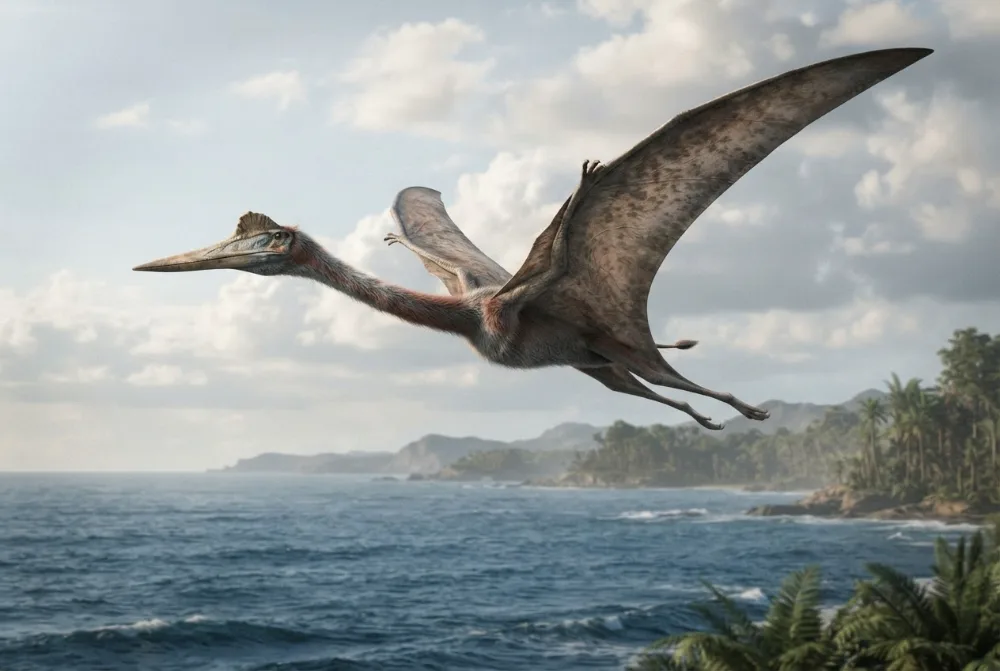
Arambourgiania was one of the biggest flying animals that ever lived. It was a pterosaur, not a dinosaur, and soared over ancient seas. It had a wingspan as wide as a small airplane!1
Kañ la dundoon?
Naka la réyoon?
Naka la ay laafam yaatuwoon?
Naka la diisoon?

 laaf yu yaatu ni 2,5 oto ci benn rëdd🍉diis ni 50 xaal🧸diis ni 13 xale yu maternel🎒diis ni 8 xale yu lekkool⚽mënoon na naaw ci kaw teraŋ futbal bépp ci 3,9 segond
Naka la Arambourgiania réyoon, bu ñu ko méngalee ak YAW?
Ay kalkil rekk ci sa navigatëer. Dara du ñu denc, dara du ñu yónne fenn.
Naka la gaawoon?


Xibaar yu neex
Arambourgiania lived during the Maastrichtian age, about 72 to 66 million years ago.4
Its wingspan may have reached 12 meters (about 39 feet), making it as big as Quetzalcoatlus.1
Only a few bones of Arambourgiania have been found, including a neck vertebra.1
The first fossil was discovered in a phosphate mine in Jordan.4
It belongs to the family Azhdarchidae, a group of giant pterosaurs with long necks.4
Laaj yi ñu gën a laaj ci Arambourgiania
?How big was Arambourgiania?
It was one of the largest flying animals ever, with a wingspan estimated at 10 to 12 meters (33 to 39 feet). Some studies suggest a wingspan of 8 to 10 meters (26 to 33 feet).12
?Was Arambourgiania a dinosaur?
No, it was a pterosaur, a flying reptile that lived at the same time as dinosaurs but is not a dinosaur itself.2
?What did Arambourgiania eat?
Scientists are not sure, but it likely ate fish or other small animals it could catch while flying or wading. Its fossils are found in ancient seas, so it may have eaten aquatic prey.2
?When did Arambourgiania live?
It lived during the Maastrichtian age of the Late Cretaceous period, about 72 to 66 million years ago.2
?Where was Arambourgiania found?
Its first fossil was discovered in a phosphate mine near Ruseifa, Jordan. Other possible remains have been found in the United States and Morocco.2
Ku tas léeb yu dul dëgg
Léeb: Some people think Arambourgiania was a dinosaur.
Dëgg: Arambourgiania was a pterosaur, a flying reptile that lived at the same time as dinosaurs but was not a dinosaur.4
Ngir ñi xam dino lool
- Turu xam-xam
- Arambourgiania
- Ku ko tudde
- Nessov et al. 19874
- Kurél
- Reptil yuy naaw
- Njaboot / klad
- Azhdarchidae4
- Klasifikasiyoŋ
- Pterosauria > Pterodactyloidea > Azhdarchidae4
- Màggaayu doj yi
- 72 ba 66 milyoŋ at (Maastrichtian)4
- Formasiyoŋi doj
- Phosphorite Unit4
- Réew yi
- Jordani4
- Fosil yu ñu gis
- 2 ci The Paleobiology Database4
- Gisees
- The first fossil was described by Camille Arambourg in 1959, and the genus was named Arambourgiania by Nessov and colleagues in 1987.4
- Ñu ngi koy werante ba tey
- Scientists are not sure exactly how big Arambourgiania was because only a few bones have been found.1
Fa xibaar yi jóge
- A reappraisal of Arambourgiania (Pterosauria, Pterodactyloidea): One of the world's largest flying animals - Neues Jahrbuch für Geologie und Paläontologie - Abhandlungen Band 199 Heft 2, Schweizerbart science publishers (schweizerbart.de)
- Arambourgiania (en.wikipedia.org)
- New pterosaur remains from the Late Cretaceous of Afro-Arabia provide insight into flight capacity of large pterosaurs: Journal of Vertebrate Paleontology: Vol 44 , No 1 - Get Access (tandfonline.com)
- Arambourgiania in The Paleobiology Database (CC BY 4.0): at, béréb yi, formasiyoŋi doj, klasifikasiyoŋ.
Bépp xibaar ci xët wii am na lim bu wone fa mu jóge. Su nu juumee, baal nu, nun ñu bëgg dino lanu, du ab sërnaalu xam-xam. Wax nu ko ci [email protected] nu defar ko.
 Rex xiif na! Dino Wiki, mbiru ab baay la ngir doomam ju góor ju bëgg dinosoor, ci neen te amul kaamuñaate, amul tracker. Mag ñi mën nañu jox Rex tuuti ñam ngir dimbali ko mu des ci internet.Dundal Rex
 Pteranodon
 Quetzalcoatlus
 Dorygnathus
 Rhamphorhynchus
 Anhanguera
 Pterodactylus
 Tyrannosaurus
 Triceratops
 Velociraptor
 Spinosaurus
 Ankylosaurus
 Parasaurolophus